Yes—pelvic floor muscle training (Kegels) can genuinely help a mild-to-moderate prolapsed uterus. It won’t hoist the uterus back into a “perfect” position on a scan, but done correctly for about 12 to 16 weeks it strengthens the muscular hammock that supports your pelvic organs, easing the dragging, heaviness and bulge symptoms and helping slow progression. Severe prolapse—or symptoms that disrupt daily life—deserves a clinician’s assessment for a pessary or surgery.
Can pelvic floor exercises really help a prolapsed uterus?
For most women with early or moderate prolapse, the honest answer is yes—with realistic expectations. Your pelvic floor is a sling of muscles running from your pubic bone to your tailbone that holds up the bladder, uterus and bowel. When those muscles and their connective tissue weaken (after childbirth, with age, and as estrogen falls around menopause), the organs can sag downward. Training the muscles builds back some of that support.
Major health bodies now treat supervised pelvic floor muscle training as a first-line, conservative option for symptomatic prolapse, and doctors often teach the exercises or refer you to a pelvic-health physiotherapist.[1] What the exercises realistically do:
- Reduce symptoms — less heaviness, less “something falling out” sensation, fewer bladder leaks.
- May reduce the felt severity of the bulge and how much it bothers you day to day.
- Support other treatments — they work alongside a pessary and are recommended before and after prolapse surgery.
What they can’t do: exercises won’t “cure” an advanced prolapse or put a uterus that protrudes past the vaginal opening back for good. That’s not failure on your part—it’s just the limit of muscle strengthening. Give it a fair trial: most people need at least 12 to 16 weeks of daily practice before judging results.
First, what is a prolapsed uterus — and what do the “grades” mean?
Uterine prolapse means the uterus has descended into the vaginal canal because its support has stretched or weakened. Clinicians usually stage it by how far the lowest point drops, often using the POP-Q system (stages 0–4). In plain terms:
- Stage 1 (mild): the uterus has dropped into the upper vagina; often no symptoms.
- Stage 2 (moderate): it has descended close to the vaginal opening; you may feel a bulge or pressure.
- Stage 3 (moderate–advanced): the cervix protrudes outside the opening.
- Stage 4 (severe): the uterus has come almost entirely outside the vagina.
Pelvic floor training helps most at stages 1 and 2.[4] A key, reassuring point: you generally don’t need treatment at all unless the symptoms bother you.[5] Common symptoms include a feeling of heaviness or dragging in the pelvis, a visible or palpable bulge, urinary leaking or difficulty emptying, and discomfort with sex. If leaking is your main issue, our guides to urinary incontinence and bladder changes after menopause go deeper.
How do you do a Kegel correctly? (step by step)
Most people who say “Kegels didn’t work for me” were doing them wrong—usually bearing down instead of lifting. Here’s the correct technique:
- Empty your bladder first, then get comfortable—start lying down or sitting so gravity isn’t working against you.
- Find the right muscles. Imagine gently stopping the flow of urine and holding back gas at the same time. That squeeze feels like a “lift” inward and upward—not a push down.
- Do a slow hold. Squeeze and lift, hold for 3–5 seconds (build toward 8–10 over time), breathing normally throughout, then fully let go.
- Rest as long as you squeezed. The relaxation is part of the exercise—the muscle has to release completely between reps.
- Add quick flicks. After the long holds, do several fast, strong squeeze-and-release contractions.
- Build up gradually. A common target is up to 10 slow holds plus 10 quick squeezes, about 3 times a day.
- Progress to standing. Once it’s easy lying down, practice sitting, then standing, then during real-life moments (before you cough, lift or stand up).
- Stay consistent. Tie it to a daily habit—brushing teeth, red lights, the kettle boiling—so you actually keep going for the full 3–4 months.
For a fuller walkthrough with progressions, see our dedicated guide to pelvic floor exercises.
Common Kegel mistakes to avoid
- Bearing down (pushing out as if for a bowel movement) instead of lifting up—this actually pushes the prolapse the wrong way.
- Holding your breath or clenching your buttocks, abs or inner thighs to fake the effort.
- Never fully relaxing between reps, or only ever doing quick flicks and skipping the long holds.
- Stopping urine midstream as routine practice—fine as a one-time check of which muscles to use, but doing it regularly can upset normal bladder emptying.
- Quitting after a week. No consistency, no result.
- Over-doing it. A pelvic floor that’s always clenched and can’t relax can cause its own problems, including pelvic pain. If squeezing hurts or you can’t relax afterward, see a pelvic-health physiotherapist rather than gritting through it.
Which movements are safe, and which need caution?
You do not need to give up exercise—staying active is good for you. The goal is to build strength and control while avoiding repeated spikes of downward pressure inside the abdomen. The rule of thumb: exhale on the effort, never hold your breath, and don’t let your belly bulge or bear down.
| Movement or activity | Verdict | How to do it more safely |
|---|---|---|
| Kegels / pelvic floor training | Recommended | The foundation—daily, with full relaxation between reps. |
| Walking | Safe | An ideal low-impact baseline; build up distance gradually. |
| Swimming & water aerobics | Safe | Buoyancy takes downward load off the pelvic floor. |
| Diaphragmatic (belly) breathing | Safe | Exhale as you exert; coordinates breath with pelvic-floor lift. |
| Glute bridges | Generally safe | Exhale and gently lift the pelvic floor as you raise your hips; don’t bear down. |
| Clamshells & gentle hip/glute work | Generally safe | Builds supporting muscles without high impact. |
| Shallow squats & sit-to-stand | Generally safe | Keep depth comfortable, exhale on the way up, avoid straining. |
| Heavy lifting & max-load weights | Caution | Spikes abdominal pressure—lighten loads, exhale on the lift, never breath-hold (Valsalva). |
| Running, jumping, trampolining, plyometric HIIT | Caution | Repeated downward impact can worsen symptoms; try low-impact swaps or wait until stronger. |
| Deep loaded squats & heavy leg press | Caution | Deep load pushes down—reduce range and weight, keep breathing. |
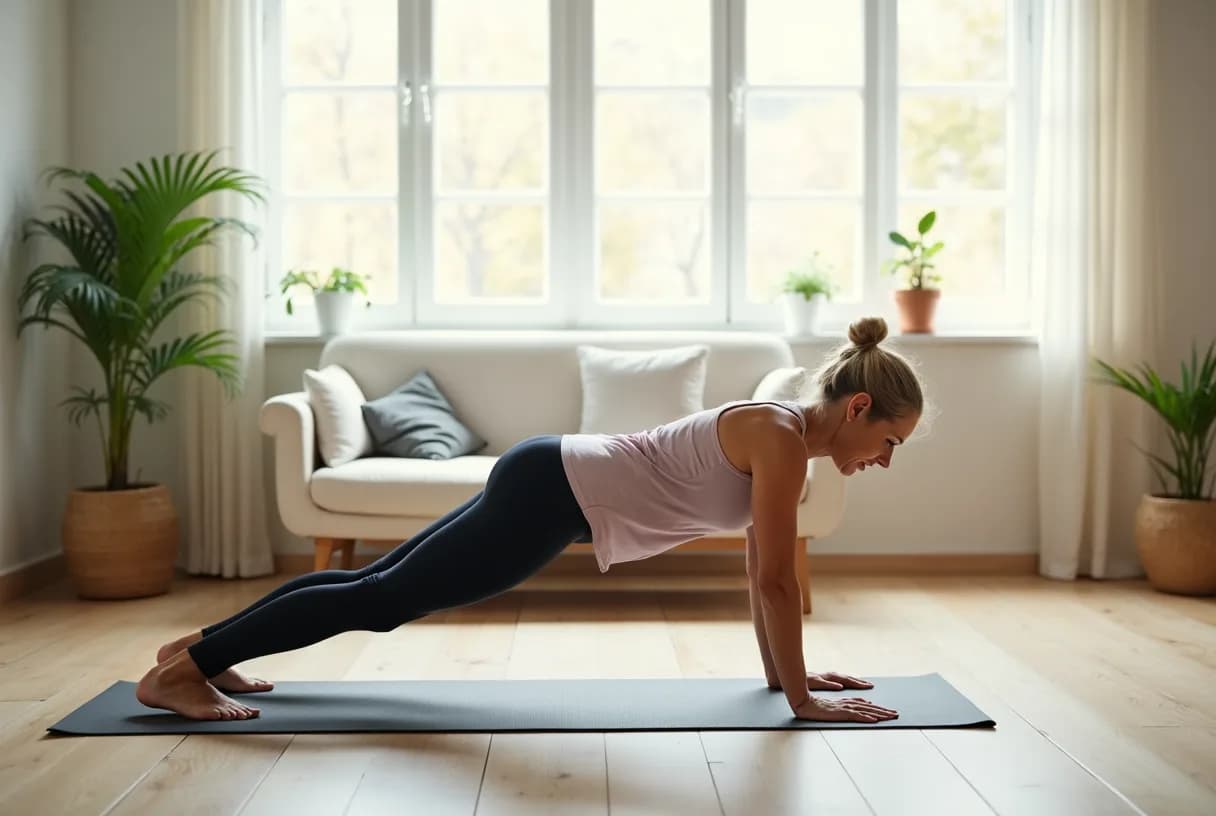
| Traditional sit-ups, crunches, full planks | Caution | If your belly domes or you feel downward pressure, swap for breath-led core work. |
| Straining on the toilet | Avoid | The single biggest daily offender—never push; manage constipation instead. |
Health services specifically advise easing off activities that heavily strain the pelvic floor, such as heavy lifting, running and trampolining, especially while symptoms are active.[2] None of this is forever—as your strength and control improve, you can often reintroduce more, ideally with a physiotherapist’s guidance.
Everyday habits that take pressure off your pelvic floor
Exercise is only part of the picture. These daily moves protect your progress:
- Don’t strain on the toilet. Chronic constipation and pushing are major drivers of prolapse. Aim for enough fiber and fluids, use a footstool to raise your knees, and if you’re prone to constipation, options like magnesium can help soften things—see our guide to magnesium for women.
- Learn “the knack.” Squeeze and lift your pelvic floor just before you cough, sneeze, lift or stand up. Bracing first blunts the downward push.
- Treat a chronic cough and, if you smoke, get support to stop—a persistent cough constantly loads the pelvic floor.
- Support a healthy weight, since extra abdominal weight adds constant downward pressure.
- Track what makes symptoms better or worse. A simple log—like our menopause symptom diary—helps you and your clinician see patterns over weeks.
When should you see a doctor or pelvic-health physiotherapist?
Book an appointment—don’t just wait it out—if any of these apply:
- You can see or feel a bulge at or outside the vaginal opening.
- Symptoms are affecting daily life—work, exercise, sex, or your mood.
- You have trouble emptying your bladder or bowels, or need to press on the bulge to go.
- You have new or worsening leaking of urine or stool, or recurrent urinary infections (see overactive bladder if urgency is the issue).
- There’s pain, bleeding, or a sore/ulcerated area on tissue that protrudes.
- You’ve done Kegels correctly for 3–4 months with no improvement, or you’re not sure you’re doing them right.
A referral to a pelvic-health physiotherapist is often the highest-value next step: they can confirm you’re activating the right muscles (many women aren’t), tailor a progression, and add tools like biofeedback. Get assessed sooner rather than later if you’re pregnant, recently gave birth, or symptoms are climbing.
What if exercises aren’t enough?
Two well-established medical options exist, and neither means you failed at Kegels:
- A vaginal pessary—a soft silicone device fitted by a clinician to physically support the uterus—is often the first device tried and can be used short- or long-term.[1] It pairs well with continued pelvic floor training.
- Surgery is generally reserved for more severe or bothersome prolapse; a gynecologist can walk you through uterus-sparing and other approaches based on your stage, age and plans. Doing pelvic floor work before and after surgery is standard advice.
The bottom line: for a mild-to-moderate prolapsed uterus, correct, consistent pelvic floor training—plus smart daily habits and easing off high-strain moves—is a legitimate, evidence-backed first step that eases symptoms for many women. If you can see or feel a bulge, or symptoms are disrupting your life, loop in a clinician or pelvic-health physiotherapist so you get the right combination of exercise, pessary or surgery for your situation.