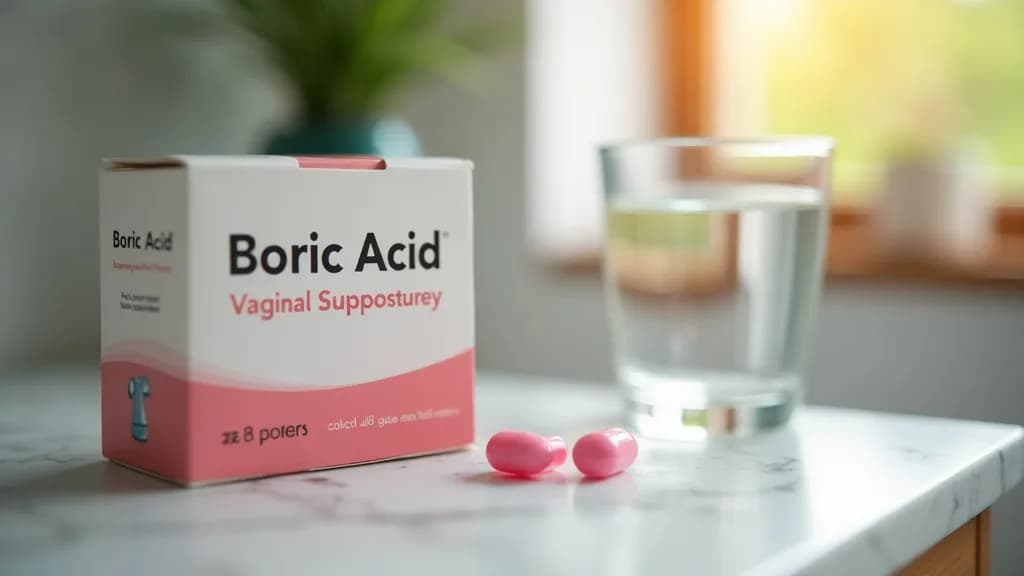
Boric acid vaginal suppositories are small capsules of boric acid powder inserted into the vagina, most often used as an add-on treatment for infections that resist standard medicine or keep coming back. They are best understood as an adjunct — a helper alongside proper diagnosis and first-line treatment — rather than a cure-all. The two situations with the most support are yeast infections caused by non-albicans species that shrug off usual antifungal creams, and recurrent bacterial vaginosis (BV).
Before anything else, one rule matters more than the rest: boric acid is poisonous if swallowed. These capsules are for vaginal use only, must be kept away from children and pets, and should never be used during pregnancy. We'll return to safety in detail below.
What are boric acid suppositories?
Boric acid is a weak acid derived from the element boron. In gelatin capsules made for vaginal use, it has a long history in treating vaginal complaints. It has mild antifungal and antibacterial activity, and researchers think part of how it works is by disrupting the biofilms and microbial overgrowth that drive some stubborn infections. Its full mechanism isn't completely settled, so treat any single tidy explanation — including claims that it simply "rebalances pH" — with a measure of caution.
Boric acid is sold over the counter in the US as a vaginal capsule, typically for insertion at bedtime over one to two weeks. It is a chemical compound, not a prescription drug, and it is not a substitute for seeing a clinician when you have symptoms.
Do they work for yeast infections?
Most vaginal yeast infections are caused by Candida albicans, which usually responds well to standard over-the-counter antifungals or a short prescription course. For these routine infections, boric acid offers no advantage and shouldn't be your first move.
Where boric acid becomes genuinely useful is non-albicans yeast — species such as Candida glabrata — which often resist the usual azole antifungals. This is where the evidence is best characterized: the CDC's guidance on vulvovaginal candidiasis describes a defined intravaginal boric acid regimen for non-albicans yeast, with roughly 70% of cases clearing. For these harder cases, boric acid is a recognized second-line option, typically used daily for about two weeks.
The catch: you can't reliably tell which species you have from symptoms alone. Recurrent or treatment-resistant yeast infections often warrant a culture so treatment is aimed correctly. Mayo Clinic notes that boric acid may be used for yeast infections resistant to usual therapy, under medical guidance.
Do they work for bacterial vaginosis?
Bacterial vaginosis is the most common cause of unusual vaginal discharge and odor in people of reproductive age. It is notoriously prone to recurrence — many people relapse within months of antibiotic treatment. That frustrating pattern is why boric acid gets used here at all.
The honest picture: for BV, the evidence behind boric acid is more limited than for non-albicans yeast. The CDC's STI treatment guidelines mention intravaginal boric acid only as a limited-data option for recurrent BV — used as part of a suppression plan alongside antibiotic (metronidazole gel) therapy, not on its own. The idea is that boric acid may help dismantle the bacterial biofilm that antibiotics alone struggle to clear, but this rests on far less data than the non-albicans yeast regimen.
What boric acid is not: a validated stand-alone first-line cure for a new episode of BV. First-line treatment remains antibiotics, as reflected by ACOG and the CDC. If you have never been diagnosed, using boric acid instead of getting evaluated risks missing something that needs different treatment.
When boric acid makes sense — and when it doesn't
| Situation | Is boric acid appropriate? |
|---|---|
| Non-albicans yeast (e.g. C. glabrata) resistant to azoles | Best-supported use — recognized second-line option |
| Recurrent yeast infections confirmed by culture | May help as part of a plan |
| Recurrent BV, as suppression alongside antibiotics | Limited-data adjunct — discuss with a clinician |
| First-ever episode of BV or yeast | No — get diagnosed; use first-line treatment |
| Routine C. albicans yeast infection | No advantage over standard antifungals |
| Pregnancy | Never — contraindicated |
| General "vaginal health," odor, or douching alternative | Not recommended — no benefit, possible harm |
How boric acid suppositories are generally used
Regimens vary, so follow your clinician's or the product's instructions rather than a generic script. In broad terms, a boric acid capsule is inserted high into the vagina, usually at bedtime, for a defined course — commonly one to two weeks for an active problem, or intermittently as suppression for recurrent BV under medical guidance. Lying down after insertion reduces leakage; a panty liner helps with any discharge, which can be watery and is normal.
Boric acid should not be used continuously or indefinitely without a reason. It is a targeted tool for specific, usually stubborn problems — not a daily hygiene product. The vagina is self-cleaning, and routine use of any insert to control normal odor or as a substitute for douching is unnecessary and can backfire by disrupting healthy bacteria.
Safety: the non-negotiables
This is the part to read twice.
- Toxic if swallowed. Boric acid is poisonous when taken by mouth and can cause serious harm or be fatal, especially to a child who mistakes a capsule for candy. MedlinePlus documents boric acid poisoning. Never ingest it, and if someone swallows it, contact Poison Control or emergency services immediately.
- Vaginal use only. These capsules are formulated for the vagina — not the mouth, not for open wounds, not for other body areas.
- Keep away from children and pets. Store capsules well out of reach in their original packaging.
- Never during pregnancy. Boric acid is contraindicated in pregnancy because of concerns about harm to a developing pregnancy. If you are pregnant, could be pregnant, or are trying to conceive, do not use it — see your clinician for a pregnancy-safe option.
- It's an adjunct, not a diagnosis. Boric acid does not tell you what's wrong. Using it to self-treat repeated symptoms can mask a condition — including sexually transmitted infections — that needs different care.
Common, usually mild side effects include vaginal burning, watery discharge, or redness at the opening. Stop and seek care if you develop significant pain, fever, pelvic pain, or worsening symptoms. Some people avoid vaginal intercourse during a course. As a general precaution with any vaginal insert, don't assume barrier methods such as condoms or diaphragms will perform normally while a capsule and its residue are present; if pregnancy or STI prevention matters to you, ask your clinician about timing.
When to see a doctor
See a clinician if this is your first episode of vaginal symptoms; if symptoms keep returning; if you have pelvic pain, fever, or sores; if you're pregnant or could be; or if you've finished a boric acid course and aren't better. Recurrent BV and recurrent yeast infections deserve a proper workup — sometimes a culture, sometimes a look for contributing factors like diabetes — so treatment actually targets the cause. As the NHS and Cleveland Clinic both emphasize, unusual discharge or odor is worth getting checked rather than guessing.
The honest bottom line
Boric acid suppositories are a legitimate, evidence-backed tool for two narrow jobs: treating non-albicans yeast infections that don't respond to standard antifungals — the best-characterized use — and, on more limited data, helping suppress recurrent BV alongside antibiotics. They are an adjunct, best used with, or after, proper diagnosis and first-line treatment. They are marketed far more broadly than the evidence supports, so be skeptical of claims that they are an everyday way to "balance pH," banish odor, or serve as routine vaginal upkeep. And never lose sight of the core safety rules: for vaginal use only, toxic if swallowed, kept away from children, and never in pregnancy.
Related: Not sure what's causing the smell? Vaginal Odor: Causes, When to Worry, and What Helps.