The short answer
Cervical mucus is a water-rich gel secreted by crypts (small glandular pockets) lining the cervical canal, built mainly from large gel-forming mucin proteins — MUC5B is the dominant one, and the amount of it in mucus peaks at midcycle. Its texture is controlled by two hormones: estrogen pulls water into the gel and loosens its mesh; progesterone squeezes water out and tightens it. That is why mucus runs from absent or sticky early in the cycle, through creamy, to clear, slippery and stretchy — egg-white mucus — at peak estrogen just before ovulation, then abruptly becomes thick and scant once progesterone rises. The most useful structural fact to hold on to: fertile mucus is not a different substance. It is the same gel holding far more water, with wider spaces between the mucin strands for sperm to swim through.
What it actually is, and why estrogen is the whole story
The cervical canal is not a smooth tube. It is lined with folds and crypts whose secretory cells produce mucins — enormous, sugar-coated proteins that tangle into a mesh and trap water. Whether that mesh is a barrier or a highway depends almost entirely on how hydrated it is.
Estrogen, acting on estrogen receptors in the endocervical epithelium, increases both the volume of secretion and its water content. A well-estrogenised mucus is thin, low-viscosity, alkaline, and — under a microscope — arranged in parallel channels. Sperm swim through the unbound water between the mucin strands, so hydration is not a cosmetic detail; it is the mechanism. As mid-cycle approaches, mucus volume rises sharply and the gel becomes markedly less viscoelastic, which is precisely when sperm penetration is easiest.
After ovulation, the corpus luteum starts producing progesterone. Progesterone reverses all of it: less secretion, less water, a denser and more viscoelastic gel with a tight mesh that sperm cannot cross. Within a day or two the "highway" becomes a plug. This is not a subtle shift — it is one of the sharpest hormonal switches in the body, and it is also, incidentally, how progestin-only contraception acts at the cervix. For the wider picture of these two hormones, see estrogen vs progesterone and the menstrual cycle phases hub.
The types, decoded
Descriptions vary between fertility-awareness systems, and no two people produce identical patterns. Use this as a map, not a rulebook — cycle length, cycle day and individual variation all move the timings.
| Type | What it looks and feels like | Roughly when | Hormonal driver |
|---|---|---|---|
| Dry / none | Nothing noticeable; the vulva feels dry. No mucus on tissue. | The few days after a period ends | Estrogen at its cycle low after menstruation |
| Sticky / tacky | Pasty, crumbly, glue-like. Breaks apart when pulled; doesn't stretch. | Early follicular phase | Estrogen rising but still low; mucin mesh dense |
| Creamy / lotion-like | White or pale yellow, opaque, smooth like hand lotion. Not slippery. | Mid-follicular | Estrogen climbing; more water, mesh loosening |
| Watery | Thin, clear or nearly clear, wet sensation. Often the first truly fertile-type sign. | Late follicular, approaching ovulation | High estrogen; hydration rising fast |
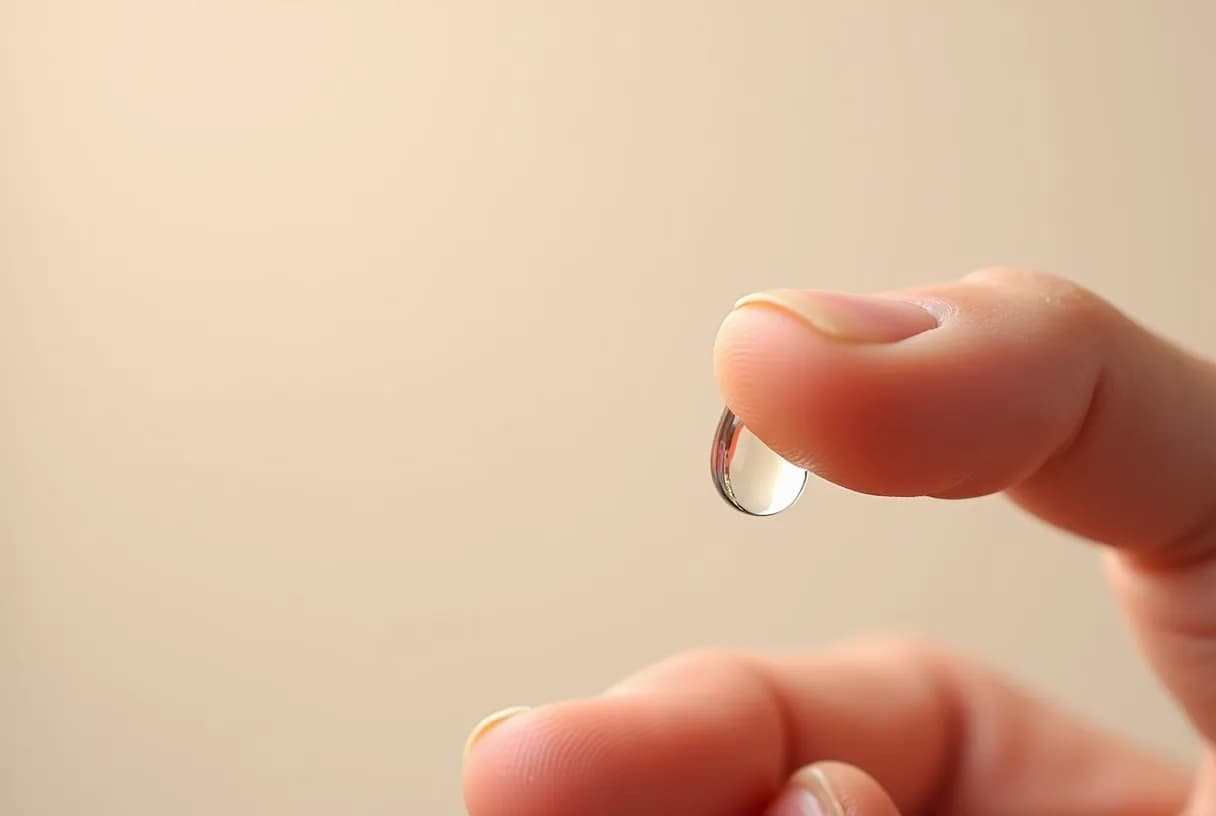
| Egg-white (stretchy) | Clear, glossy, slippery; stretches between the fingers without breaking. Like raw egg white. | The day or two before ovulation, sometimes the day of | Estrogen peak — maximum hydration, widest channels |
| Thick / scant again | Sticky, cloudy, sparse, or nothing at all. The change is abrupt. | Luteal phase, after ovulation until the next period | Progesterone from the corpus luteum dehydrating the gel |
The reason egg-white mucus is called the peak sign is not the appearance but the timing: it tracks the estrogen surge that precedes ovulation. Sperm can survive for several days in that hospitable, alkaline environment, which is why the fertile window opens before the egg is released, not after it (see how long ovulation lasts). Our discharge decoder can help you place what you are seeing.
What mucus can — and cannot — tell you
It can tell you, roughly, that your body is producing enough estrogen to build fertile-type mucus and that ovulation is probably approaching. Charted alongside basal body temperature — which rises after ovulation, under progesterone — it is a genuine biological signal and a legitimate component of fertility awareness–based methods.
It cannot confirm that ovulation actually happened. Estrogen can rise, produce textbook egg-white mucus, and the follicle can still fail to release an egg. Mucus reflects estrogen, not ovulation.
And it is not reliable contraception on its own. This matters enough to say bluntly. NHS figures put fertility awareness methods at 91–99% effective when followed exactly, but only about 76% effective if the instructions are not followed exactly — meaning 24 in 100 people tracking their fertility conceive within a year. A systematic review in Obstetrics & Gynecology (2018) found typical-use first-year pregnancy rates spanning a very wide range across methods and studies, and rated most of the underlying evidence as low quality — so anyone quoting you a single reassuring number is overstating what is known. ACOG also flags the ordinary things that scramble the signal: semen, lubricant, douching, a recent pelvic exam, infection, medications, breastfeeding. If you are relying on mucus alone to avoid pregnancy, you are accepting a meaningful failure rate — and if pregnancy would be a serious problem for you, that is worth discussing with a clinician alongside other options. Nothing here is advice to start, stop or change any contraceptive.
Be sceptical, too, of the wellness-internet extensions of mucus charting. Elaborate "cycle syncing" protocols — eating, training or working to your mucus pattern — rest on thin and largely untested evidence, and so does diagnosing a "luteal phase defect" from chart patterns alone; that entity remains contested and is not something a chart can establish. We would rather say so than dress it up.
The part nobody writes: mucus in perimenopause
Nearly every mucus guide online is written for a 30-year-old with a 28-day cycle. Here is what happens when the machine starts winding down — and it is usually the opposite of what women expect.
In perimenopause, the ovary's dwindling follicles respond erratically to FSH. Some cycles produce a large estrogen surge; some produce very little; some produce estrogen but no ovulation at all, so no progesterone follows. The consequences for mucus are direct:
- The pattern loses its shape. You may get repeated stretches of watery or egg-white-type mucus that lead nowhere, because estrogen rose and ovulation did not follow. Or you may ovulate with almost no fertile mucus at all, because baseline estrogen is lower and the crypts secrete less.
- You cannot use mucus to know whether you are still ovulating. The signal has become uncoupled from the event. Neither its presence nor its absence proves anything.
- You can still conceive. Erratic ovulation is not absent ovulation. Fertility falls steeply with age, but it does not hit zero at the first missed period, and a late, unannounced ovulation after months of nothing is exactly the scenario that catches people out.
That last point is why contraceptive guidance in midlife is defined by time since your last period, not by symptoms and not by mucus. The UK's Faculty of Sexual and Reproductive Healthcare advises continuing contraception for 1 year after the last menstrual period if you are aged 50 or over, and 2 years if you are under 50; contraception can generally be stopped at age 55, when spontaneous pregnancy is exceptionally rare. The under-50 rule is longer for a reason — younger perimenopausal ovaries are more likely to surprise you with a late ovulation after months without a period. Read this alongside irregular periods in perimenopause and can you get pregnant after menopause. Your own timing is a conversation with your clinician, not a rule to apply from a web page.
After menopause: the mucus goes, and that is treatable
Once the follicular supply is exhausted, estradiol falls to a low, flat level. Estrogen receptors are densely expressed throughout the vagina, vulva, urethra and bladder trigone, and without their ligand the tissue changes: the epithelium thins, blood flow drops, glycogen production falls (which starves the Lactobacillus that keep vaginal pH acidic), and cervical and vaginal secretions decline sharply. Mucus becomes scant or absent, and lubrication with arousal is slower and less abundant. If you are ever quoted a number for vaginal pH, treat it with care: reference ranges vary between laboratories and shift with cycle day and menopausal status, so a value only means something in the context of who measured it and when.
This is not "just dryness," and it is not something to endure. It is genitourinary syndrome of menopause (GSM) — a named, progressive condition that also drives painful sex, urinary urgency and recurrent UTIs. Unlike hot flushes, it does not fade with time; untreated, it tends to worsen. It is also among the most treatable problems in menopause medicine: low-dose vaginal estrogen restores the local epithelium and secretions, and vaginal moisturisers and lubricants address symptoms. Whether and what to use is a decision for you and your clinician — but the fact that it can be fixed is the part worth knowing. See also vaginal health after menopause.
What is not normal mucus
Healthy cervical mucus is clear or white, has little or no odour, and does not itch, burn or bleed. The following are not mucus variants — they are signs that something else is going on, and they need assessment rather than decoding.
| What you notice | Commonly suggests | Why it matters |
|---|---|---|
| Thin grey or white discharge with a fishy smell, worse after sex | Bacterial vaginosis | A shift in the vaginal microbiome, not a hygiene failure. Needs assessment and treatment, not douching. |
| Thick, white, cottage-cheese-like discharge with itching and burning | Yeast infection | Frequently confused with BV — the treatments differ. See yeast infection vs BV. |
| Green, yellow or frothy discharge, often with a bad smell | Trichomoniasis or another infection | Per MedlinePlus, greenish-yellow, frothy discharge is a classic trichomonas sign. It is sexually transmitted and treatable. |
| Any bleeding or blood-tinged discharge more than 12 months after your last period | Postmenopausal bleeding | Always needs evaluation, however light or brown. Most causes are benign, but this is the cardinal symptom of endometrial cancer. See postmenopausal bleeding. |
Colour alone is a weak signal, which is why we cover brown, yellow, white, pink and watery discharge separately. Do not douche to "clean up" abnormal discharge, either — it strips the protective flora and makes BV more likely (why douching backfires). And if the change you are noticing is bleeding rather than discharge, start with the bleeding decoder.
When to see a doctor
Book an appointment if you have:
- Any vaginal bleeding or spotting after menopause (12+ months since your last period) — including brown or pink discharge, and including bleeding on HRT that is new, heavy or persistent. This is prompt-assessment territory, not wait-and-see.
- A foul, fishy or otherwise strong odour, or discharge that is grey, green or frothy.
- Itching, burning, soreness, or pain with sex or urination alongside the discharge.
- New pelvic pain, fever, or bleeding after intercourse.
- Discharge that changes and does not settle within a couple of weeks, or that keeps returning after treatment.
- Vaginal dryness affecting sex, comfort or your bladder — GSM is treatable, and there is no reason to live with it.
- Periods that have become very heavy, very frequent or unpredictable in your forties — soaking a pad or tampon every hour, passing clots bigger than a coin, or waking at night to change protection all count as heavy. See heavy periods, and consider taking a symptom report with you.
And if the question is whether you still need contraception, the answer depends on your age and the date of your last period — not on what your mucus is doing.