Slow, controlled breathing calms anxiety by shifting your body out of "fight-or-flight" and into the parasympathetic "rest-and-digest" state. The key is a long, unhurried exhale: breathing out for longer than you breathe in stimulates the vagus nerve, which slows your heart rate and turns down the stress response, often within a couple of minutes.[1] The techniques below — extended-exhale breathing, box breathing, 4-7-8, the physiological sigh and diaphragmatic breathing — all use this same mechanism. They are genuinely useful for calming symptoms in the moment, but they are a coping tool, not a cure for an anxiety or panic disorder.
Why does slow breathing calm anxiety?
When you feel anxious, your sympathetic nervous system fires: adrenaline surges, your heart speeds up, and your breathing turns fast and shallow — the classic adrenaline rush. Breathing is unusual among body functions because it runs on autopilot but you can also take it over on purpose, which makes it a direct handle on the nervous system.
That handle is the vagus nerve, the main nerve of the parasympathetic ("rest-and-digest") branch. Every time you exhale, the vagus nerve briefly slows your heart; every time you inhale, it lets the heart speed back up. By making your exhale longer and slower than your inhale, you tip that balance toward the calming side and pull your heart rate and blood pressure down.[3] Deliberate slow breathing — roughly six breaths a minute — has been shown to strengthen this vagal "brake" and reduce feelings of stress and anxiety.[1]
This is also why anxiety and your stress hormones are so tangled together. Persistent worry keeps cortisol elevated, and high cortisol can feed the loop between cortisol and anxiety. Slow breathing won't fix the underlying cause, but it interrupts the acute surge so your thinking brain can come back online.
What are the best breathing techniques for anxiety?
You don't need all five. Learn one or two well enough to use them without thinking, because a technique you can't recall mid-panic is useless. Here is how each one works and when to reach for it.
1. Extended-exhale breathing (the simplest)
This is the foundation and the easiest to remember. Breathe in through your nose for a count of 4, then breathe out slowly through your nose or gently pursed lips for a count of 6. Keep the exhale longer than the inhale, and repeat for two to five minutes.[2]
- Best for: everyday anxiety, the run-up to a stressful event, or any moment you can't remember anything more complicated.
- Why it works: the long exhale maximises the vagal slowing of the heart with no counting gymnastics.
2. Box breathing (4-4-4-4)
Used by everyone from military operators to emergency nurses. Picture tracing the four sides of a box: breathe in for 4, hold for 4, breathe out for 4, hold for 4. Repeat for four or five rounds.[5]
- Best for: steadying yourself under pressure — before a presentation, a hard conversation, or when your mind is racing.
- Skip the holds if breath-holding makes you feel more panicky, and drop back to extended-exhale breathing instead.
3. 4-7-8 breathing
Popularised by integrative-medicine physician Dr Andrew Weil. Breathe in through your nose for 4, hold for 7, then exhale slowly through your mouth for 8, ideally with a soft "whoosh." Start with just four cycles.
- Best for: winding down at night — many people use it to fall back to sleep. If nighttime anxiety is a pattern, see our guides on sleep and cortisol and sleep.
- Go gently: the long hold can feel intense at first. Shorten the counts (say, 2-3-4) if you feel lightheaded, and never do it while driving.
4. The physiological sigh (fastest for a spike)
This is the quickest way to take the edge off a sharp wave of anxiety. Take a normal breath in through your nose, then — without exhaling — take a second, shorter sniff to top up your lungs, and finally let out a long, slow exhale through your mouth. One to three of these can noticeably lower arousal. In a 2023 Stanford randomised trial, five minutes a day of this "cyclic sighing" improved mood and slowed breathing rate more than mindfulness meditation did — though it was a small, short study.[6]
- Best for: a sudden surge — the first sign of a panic wave, or an acute jolt of stress.
5. Diaphragmatic (belly) breathing
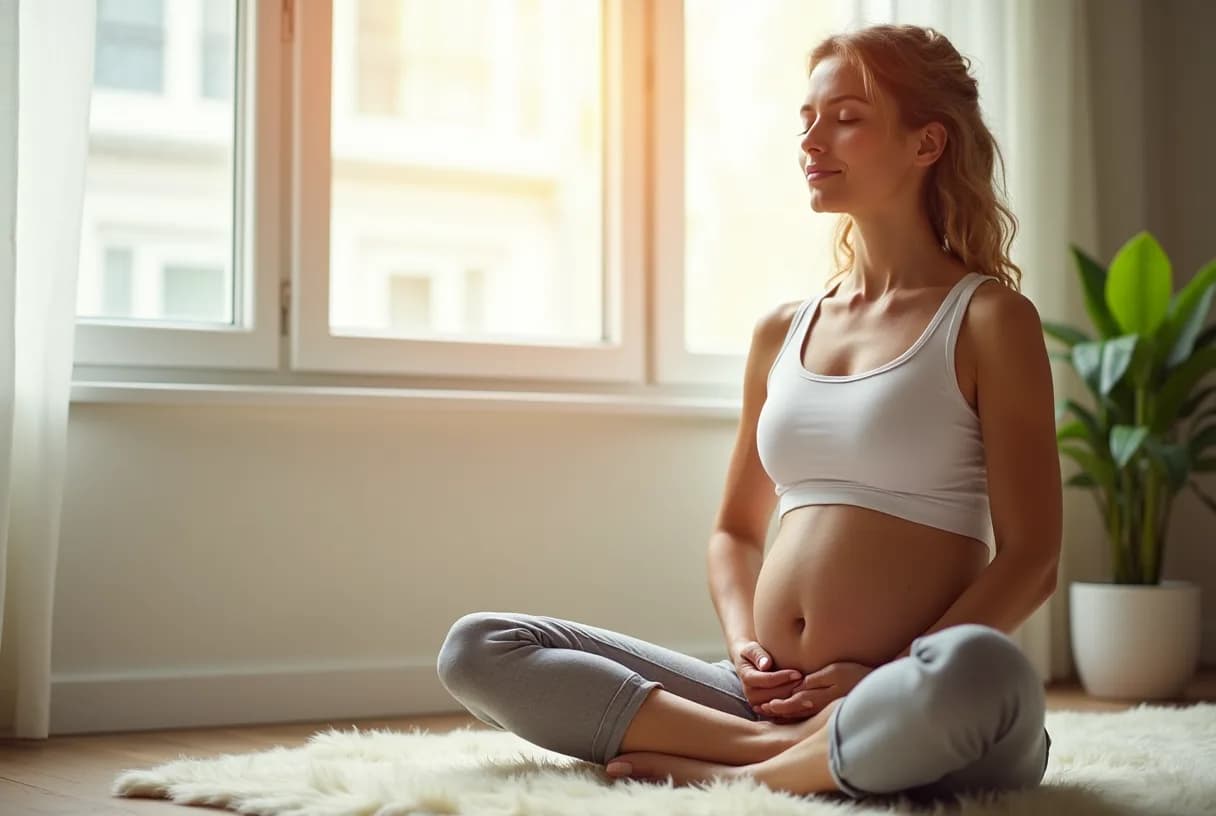
This is the technique the others are built on. Rest one hand on your chest and one on your belly. Breathe in slowly through your nose so that your belly rises while your chest stays relatively still, then exhale slowly and feel the belly fall.[4] Practising for five to ten minutes a day trains slower, fuller breathing so the other techniques come more easily when you actually need them.
- Best for: daily practice and habit-building, not just crisis moments.
| Technique | Pattern (counts) | Best moment to use it |
|---|---|---|
| Extended exhale | In 4, out 6 | Everyday anxiety; when you can't remember anything else |
| Box breathing | In 4, hold 4, out 4, hold 4 | Focus under pressure; before a stressful event |
| 4-7-8 | In 4, hold 7, out 8 | Winding down; nighttime anxiety and sleep |
| Physiological sigh | Double inhale, one long exhale | A sudden spike or the start of a panic wave |
| Diaphragmatic | Slow belly breaths, exhale longer | Daily practice to build the habit |
How do I use breathing during a panic attack?
A panic attack is a sudden rush of intense fear with physical symptoms — a pounding heart, chest tightness, shortness of breath, dizziness, tingling or numbness, and a feeling of losing control or "going crazy."[7] It is terrifying but not physically dangerous, and it peaks and passes, usually within about 10 minutes.[8] The goal of breathing here is not to force the attack to stop but to ride it out while nudging your body toward calm.
- Name it. Tell yourself: "This is a panic attack. It will peak and pass. It can't hurt me." Reducing the fear-of-the-fear is half the battle.
- Slow the exhale. Do not try to take big, deep gulps of air — that can make you over-breathe. Instead breathe out slowly and gently, longer than you breathe in. A physiological sigh or an extended-exhale pattern works best.
- Drop your shoulders and unclench. Let your jaw, hands and shoulders go loose. Tense muscles feed the alarm signal.
- Ground yourself. Press your feet into the floor and name five things you can see. This pulls attention away from catastrophic thoughts.
- Wait it out. Keep breathing slowly and let the wave crest. You are not required to make it stop — only to get through it.
One caution: if slow breathing makes you feel more lightheaded or tingly, you may be over-breathing (hyperventilating). Ease off, make the breaths smaller and quieter, and put all your attention on a relaxed exhale rather than a big inhale.
Do breathing exercises actually cure anxiety?
No — and any source that says otherwise is overselling. Breathing exercises are a well-supported way to calm the symptoms of anxiety in the moment and to lower baseline stress with regular practice.[1] They are not, on their own, a treatment for a diagnosed anxiety or panic disorder. For that, the therapies with the strongest evidence are cognitive behavioural therapy (CBT) and, for some people, medication.[7] Think of breathing as a reliable tool in a bigger kit that also includes stress management, movement, sleep and, when needed, professional care. Our guide to understanding anxiety symptoms and coping covers the wider picture.
A couple of honest add-ons: some women find magnesium helps with stress-related tension and sleep, though the evidence is modest — see magnesium for anxiety and weigh our best magnesium for women roundup before spending money. And tracking when your anxiety spikes can surface triggers you'd otherwise miss; a simple symptom diary is a low-effort place to start, especially if your symptoms cluster around your cycle or perimenopause.
When should I see a doctor?
Breathing exercises are safe for almost everyone, but some symptoms need a professional rather than a technique. Book an appointment if:
- Panic attacks are frequent, or you're reshaping your life to avoid them — skipping work, driving, or social situations. That pattern can signal panic disorder, which is very treatable.[7]
- Anxiety is disrupting your daily life — your sleep, appetite, relationships or ability to function — for weeks at a time.
- You have thoughts of self-harm or hopelessness. Contact a crisis line or emergency services straight away.
And treat the following as an emergency, not anxiety, until proven otherwise:
- New, severe or crushing chest pain — especially with pain spreading to the arm, jaw or back, a cold sweat, nausea, or breathlessness. Call emergency services. Panic attacks and heart attacks can feel alike, and women's cardiac symptoms are often atypical, so never assume chest pain is "just anxiety," particularly a first episode.[8] Our heart health section explains the warning signs.
- Fainting, a racing or irregular heartbeat, or breathing trouble that doesn't settle.
If anxiety has become a regular part of your days, that's a signal to talk to a clinician — not a personal failing. Explore more in our mental health and stress and cortisol guides.