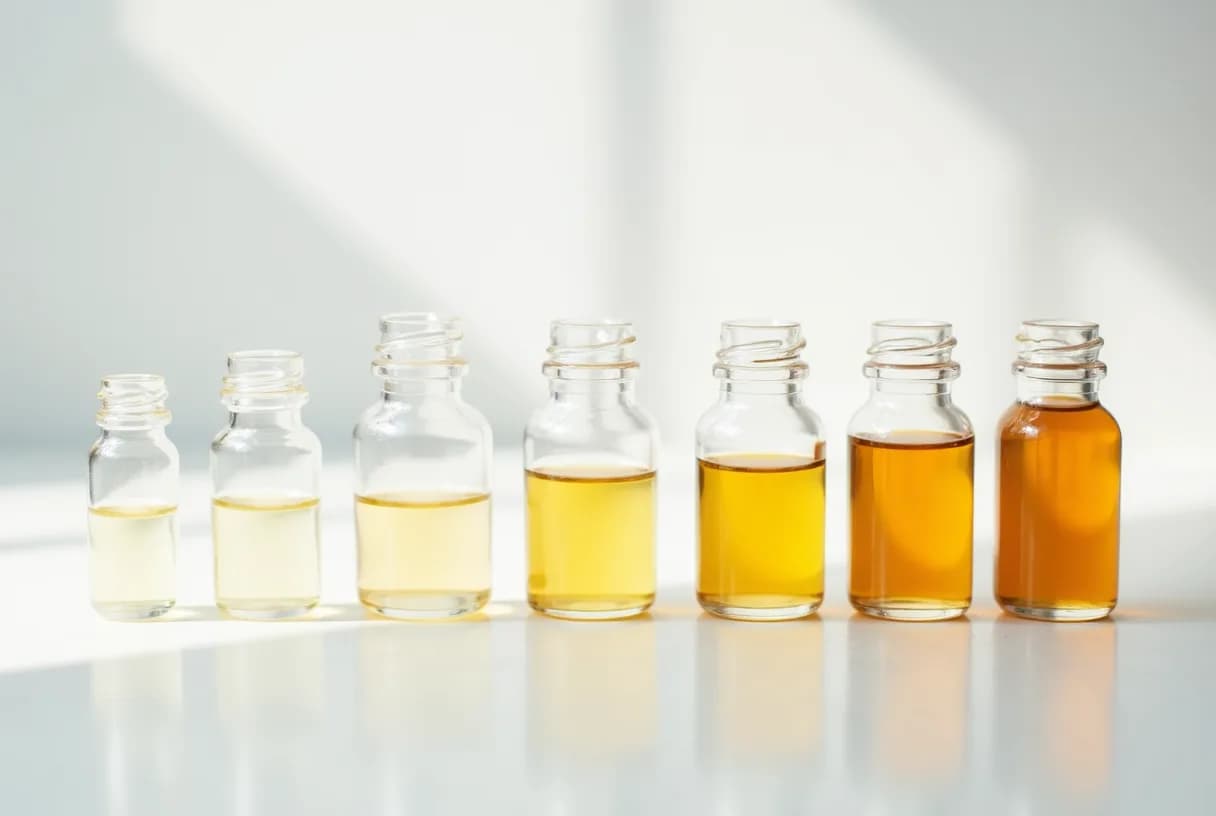
Healthy urine runs from pale straw to light yellow. Dark yellow or amber usually means it is concentrated and you need fluids; water-clear urine often means you are drinking more than your body needs right now. But color is a rough hydration gauge, not a diagnosis — and one rule overrides everything else on this page: pink, red, or cola-colored urine needs medical evaluation, even if it does not hurt and even if it happens only once.
Below is the decoder, the benign explanations that account for most color changes, and the specific ones that should send you to a clinician this week.
Urine color chart: what each shade usually means
| Color | What it usually means | Common benign causes | See a doctor if… |
|---|---|---|---|
| Transparent / water-clear | Very dilute urine — often more fluid than you need | Drinking a lot of water; caffeine or alcohol; a diuretic | It stays clear all day and you are unusually thirsty or urinating very often — that pattern can point to high blood sugar or a hormonal cause of excess urine |
| Pale straw to light yellow | The usual, well-hydrated range | Normal | No color concern — but color cannot rule out infection, protein, or kidney disease |
| Dark yellow to amber / honey | Concentrated urine — most often simply not enough fluid | First urine of the morning; heat, exercise, sweating; skipped drinks | It stays dark after you rehydrate, or comes with fever, flank pain, vomiting, or very low urine output |
| Neon or fluorescent yellow | Excess riboflavin (vitamin B2) being excreted | B-complex vitamins, multivitamins, energy drinks, fortified foods | Rarely a problem in itself — but note that B vitamins make color useless as a hydration check |
| Orange | Concentrated urine, a drug pigment, or bile in the urine | Phenazopyridine (AZO-type bladder-pain tablets), rifampin, sulfasalazine, high-dose beta-carotene, senna | You have taken none of those — or you also have pale, clay-colored stools, yellow eyes or skin, or itching, which points to a liver or bile-duct problem |
| Pink or red | Blood until proven otherwise — sometimes food or drug pigment | Beets, blackberries, rhubarb, food coloring, phenazopyridine, rifampin; menstrual blood contaminating the sample | Always. Get it checked — even one painless episode, even if it has already stopped |
| Brown, tea, or cola-colored | Old blood, muscle-breakdown pigment, or bile | Severe dehydration; fava beans, rhubarb, aloe; senna, cascara, metronidazole, nitrofurantoin | Get seen promptly — especially with muscle pain after hard exercise, jaundice, or a recent sore throat or skin infection |
| Green or blue | Almost always a dye or drug; rarely a specific bacterium | Methylene blue, propofol (after surgery), amitriptyline, indomethacin, some food dyes | You have had no dye or those drugs — or you also have burning, fever, or foul-smelling urine (a Pseudomonas infection can turn urine green) |
| Cloudy or milky | Cells, crystals, or debris — not really a "color" at all | Concentrated urine; harmless phosphate crystals after a big meal; discharge in the sample | It comes with burning, urgency, pelvic pain, fever, or a strong smell — or it keeps recurring |
If you have a urinalysis or dipstick report in front of you and want to see how the color line fits with the rest of it, our urinalysis decoder walks through each field, and lab results explained covers the tests that typically get ordered next.
Why is urine yellow in the first place?
The yellow is urobilin, a pigment produced when your body recycles old red blood cells. Hemoglobin is broken down into bilirubin, gut bacteria convert bilirubin into urobilinogen (the specific bacterial enzyme responsible, bilirubin reductase, was only identified in 2024), and some of it is reabsorbed and excreted in urine as urobilin. It is the same pigment at every shade — what changes is how much water it is diluted in.
That is why color tracks hydration, and also why it is so easily overridden. Any pigment more strongly colored than urobilin — riboflavin, beet pigment, rifampin, phenazopyridine — simply paints over the signal.
How reliable is urine color as a hydration check?
Strength of evidence: moderate. Validated 8-point urine color charts correlate reasonably well with lab measures of urine concentration (specific gravity, osmolality) in healthy adults, which is why they are used in sports and occupational settings. They are useful for spotting a trend across a day. They are not precise, and they mislead in predictable ways:
- Morning urine is normally darker. You did not drink for eight hours. Judge your color at midday, not at 6 a.m.
- B vitamins invalidate the reading. A multivitamin can keep urine bright yellow while you are genuinely dehydrated.
- Color runs ahead of hydration. Urine can turn pale within an hour of one large glass of water without your body being meaningfully better hydrated.
- Some kidney conditions blunt the signal. Kidneys that cannot concentrate urine well may produce pale urine even when you are dry.
For a daily target rather than a color target: the National Academies' adequate intake for adult women is about 2.7 liters (roughly 91 oz) of total water per day — and about 20% of that normally comes from food, so the drinking portion is closer to 2 liters. Thirst plus a midday glance at color is enough for most people. If you have heart, kidney, or liver disease, ask your clinician for a personal fluid target instead of following a general one.
Is clear urine a good sign?
Usually harmless, occasionally a clue. Consistently water-clear urine means you are excreting more fluid than you need — for most healthy women that is unnecessary rather than dangerous. Two situations deserve a second look:
- Large volumes plus constant thirst. Passing a lot of dilute urine and never quite quenching thirst can signal high blood sugar or a hormonal problem with water handling. That calls for a blood glucose test, not more water.
- Deliberate over-drinking around endurance exercise. Drinking far past thirst during a long event can dilute blood sodium (exercise-associated hyponatremia). It is uncommon but can be serious. Drink to thirst, not to a color.
Pink or red urine: when it is beets, and when it is blood
This is the section that matters most.
Beeturia — pink-red urine after eating beets — is real, harmless, and affects an estimated 10–14% of people (it appears more common in those with low iron stores). Blackberries, rhubarb, and heavy food coloring can do the same. Phenazopyridine, the over-the-counter bladder-pain tablet, turns urine vivid orange-red and stains underwear and contact lenses; it numbs symptoms and does not treat an infection. Rifampin, an antibiotic used for tuberculosis and some other infections, produces the same red-orange.
Here is the honest problem: you cannot reliably tell pigment from blood by looking. Neither can we. The only way to know is a urinalysis, which distinguishes red blood cells from dye.
Visible blood in urine is called gross hematuria. Four facts most articles soften:
- Painless is not reassuring — it is the classic pattern. Painless visible blood is the textbook first sign of bladder cancer. The absence of burning does not make it benign; it removes the most innocent explanation.
- One episode counts. Bleeding that appears once and clears still warrants evaluation. It does not have to repeat to be real.
- Women are diagnosed later, and the reason is documented. Visible blood in women is more often attributed to a urinary tract infection or gynecologic bleeding and treated without further workup, which delays referral. If you are told "it's just a UTI," ask for a repeat urinalysis after treatment to confirm the blood is gone.
- Periods and perimenopausal spotting confound the sample. Erratic bleeding is common in the menopause transition and can contaminate a urine sample. The fix is repeating the test when you are not bleeding — not skipping it. And bleeding after menopause is itself a symptom that needs evaluation, whatever its source.
Most causes of blood in urine turn out to be benign: infection, kidney stones, vigorous exercise, or no cause found at all. That is genuinely reassuring after the workup, not instead of it. Our full guide to blood in urine covers what the evaluation involves.
One technical note if you are reading a lab report: a dipstick reading "trace blood" is not the same as visible blood, and a dipstick alone is not enough to diagnose it. The American Urological Association defines microhematuria as 3 or more red blood cells per high-power field on microscopy of a properly collected sample, and it recommends confirming a positive dipstick under the microscope before working it up. Reference ranges and reporting conventions vary between laboratories — your clinician reads the number in the context of you.
Brown or cola-colored urine
Dark brown urine can be severe dehydration, or fava beans, rhubarb, aloe, or laxatives containing senna or cascara. But three causes need same-week — sometimes same-day — attention:
- Muscle breakdown (rhabdomyolysis). Cola-colored urine with deep muscle aching and weakness after an unusually hard workout, a fall with a long lie, or a new medication is an urgent-care situation: the pigment can injure the kidneys.
- Kidney inflammation (glomerulonephritis). Tea- or cola-colored urine appearing a day or two after a sore throat, or a few weeks after a strep throat or skin infection, sometimes with puffy eyes or new high blood pressure.
- Liver or bile-duct disease. Dark urine with pale stools, yellowing eyes, or itching is bilirubin showing up where it should not.
A note for anyone taking iron: oral iron tablets darken stool, not urine. If you take iron and your urine turns brown, do not write it off — see our guide to iron supplements for what iron does and does not change.
Which medications and foods change urine color?
| Substance | Typical color | How to tell it apart |
|---|---|---|
| Riboflavin (vitamin B2), B-complex, multivitamins | Bright / neon yellow | Appears within hours of the dose and fades over a day or two if you stop |
| Beets, blackberries, rhubarb, food dye | Pink to red | Clears within 24–48 hours of the food — but a urinalysis is still the only way to be sure it was not blood |
| Phenazopyridine (AZO-type bladder-pain tablets) | Vivid orange to red-orange | Stains fabric and contact lenses; starts with the first dose. Relieves burning; does not cure a UTI |
| Rifampin, sulfasalazine | Orange to red-orange | Expected and harmless with these drugs — never stop a prescribed antibiotic over the color; tell your prescriber |
| Senna, cascara (stimulant laxatives) | Yellow-brown to reddish-brown | Tracks with laxative use; no muscle pain, no jaundice |
| Nitrofurantoin, metronidazole | Dark yellow to brown | Common with these antibiotics; report it, but it is usually expected |
| Beta-carotene (carrots, supplements), high-dose vitamin C | Deeper yellow to orange | Gradual, dose-related, no other symptoms |
| Methylene blue, propofol, amitriptyline, indomethacin | Blue or green | Almost always traceable to a recent procedure or a known prescription |
Read this table as a list of plausible explanations, not permission to stop looking. A red pigment and a bleeding bladder can produce the same shade in the same toilet bowl.
Cloudy or foamy urine — and why they are not the same thing
Cloudiness comes from cells, crystals, or debris. It can be nothing (phosphate crystals after a rich meal are harmless) or white blood cells and bacteria — the classic urinary tract infection picture, especially alongside burning, urgency, and a strong smell. If a dipstick flagged white cells, see leukocytes in urine.
Foam is a different signal entirely. Persistent foam that needs several flushes to clear can mean protein is leaking into the urine — an early sign of kidney damage that color will never show you. That belongs in the protein in urine conversation, not the color one. Smell is its own axis as well: asparagus, concentrated urine, an infection, and uncontrolled blood sugar all change how urine smells without necessarily changing how it looks.
What urine color cannot tell you
This is where color charts oversell themselves. Perfectly normal pale-yellow urine is fully compatible with:
- Early kidney disease, which is usually silent — protein and creatinine tests find it, not your eyes
- Microscopic blood, including blood from a bladder tumor
- A urinary tract infection, especially the low-grade recurrent kind that is common after menopause
- Diabetes, high blood pressure, and high cholesterol
If you are in midlife and your bladder has changed — more urgency, more infections, more night-time trips — falling estrogen is a plausible driver, and it is treatable. That is a different conversation from color: see bladder and menopause and the rest of our bladder and urinary health coverage.
When to see a doctor about urine color
Seek same-day or urgent care if you have:
- Cola- or tea-colored urine with muscle pain or weakness
- Blood or clots in the urine with fever, flank pain, or vomiting
- Blood plus difficulty or inability to pass urine
- Dark urine with yellow eyes or skin, confusion, or severe abdominal pain
Book an appointment within days if you have:
- Any pink, red, or cola-colored urine you cannot confidently explain — including a single painless episode, and including bleeding that has already stopped
- Urine that stays dark after you rehydrate
- Orange urine with pale stools or itching
- Cloudy urine with burning, urgency, or pelvic pain
- Persistent foam
- Blood that appeared alongside a UTI and has not been re-checked after treatment
Do not self-treat. Do not take leftover antibiotics, and do not start iron because your urine looked "off" — both can muddy the very tests that answer the question.
What happens at the appointment
Expect a urinalysis (dipstick plus microscopy), a blood pressure check, and usually a serum creatinine to assess kidney function. Bring a list of every supplement, laxative, and over-the-counter product you take — the answer is often sitting in that list. If visible blood is confirmed, guidelines call for risk-stratified evaluation, which for many adults means imaging of the kidneys and a look inside the bladder with a cystoscope.
The framing worth keeping: a color is a clue, not a result. A result is a clue, not a diagnosis. Lab reference ranges differ between laboratories, and only a clinician who knows your history, your medications, and your symptoms can put the pieces together.
This article is information, not medical advice. It cannot diagnose the cause of a color change, and it cannot tell you a change is harmless. If your urine is pink, red, or brown, get it checked.