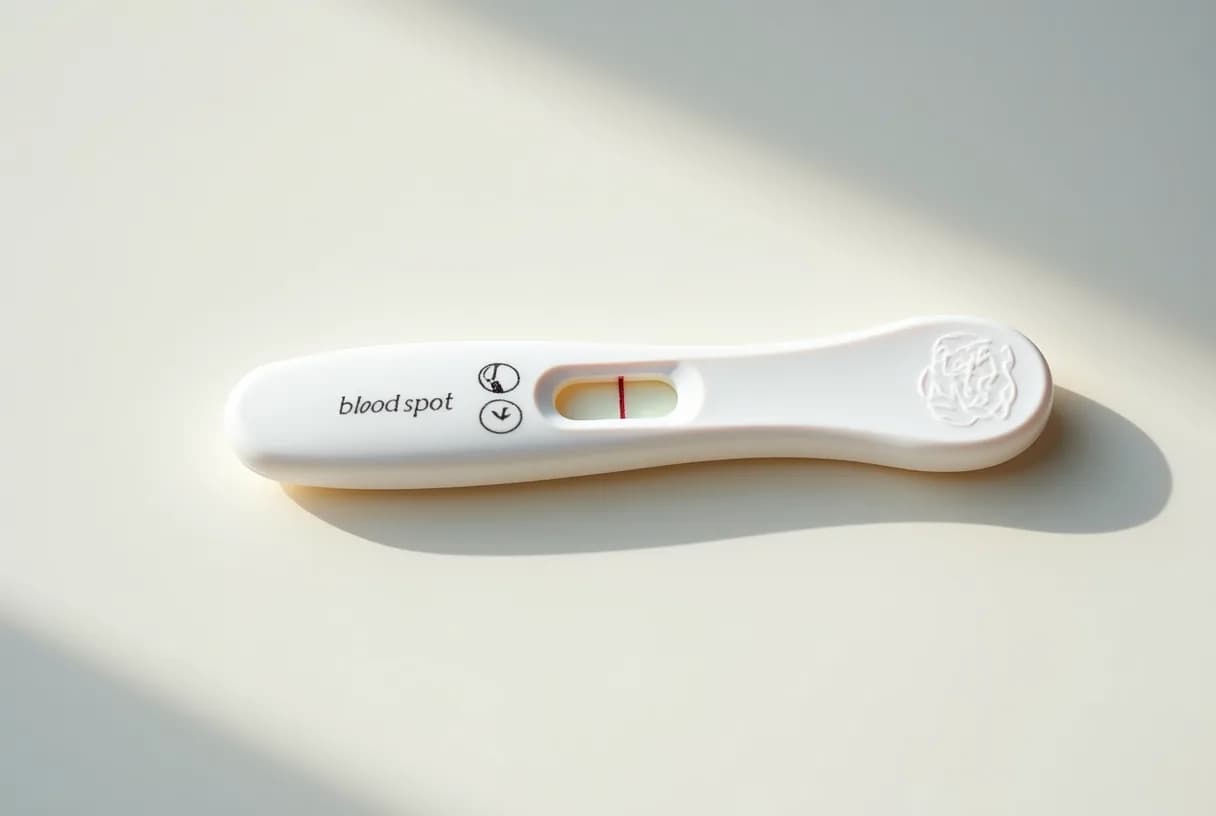
For most women, the best at-home menopause test is the one you don't buy. Menopause and perimenopause are diagnosed clinically — from your age, your symptoms, and the way your periods are changing — not from a hormone number. A home follicle-stimulating hormone (FSH) test can read "menopausal" one week and "normal" the next, because FSH swings wildly during the transition, so it can neither confirm nor rule out perimenopause. Below is what each type of test actually measures, the narrow situations where testing genuinely helps (mainly suspected early menopause under 40), and what you'd realistically pay.
Quick verdict
- Best overall For most women 45 and older: skip the test. Your cycle pattern and symptoms already make the diagnosis, and a home FSH result won't change the plan.
- When it helps Under 40 with skipped or absent periods: see a clinician for FSH checked on two separate draws (possible premature ovarian insufficiency) — not a one-day strip.
- Most rigorous format A CLIA-lab mail-in blood panel (FSH, estradiol, LH), physician-reviewed — real numbers, but it still cannot "diagnose" menopause.
- Least useful A single urine FSH strip: a one-day snapshot of a hormone that changes week to week.
- Best money The roughly $20–$130 a kit costs is usually better spent on the appointment that can actually diagnose and treat symptoms.
Why do most at-home menopause tests answer the wrong question?
Menopause is defined in hindsight: it's the day you've gone 12 full months without a period. The years of symptoms before it — irregular cycles, hot flashes, night sweats, sleep disruption, mood shifts — are perimenopause. Both the American College of Obstetricians and Gynecologists (ACOG) and the Menopause Society agree that in otherwise healthy women over 45, this is a diagnosis you make from symptoms and menstrual changes, not blood tests. As ACOG puts it, an ob-gyn can usually tell you're in perimenopause from your age, your symptoms, and how your periods have changed — no lab required.
The reason isn't laziness; it's biology. During perimenopause your ovaries don't switch off smoothly — they sputter. FSH, the pituitary hormone that rises as the ovaries wind down, can be high one day and back to premenopausal levels a week later. That single-day variability is exactly why a home hormone reading can't pin down where you are. We unpack this in FSH levels and perimenopause, and compare the whole category in how to compare at-home hormone tests.
What does each type of at-home test actually measure?
"Menopause test" covers several very different products. Here's what each one measures, what it can and can't tell you, and a realistic 2026 price. Prices vary by retailer, location, and insurance — verify before you buy.
| Test type | What it measures | What it can tell you | What it can't | Typical cost | Honest verdict |
|---|---|---|---|---|---|
| Single urine FSH strip (OTC) | Whether urine FSH is elevated (yes/no) | That FSH was high on that one day | Confirm or rule out perimenopause; it misses the day-to-day swing | ~$10–$25 per multi-pack | Skip — a coin-flip snapshot |
| Multi-day urine FSH + app (e.g., Clearblue Menopause Stage Indicator) | FSH across 5 samples plus your age and cycle history in an app | A "likely stage" estimate | No validated accuracy for the stage itself; the maker is discontinuing it (app support ends Sept 1, 2026) | ~$20–$30 | Rarely changes what you'd do |
| Mail-in blood panel, CLIA lab (e.g., Everlywell Perimenopause Test) | FSH, estradiol, and LH from a finger-prick sample | A physician-reviewed snapshot of several hormones | Still can't "diagnose" menopause; one draw, and home collection is less precise than a venous draw | ~$70–$130 | Real data, wrong question for most |
| AMH ("ovarian reserve" / menopause-timing) test | Anti-Müllerian hormone | A rough marker of ovarian reserve | Predict when menopause will start, or your natural fertility | ~$70–$150 | Don't buy it to time menopause |
| Clinician visit + targeted labs (when indicated) | History plus FSH, thyroid, and others only if needed | An actual diagnosis and a treatment plan | — | Visit varies; FSH ~$22–$55 direct-access | Best value when something's off |
Why is a home FSH result basically a coin flip?
Home urine FSH kits are FDA-cleared, and the chemistry works: the FDA says they correctly detect elevated FSH about 9 times out of 10. The catch is what that result means. These are qualitative tests — they tell you whether FSH is high on that sample, not whether you're in menopause. In the FDA's own words, the test "does not detect menopause or perimenopause." A negative result doesn't reassure you either: you can have menopausal symptoms and a "normal" strip on the same day.
Even the more sophisticated multi-test kits inherit this problem. The Clearblue Menopause Stage Indicator, for example, has you test urine five times over about ten days and feeds the results plus your age and cycle history into an app algorithm that reports a "likely stage." In lab testing it reliably detects FSH above the 25 mIU/mL threshold, but the product carries no validated accuracy claim for the menopause stage it reports — there's no gold-standard stage to measure it against. Notably, the manufacturer has announced it is discontinuing the product, with app support ending September 1, 2026. Mail-in blood panels give you real, physician-reviewed numbers (FSH, estradiol, LH), which feels more authoritative — but a single blood draw still can't overcome the underlying fluctuation, and it can't make the clinical diagnosis for you. For the fuller trade-off, see at-home hormone test vs. seeing a doctor.
When is a menopause test genuinely worth it?
There are real exceptions. Testing meaningfully changes care when the question isn't "am I in normal-age menopause?" but "is something else going on?"
- Suspected early menopause (under 40). Periods that stop or become erratic well before the typical age can signal premature ovarian insufficiency (POI). Here FSH genuinely helps — but the diagnosis is made by a clinician who checks FSH on two separate occasions several weeks apart (commonly with a threshold above 25 mIU/mL) alongside months of menstrual disturbance, not by a single home strip. POI also warrants further workup, so this is not a self-diagnosis.
- The 40–45 gray zone. If symptoms are ambiguous at this age, a clinician may order FSH to help clarify the picture — again as one input, not the verdict.
- Ruling out conditions that mimic menopause. Thyroid disease, iron-deficiency anemia, high prolactin, and pregnancy can all produce fatigue, mood changes, or irregular cycles. A clinician can order the right tests — see thyroid testing — rather than assuming everything is hormonal.
When to see a clinician promptly: any bleeding after menopause, unusually heavy or prolonged bleeding, periods stopping before age 40, or new severe symptoms deserve a professional evaluation — not a home kit. Postmenopausal bleeding in particular always needs to be checked. A home test can delay care by offering false reassurance.
What about AMH and "when will I hit menopause" tests?
A growing crop of direct-to-consumer kits market AMH as a way to "predict menopause" or gauge fertility. Be skeptical. ACOG's guidance is blunt: using AMH to predict the onset of menopause is "unsuitable for clinical practice at this time," and AMH isn't validated as a fertility predictor in women who aren't already being evaluated for infertility. AMH can be a useful marker of ovarian reserve within a fertility workup, but as a standalone "how long do I have?" test it promises precision it can't deliver. We go deeper in AMH and ovarian reserve.
How much should you actually pay?
As of 2026, over-the-counter urine FSH kits run roughly $10–$30, and mail-in blood panels roughly $70–$130 — prices vary by retailer and change often, so verify. Compare that to the clinical route: a standalone FSH blood test through direct-access labs is often about $22–$55, and when your ob-gyn orders FSH or thyroid labs to investigate symptoms, they're frequently covered under standard diagnostic codes. In other words, the "cheap" home option often isn't cheaper than the test that actually informs care. To estimate your out-of-pocket costs, use our cost & coverage estimator, break down the numbers in at-home hormone test cost, and if you do have lab results in hand, our lab results explainer can help you read them in context.
How we chose — and what we don't do
VidaBeacon does not run a testing lab, and we don't crown a single "winner" brand for a category where the honest answer is "you probably don't need this." We evaluated at-home menopause tests by two questions that actually matter: can the test reliably measure what it claims (analytic validity), and does the result meaningfully change your care (clinical usefulness)? We describe tests by type and use case, cross-check every claim against the FDA, ACOG, and the Menopause Society, and name a specific product only to illustrate how a format works — never as a paid endorsement. When a popular product answers a question you shouldn't be asking, we say so.
The bottom line
If you're over 45 and your periods and symptoms are telling the story, an at-home menopause test mostly buys you a number that can't change your diagnosis — and might mislead you. The strongest, most honest use of your money is a conversation with a clinician who can diagnose menopause clinically, rule out mimics, and treat what's actually bothering you. Save the test budget for care. If you're under 40 with skipped periods, don't self-test — get evaluated. Start with our menopause hub or find a clinician when you're ready.