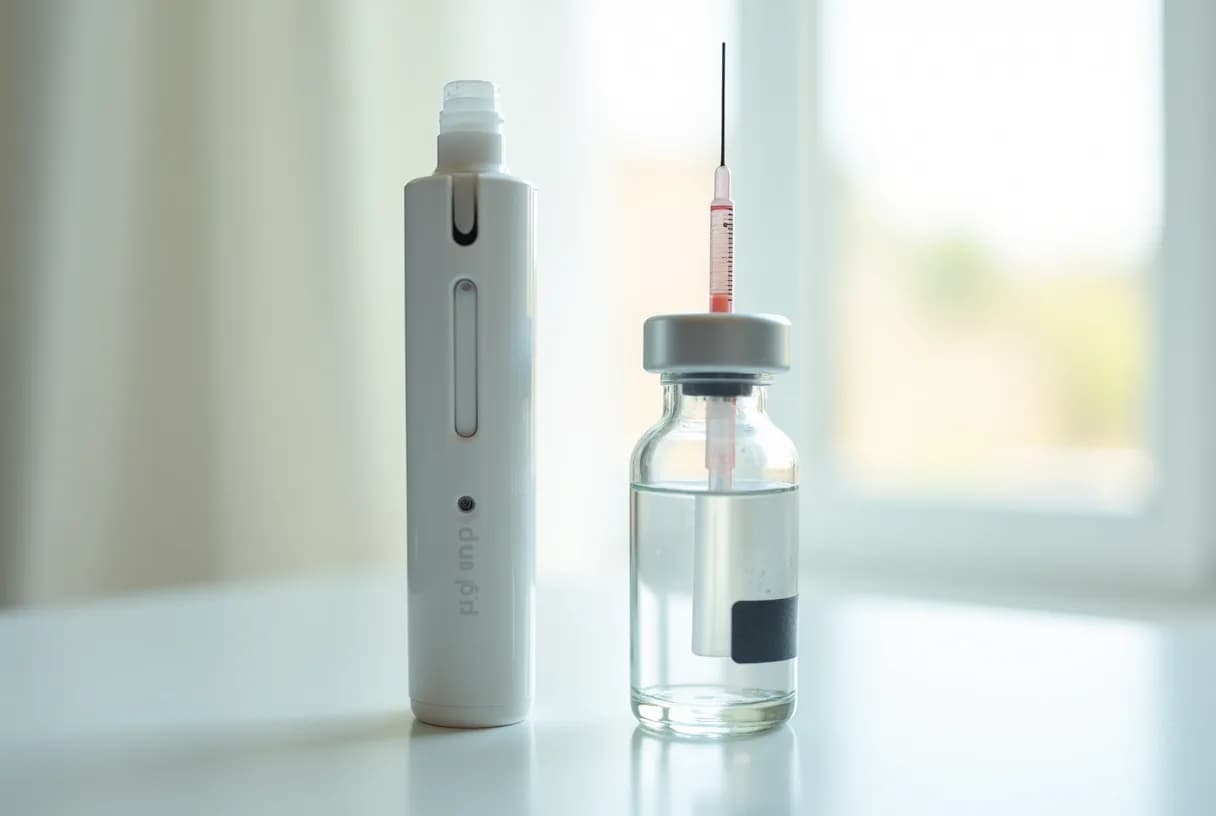
Wegovy is an FDA-approved medicine. It goes through the agency's review for safety, effectiveness and manufacturing quality, and it arrives as a fixed-dose pen — you cannot easily draw up the wrong amount. Compounded semaglutide is not FDA-approved. The FDA does not review it for safety, effectiveness or quality, it typically arrives as a vial you measure yourself, and the agency has documented overdoses — some requiring hospitalisation — caused by that difference. The legal basis that allowed compounders to mass-produce copies ended in 2025 when the FDA declared the semaglutide shortage resolved. Cost was the honest reason most people chose compounding; in July 2026 that price gap is far smaller than it was.
What "compounded" actually means
Compounding is when a licensed pharmacist mixes or alters a drug for a specific patient — historically, for real clinical reasons: a child who needs a liquid instead of a tablet, a patient allergic to a dye in the commercial product, a dose that simply is not manufactured.
Compounded drugs are legal, but they occupy a different regulatory universe from approved drugs. A compounded product is not reviewed by the FDA before it reaches you. Nobody at the agency has checked that the vial contains what the label says, at the strength it says, free of contaminants, stable for as long as it claims. That is not a rhetorical flourish — it is the literal statutory position, and the FDA states it plainly on its own compounding pages.
Two kinds of facility make these products. 503A pharmacies compound for an individual patient against a prescription. 503B outsourcing facilities make larger batches and are held to tighter manufacturing standards, though still without product-level FDA approval. Most of the telehealth semaglutide sold in 2023–2025 came from one of these two channels.
The legal story, told straight
Federal law generally bars compounders from making a copy of a commercially available approved drug. There is a carve-out: when a drug is on the FDA's official shortage list, compounders may make copies of it. Semaglutide went on that list, and an entire telehealth industry was built on the exception.
That door has closed. Key dates:
- 21 February 2025 — the FDA declared the semaglutide shortage resolved, removing the legal basis for copying it.
- 22 April 2025 and 22 May 2025 — the FDA's stated enforcement-discretion period ended for 503A pharmacies, then for 503B outsourcing facilities.
- 2025–2026 — the FDA issued warning letters to compounders and telehealth sellers over claims such as "the same active ingredient as Ozempic and Wegovy" and branding that obscured who actually compounded the drug.
- 30 April 2026 — the FDA proposed excluding semaglutide, tirzepatide and liraglutide from the 503B bulk-substances list — the mechanism outsourcing facilities relied on for large-scale compounding — finding no clinical need for it. The comment period closed on 29 June 2026. As of 13 July 2026 this is a proposal, not a final rule. That distinction is worth holding onto, because sellers describe it both ways depending on what they want you to believe.
What remains legal is narrow: a 503A pharmacy may still compound semaglutide when a specific patient has a documented clinical need the approved product cannot meet — a genuine allergy to an inactive ingredient, for example. Wanting it cheaper is not, in the FDA's framing, such a need. If a website is still selling you compounded semaglutide today, it is worth understanding which of those narrow doors it claims to be standing in.
Side by side
| Compounded semaglutide | Wegovy (semaglutide) | |
|---|---|---|
| FDA approval | None. Not reviewed for safety, effectiveness or manufacturing quality. | Approved. Reviewed, with a public label on DailyMed. |
| Active ingredient | Sometimes a salt form (semaglutide sodium, semaglutide acetate), which the FDA says is a different active ingredient from the approved base form. | Semaglutide base — the molecule studied in the trials. |
| Dosing format | Usually a multi-dose vial plus syringe. You calculate and draw the dose. Concentration varies between compounders. | Single-dose pen with a fixed dose. Nothing to calculate. |
| Oversight | State boards of pharmacy; FDA inspects facilities but not the product. | FDA reviews the product, the plant, the label and post-market safety reports. |
| Cost (checked 13 July 2026) | Varies by seller; historically the reason people chose it. No published national price. | NovoCare Pharmacy self-pay: $349/month for the 0.25, 0.5, 1, 1.7 and 2.4 mg pens; $399/month for the 7.2 mg HD pen; $199/month introductory price for the first two fills of starter doses (stated through 31 Dec 2026); $149/month for the oral 1.5 mg and 4 mg (4 mg stated to rise to $199 after 31 Aug 2026). |
| If something goes wrong | No manufacturer recall infrastructure behind an approved product; no FDA-approved Medication Guide; harder to trace batch, API source and liability. | Recalls, MedWatch reporting, a named manufacturer, a Medication Guide, and a documented safety database. |
The harm that is actually documented: the vial
This is the part most articles hedge, and it deserves to be concrete.
On 26 July 2024 the FDA issued an alert after receiving reports of adverse events — some requiring hospitalisation — from overdoses of compounded injectable semaglutide. The mechanism was not exotic. Compounded product comes in a vial measured in milligrams per millilitre, and patients drew it up with an insulin syringe marked in units. Converting milligrams to units to millilitres in a kitchen at 7am is exactly the kind of arithmetic that goes wrong. In the worst reports, people administered five to twenty times the dose they intended.
The FDA is specific about the cause: confusion between units of measurement — millilitres, milligrams and "units" — contributed to the errors, and most reports described a patient drawing up more than the prescribed dose from a multiple-dose vial. Health care providers miscalculated doses too, so this is not simply a story about careless patients. Concentration also varies between compounders, so a syringe mark that meant one dose from last month's vial can mean something else from this month's. Reported effects included nausea, vomiting and abdominal pain, fainting, headache, dehydration, gallstones and acute pancreatitis.
A case series published in the Journal of the American Pharmacists Association in 2023 documented three patients who gave themselves ten-fold overdoses of compounded semaglutide, with nausea, vomiting and abdominal pain lasting days. The authors' point was structural: vials lack the safety features of a prefilled manufactured pen, and so permit an error a pen does not.
A Wegovy pen does not permit this error. That is not marketing; it is the single most important practical difference between the two products.
Salt forms: not the same ingredient
The FDA has reported that some compounders used semaglutide sodium or semaglutide acetate instead of semaglutide base. These are chemically different substances. They were not what was tested in the STEP or SELECT trials, and the FDA has said they have not been shown to be safe or effective. If a product's certificate of analysis names a salt form, the honest description is that you do not know what the effectiveness or safety profile is, because nobody has established one.
The cost argument, taken seriously
People did not turn to compounded semaglutide because they were reckless. They turned to it because a month of brand-name treatment cost more than a car payment, insurance denied it as "cosmetic", and the telehealth ad said $200. That was a rational response to a broken price.
The arithmetic has changed. Checked on novocare.com on 13 July 2026: Novo Nordisk's own pharmacy lists Wegovy pens at $349 per month self-pay for the 0.25, 0.5, 1, 1.7 and 2.4 mg doses, with an introductory $199 per month for the first two fills of the starter doses (offer stated as running through 31 December 2026), and $399 per month for the 7.2 mg HD pen. The oral form is listed at $149 per month for the 1.5 mg and 4 mg doses, with the 4 mg price stated as rising to $199 after 31 August 2026. Prices change; verify on the manufacturer's page the week you buy.
Separately, a federal pricing agreement announced on 6 November 2025 committed Novo Nordisk and Eli Lilly to a Medicare and Medicaid price of $245 per month for GLP-1s, and to Medicare coverage of obesity treatment with a stated $50 monthly copay. We cannot tell you whether your specific plan has implemented it — plans differ, and only your plan knows its own rule. That is a phone call, not a guess. Our cost and coverage estimator can help you frame it.
What you are trading away
Many people used compounded semaglutide and came to no harm. That is true, and pretending otherwise insults the reader. What is also true is what you give up:
- Identity and purity. No FDA review means nobody independent has confirmed the vial contains the drug, at the strength claimed, uncontaminated.
- A recall pathway. If a batch is wrong, an approved drug has machinery to find you. A compounded product often does not.
- A dose you cannot get wrong. See above.
- Recourse. Warning letters and patent litigation have already pushed sellers out of the market mid-treatment, leaving patients to re-source a drug they were titrating.
Questions to ask before you spend a dollar
You do not need us to tell you what to do. You need the questions that get you a real answer. Ask the prescriber or pharmacist, and get it in writing:
- Is this product FDA-approved, yes or no?
- Which pharmacy or outsourcing facility compounds it, and in which state is it licensed?
- Is the active ingredient semaglutide base, or a salt form? Can I see the certificate of analysis?
- Is it a pen or a vial? If a vial, what is the concentration in mg/mL, and who is going to teach me to draw the dose?
- Which clinical reason makes a compounded product appropriate for me specifically, rather than the approved one?
- If I have a serious reaction, who do I call, and to whom is it reported?
A legitimate service answers all six without flinching. If a website will not name its compounder, that is your answer. Our guide to evaluating online GLP-1 services walks through the rest.
On dosing: reference, not instruction
The Wegovy label published on DailyMed describes a stepwise escalation through 0.25, 0.5, 1, 1.7 and 2.4 mg once weekly, with a maintenance dose of 2.4 mg once weekly; a higher-dose 7.2 mg pen (Wegovy HD) also exists. That is what the label says. Your prescriber sets your dose. Do not adjust, split, stretch or skip doses on your own, and do not double up after a missed dose — take the missed-dose question to your prescriber or pharmacist, not to a forum. If you are unsure what you injected, or think you injected too much, call your poison centre or clinician immediately rather than waiting to see what happens.
When to talk to your prescriber — or get urgent care
Seek urgent medical care for severe, persistent abdominal pain (especially radiating to the back, with vomiting — a possible sign of pancreatitis), vomiting you cannot stop, signs of dehydration, fainting, a lump or swelling in the neck or trouble swallowing, or symptoms of low blood sugar if you also take insulin or a sulfonylurea.
Call your prescriber if you suspect you measured a dose wrong; if side effects are stopping you eating or drinking; if you are pregnant, planning pregnancy or breastfeeding; if you have a personal or family history of medullary thyroid carcinoma or MEN 2 (the approved label lists these as contraindications); or if the product you have been buying is discontinued and you need a plan rather than an abrupt stop. Anyone can report a problem with any drug — approved or compounded — to the FDA's MedWatch programme.
Related reading
How GLP-1 medicines work · Wegovy vs Ozempic · Side effects, ranked by how common they are · What the dosing schedule looks like · Semaglutide drug page · Weight & metabolism
Disclosure: VidaBeacon may earn a commission from some links to care services or products. We do not accept payment for coverage, and no company reviewed here paid to be included or excluded. We name no telehealth provider as a recommendation.
This article is information, not medical advice. It does not tell you to use or to avoid any product. Prices and regulatory status were verified on 13 July 2026 and change frequently — check the manufacturer's and FDA's own pages before you act.