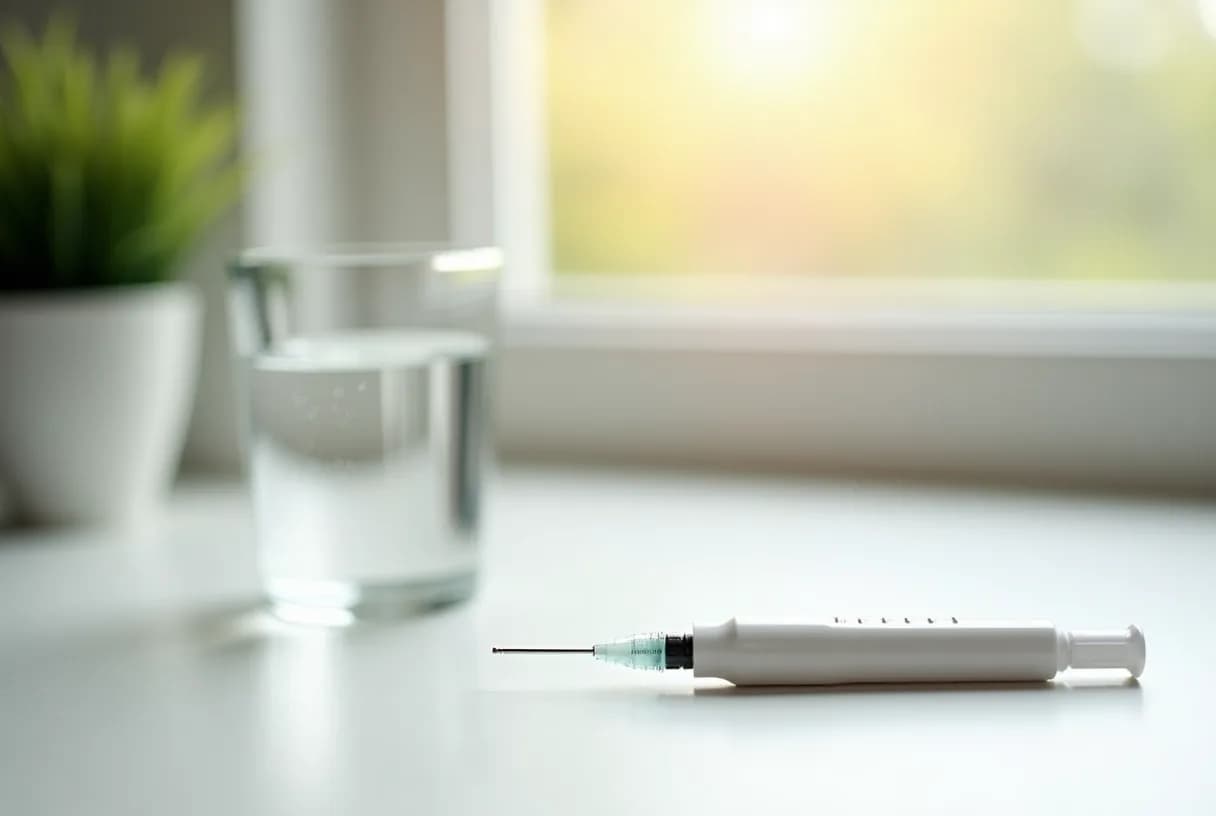
If you have just been prescribed Wegovy, Ozempic, Mounjaro or Zepbound, the dosing schedule can look confusing — a string of rising numbers spread over several months. The underlying logic is simple: these once-weekly injections are almost always started at a low "starter" dose and stepped up gradually, usually about every four weeks, so your body can adapt and side effects stay manageable. The exact milligram amount and how fast you move up the ladder are decisions your prescriber makes for you, based on why you are taking the medicine and how you respond. This article explains the general principles — it is health education, not personal medical instructions, and nothing here should be used to start, stop or change a dose on your own.
This matters to a lot of women in midlife. Perimenopause and menopause shift where the body stores fat and how it handles blood sugar, and many women are now offered a GLP-1 medicine for type 2 diabetes or weight management during exactly this stage of life. If you want the background on how these drugs work in the first place, start with our explainer on what GLP-1 medications are, and see menopause and belly fat for the hormonal side of midlife weight change.
How are Wegovy, Ozempic and Mounjaro doses scheduled?
All four of these medicines are subcutaneous injections given once a week, on the same day each week, at any time of day, with or without food. You do not take them daily, and you do not "top up" between doses.
Instead of starting at the full treatment dose, they use a process called dose titration. You begin on a deliberately low dose that is not expected to do much on its own, then move up one rung at a time on a set schedule. Each rung is usually held for about four weeks before the next increase. Semaglutide (the drug in Ozempic and Wegovy) and tirzepatide (the drug in Mounjaro and Zepbound) both follow this stepwise pattern, and drug-safety references from the NHS and MedlinePlus describe the same principle: your doctor starts you low and increases the dose no more often than roughly every four weeks.
One important distinction: Ozempic and Mounjaro are approved for type 2 diabetes, while Wegovy and Zepbound are approved for chronic weight management. Same active ingredients, different brand names and different target doses. Tirzepatide (Mounjaro, Zepbound) is also slightly different from semaglutide — it is a dual GLP-1 and GIP receptor agonist, meaning it acts on two gut-hormone pathways rather than one.
What does a typical GLP-1 titration schedule look like?
The table below shows, at a high level, how each medicine is publicly documented to escalate on its manufacturer label. Read it as a conceptual map of the ladder, not as a dosing chart for you personally — your own numbers and timing may look different, and only your prescriber can tell you where you should be.
| Medicine (active ingredient) | Approved use on the label | Starting dose | How the dose steps up | Documented maintenance milestone |
|---|---|---|---|---|
| Wegovy (semaglutide) | Chronic weight management | 0.25 mg once weekly | Rises about every 4 weeks: 0.25 → 0.5 → 1 → 1.7 → 2.4 mg | 2.4 mg once weekly (or 1.7 mg); the lower doses are escalation-only |
| Ozempic (semaglutide) | Type 2 diabetes | 0.25 mg once weekly (a starter, not a treatment dose) | Increases after ~4 weeks or more, one step at a time | 0.5 mg, 1 mg, or up to a maximum of 2 mg once weekly |
| Mounjaro (tirzepatide) | Type 2 diabetes | 2.5 mg once weekly | Increases in 2.5 mg steps, no more than once every 4 weeks | 5 mg up to a maximum of 15 mg once weekly |
| Zepbound (tirzepatide) | Chronic weight management | 2.5 mg once weekly | Increases in 2.5 mg steps, no more than once every 4 weeks | 5 mg, 10 mg, or 15 mg once weekly (max 15 mg) |
A few things stand out. The two weight-management medicines (Wegovy, Zepbound) climb to a higher target than their diabetes-focused twins. The starting doses — 0.25 mg for semaglutide and 2.5 mg for tirzepatide — are intentionally sub-therapeutic; they exist to ease you onto the medicine, not to treat anything yet. And "about every four weeks" is a floor, not a promise: if a step is not tolerated, the schedule can be paused or slowed. Curious how quickly effects show up as the dose rises? Our how-long-until-it-works tool sets realistic expectations for the first few months.
Why do you "start low and go slow"?
The slow ramp is not caution for its own sake — it is the single most important thing that keeps people able to stay on these medicines. GLP-1 drugs slow how fast the stomach empties and turn down appetite signals. Introduced too quickly, that same mechanism produces the classic early side effects: nausea, vomiting, diarrhea, constipation, reflux and a heavy, over-full feeling after meals.
Stepping up gradually gives your gut time to adapt at each rung, which is why manufacturer labels explicitly tie the escalation schedule to reducing the risk of gastrointestinal side effects. Move up only when your body has settled at the current dose, and each side-effect wave tends to be smaller and shorter. Push the pace, and nausea and vomiting can become severe enough that people quit altogether — or become dehydrated. For the full picture of what to expect and how to manage it, see Ozempic and Wegovy side effects and, for tirzepatide specifically, tirzepatide side effects.
Going slow protects more than your stomach. Rapid, aggressive weight loss can mean losing more muscle along with fat, which matters especially for women in midlife who are already navigating age-related muscle change — we cover this in GLP-1 medications and muscle loss. A measured schedule gives you time to keep protein intake and strength work in place as your appetite falls.
Why does your prescriber set the exact dose — and why shouldn't you change it yourself?
The tables and labels describe a standard ladder, but real prescribing is individual. Your prescriber weighs several things the label cannot know about you:
- Why you are taking it — a blood-sugar target for type 2 diabetes is a different goal than weight management, and the target doses differ.
- How well you tolerate each step — if side effects are rough, many people stay longer on a rung, or hold at a lower "maintenance" dose that works well enough. Wegovy, for example, lists 1.7 mg as an acceptable maintenance dose for people who do not tolerate 2.4 mg.
- Your other medicines and health history — combinations with insulin or a sulfonylurea, kidney concerns, a history of pancreatitis or gallbladder disease, and more all shape the plan.
- How you are responding — the ladder is adjusted to results, not followed blindly to the top.
This is exactly why you should never speed up, slow down, skip rungs, or change your dose on your own. Escalating faster than prescribed does not make the medicine work better — it mainly increases side-effect and dehydration risk. This is doubly important with compounded or telehealth-supplied versions drawn from multi-dose vials, where the concentration differs from the standard pens and self-dosing errors are easier to make. If a dose feels like too much or too little, that is a conversation to have with your prescriber, not a change to make yourself.
What should you do about a missed dose?
Because these are once-weekly medicines, a missed dose is common and usually manageable — but the rules are specific, and they differ by product and by why you take it. In general terms, the labels document a short catch-up window of a few days after the missed day, during which the dose can still be taken; if more time than that has passed, the documented guidance is to skip the missed dose and resume on your usual day. The one rule that is universal: do not take two doses close together to "make up" for a missed one.
The catch-up window itself is not the same across products. For once-weekly semaglutide, drug references list different windows depending on whether it is prescribed for diabetes or for weight loss, and tirzepatide has its own window again. Because that difference is easy to get wrong from memory, the safest move is to check the patient information leaflet that came with your pen, or ask your pharmacist or prescriber — a pharmacist can answer this in minutes, free, without an appointment. If you have missed several doses in a row and stopped for a while, do not simply resume at your old dose; that is a call for your prescriber, because you may need to re-titrate from a lower step.
When to see a doctor
Titration is designed to keep side effects mild, but some symptoms need prompt attention rather than "waiting for it to pass." Contact your healthcare provider — or seek urgent care — if you experience:
- Severe or persistent abdominal pain, especially pain in the upper belly that may spread to your back and comes with vomiting — this can be a sign of pancreatitis and needs urgent evaluation.
- Vomiting or diarrhea that will not stop, or signs of dehydration (dizziness, very little urine, a racing heart) — persistent fluid loss can also strain the kidneys.
- Signs of a gallbladder problem — pain in the upper-right abdomen, fever, or yellowing of the skin or eyes.
- Symptoms of low blood sugar (shakiness, sweating, confusion, palpitations), which are more likely if you also take insulin or a sulfonylurea.
- Any sign of a serious allergic reaction — swelling of the face, lips, tongue or throat, trouble breathing, or a rapidly spreading rash. This is an emergency: call your local emergency number right away.
Do not stop, restart, or change your dose to deal with these symptoms yourself — report them and let your prescriber decide the next step. If a symptom is severe or you are frightened, treat it as an emergency and get help immediately.
The bigger picture for women in midlife
A dosing schedule is only one part of a plan. These medicines work best alongside the everyday basics — enough protein, strength and walking-based movement, sleep and stress management — which matter even more during the menopause transition. If you are still weighing whether a GLP-1 is right for you, compare the options in Wegovy vs Ozempic and Mounjaro vs Ozempic, and look at non-prescription approaches in Ozempic alternatives. For broader context on managing weight and blood sugar in your 40s and 50s, browse our weight and metabolism hub; for the well-woman supplement basics people often ask about at the same time, our buyer's guides lay out what is worth it and what is not.
Bottom line: the escalating numbers on a GLP-1 schedule are a feature, not a bug. Starting low and stepping up slowly is what makes these medicines tolerable — and the person who sets your exact dose and pace, and adjusts it when life gets in the way, is your prescriber.