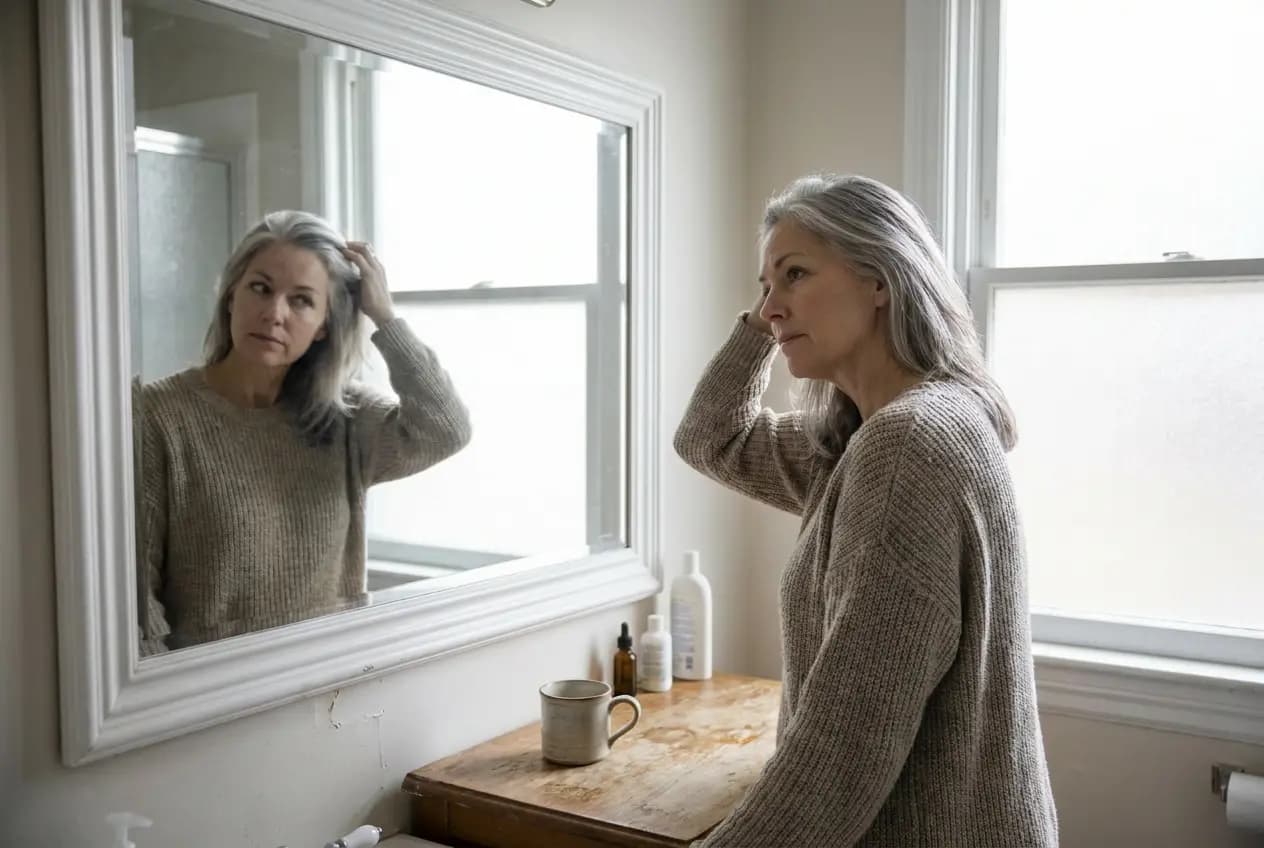
Many women notice their hair getting thinner during perimenopause and after menopause, most often as a widening part and less density across the top and crown while the hairline stays put. The main driver is hormonal: as estrogen and progesterone fall, the relative influence of androgens (male-pattern hormones women make too) rises, which shortens the hair's growing phase. Genetics and aging usually sit underneath this pattern. Gentle hair care, correcting iron or thyroid problems, eating enough protein, and topical minoxidil are the mainstays that help. Sudden, patchy, or rapid loss is different and should be checked by a clinician.
Why menopause changes your hair
Each hair follicle cycles through a long growing phase (anagen), a brief transition, and a resting-then-shedding phase (telogen). Estrogen tends to keep follicles in the growing phase longer, which is part of why many women's hair feels thickest in their reproductive years and during pregnancy. As estrogen declines around menopause, that growing phase shortens, more follicles rest at once, and each new hair can grow in finer and for less time. Over months to years this reads as diffuse thinning rather than bald spots.
The second half of the story is androgens. Your ovaries and adrenal glands still make small amounts of testosterone, and after menopause the balance tips so androgens carry more relative weight. In follicles that are genetically sensitive, androgens gradually miniaturize the hair, meaning each regrowth is shorter and thinner until the follicle produces little visible hair at all. This is the mechanism behind female-pattern hair loss (also called androgenetic alopecia), and menopause is a common trigger point for it. Cleveland Clinic and the American Academy of Dermatology both describe this widening-part, crown-thinning pattern as the most common type of hair loss in women at midlife.[1]
How menopausal thinning usually looks
Female-pattern thinning is typically:
- Diffuse and symmetric across the top of the scalp, often first noticed as a wider part or a smaller ponytail.
- Slow — developing over months and years, not days.
- Front-hairline sparing in most women, unlike male pattern baldness.
- Sometimes paired with hair that simply feels finer, drier, or slower to grow.
Some women also see extra shedding — hair coming out in the shower or brush — during the perimenopausal transition. A burst of shedding a couple of months after a stressor (illness, surgery, big weight change, high fever, emotional shock) is often telogen effluvium, a temporary reset of the hair cycle that usually recovers once the trigger passes.[4]
What else could be causing it
Menopause rarely acts alone, and several very treatable conditions cause or worsen hair loss. It is worth ruling these out because fixing them can meaningfully reverse thinning:
- Iron deficiency. Low iron stores (ferritin) are a common, correctable contributor to shedding in women.[2] Heavy perimenopausal periods can quietly drive iron down.
- Thyroid disease. Both underactive and overactive thyroid can cause diffuse hair loss; symptoms overlap with menopause, so it is easy to miss. A simple blood test checks it.
- Nutrient and protein gaps. Hair is largely protein; very low-calorie or low-protein eating and some crash diets show up in the hair months later.
- Medications and other illness. Some drugs and chronic conditions affect the hair cycle.
Signs that mean "see a clinician soon"
Diffuse, gradual thinning can be worked up without urgency, but some patterns deserve a prompt appointment:
- Round, smooth bald patches — possible alopecia areata, an autoimmune condition.[8]
- Rapid or heavy loss over weeks.
- Scalp redness, scaling, pain, itching, or scarring, or hair loss with pustules — some scarring alopecias can cause permanent loss if untreated.
- Hair loss with other androgen signs — new or increasing facial or body hair, persistent acne, or other unexpected changes — which warrant a hormonal check.
A dermatologist can confirm the pattern, run bloodwork (iron/ferritin, thyroid, sometimes vitamin D and hormones), and, when needed, examine the scalp closely or take a small biopsy.
What actually helps
There is no overnight fix, but several measures have real support and work best combined and continued.
| Approach | What it does | Honest expectation |
|---|---|---|
| Topical minoxidil | Prolongs the growing phase; the best-studied OTC option for female-pattern loss | Slows loss and can partially regrow; needs daily use for months and must be continued to keep gains |
| Treat iron/thyroid | Corrects a reversible cause | Can substantially improve shedding if these were low |
| Protein-adequate diet | Supplies building blocks for hair | Supports regrowth; won't overcome hormones or genetics alone |
| Gentle hair care | Reduces breakage and traction | Preserves the hair you have; doesn't change the follicle |
| Prescription options | Anti-androgen pills, in-office procedures | Discuss with a clinician; not for everyone |
Topical minoxidil, realistically
Minoxidil is available over the counter as a foam or solution and is the first-line non-prescription treatment for female-pattern hair loss. It works by keeping follicles in the growing phase longer. Set expectations honestly: it does not work for everyone, results take about three to six months to judge, and the benefit only lasts while you keep using it — stopping generally means the gained hair is lost over the following months.[3] Some people notice increased shedding in the first few weeks as the cycle resets; this is usually temporary. Follow the product's directions, apply to a dry scalp, and if you are pregnant, breastfeeding, or have heart or blood-pressure concerns, check with a clinician or pharmacist first. The AAD's guidance on minoxidil is a good plain-English reference.
Diet, iron, and everyday care
Aim for enough overall protein (lean meats, eggs, dairy, legumes, fish) spread through the day, and enough total calories — restrictive dieting is a frequent hidden cause of shedding. If your periods have been heavy or your energy is low, ask about checking iron. Supplements only help if you are actually deficient; more is not better, and some (like excess vitamin A) can worsen hair loss, so don't megadose on your own. For daily care: minimize tight ponytails and braids that pull (traction), go easy on high heat and harsh chemical treatments, use a gentle conditioner to reduce breakage, and be patient with wet hair, which is fragile.
Hormone therapy and prescriptions
Menopausal hormone therapy is prescribed for symptoms like hot flashes, not as a hair-loss treatment, and it is not a reliable regrower — some women feel their hair benefits, others notice no change. If pattern loss is significant, a clinician may discuss prescription anti-androgen medications or in-office options; these have their own risks, monitoring, and eligibility, so they belong in a conversation with your doctor rather than self-treatment. Beware products promising dramatic regrowth; if a claim sounds too good, it usually is.
The bottom line
Gradual thinning across the top of the scalp is a common, understandable part of the menopausal transition, driven mostly by falling estrogen and the rising relative role of androgens on a genetic background. It is manageable: rule out iron and thyroid problems, eat enough protein, protect the hair you have, and consider topical minoxidil with realistic expectations and steady use. Because some causes are urgent or reversible, bring sudden, patchy, or rapidly worsening loss — or hair loss with scalp symptoms or new androgen signs — to a clinician promptly. Your primary care doctor or a dermatologist can pinpoint the cause and tailor a plan.