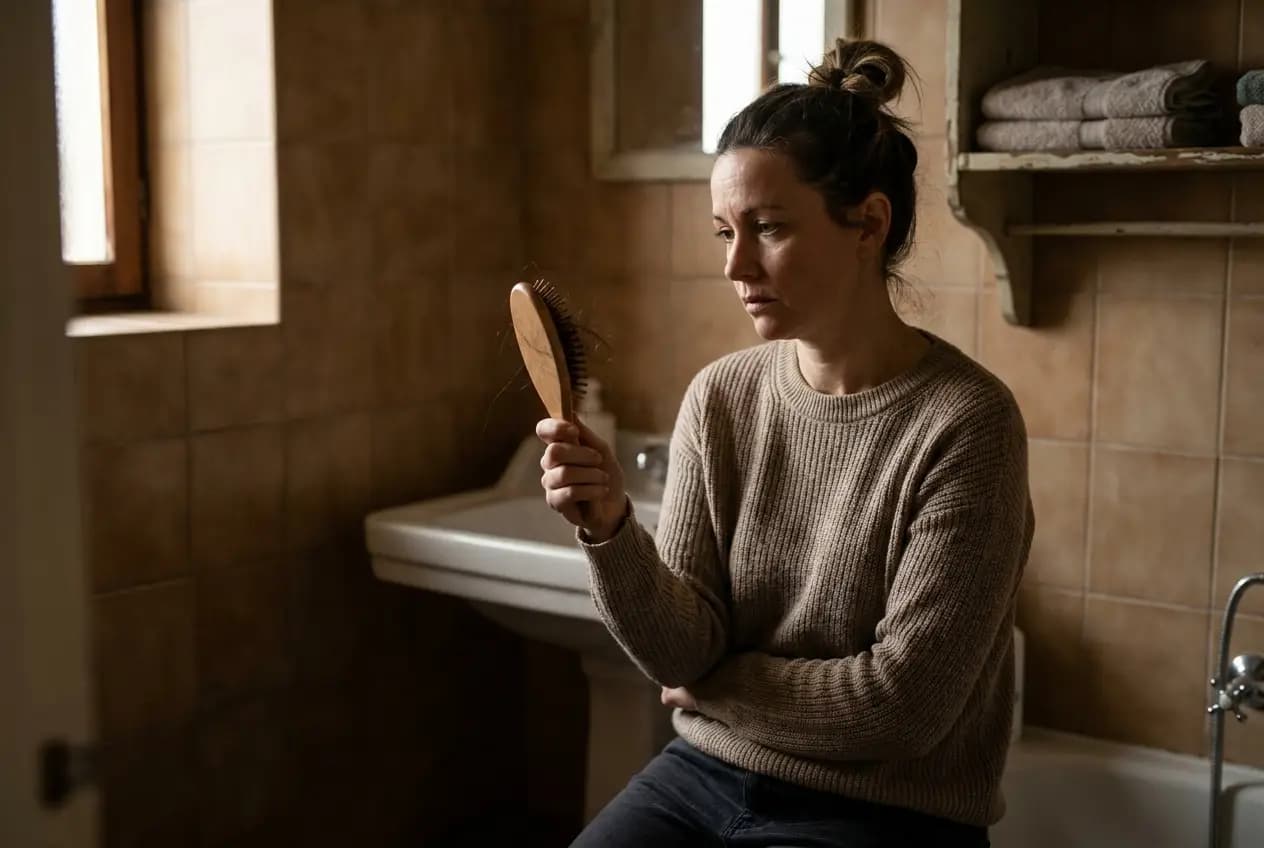
If you are finding more hair in the shower drain or on your brush, and your part looks wider than it used to, your thyroid may be part of the story. Both an underactive and an overactive thyroid can affect your hair, and the pattern is usually different from the bald patches people often picture.
Can a thyroid problem cause hair loss?
Yes. Your thyroid hormones help regulate metabolism in nearly every tissue, including the cells that grow hair. When thyroid levels are too low or too high for long enough, the hair growth cycle can be disrupted. The result is typically diffuse thinning — hair gets sparser fairly evenly across the whole scalp — rather than distinct patches of baldness.
This kind of shedding is often a form of telogen effluvium, where a larger-than-usual share of hairs shift from the growing phase into the resting and shedding phase at the same time. You may notice it most as a thinner ponytail, more scalp showing through, or handfuls of hair coming out when you wash or brush.
Hypothyroidism (underactive thyroid) and hair
An underactive thyroid is the more familiar culprit. Alongside other hypothyroidism symptoms — such as fatigue, feeling cold, dry skin, and unexplained weight changes — hair can become dry, brittle, and thin. A classic, though not universal, clue is loss of the outer third of the eyebrows. Many people with low thyroid also notice hair on the scalp feels coarser and breaks more easily.
Most cases of hypothyroidism in women are caused by Hashimoto's thyroiditis, an autoimmune condition. If you also have hair changes, it is worth knowing that other autoimmune conditions can occasionally cluster together, which is one reason a clinician may want to assess the whole picture.
Hyperthyroidism (overactive thyroid) and hair
It surprises many people that an overactive thyroid can also thin your hair. With hyperthyroidism symptoms — a racing heart, anxiety, weight loss, and heat intolerance — the metabolism speeds up, and hair may become fine, soft, and noticeably sparse. The autoimmune form, Graves' disease, is a common cause. Here too the loss tends to be diffuse across the scalp rather than patchy.
The menopause overlap
This is where things get genuinely confusing for women in midlife. Falling estrogen around perimenopause can also thin hair — see our guide to menopause hair loss — and thyroid disease becomes more common with age. So both can be happening at once, and their symptoms blur together. Fatigue, weight change, low mood, and thinning hair can come from a struggling thyroid, from hormonal change, or from both.
That is why self-diagnosis is unreliable. Our article on thyroid or menopause walks through how to tell them apart, but the short version is simple: get your thyroid checked with a blood test rather than guessing.
What about PCOS and male-pattern thinning?
Androgen-driven hair loss — seen in PCOS and in classic female- or male-pattern thinning — looks different. It tends to concentrate at the crown and along the part (in women) or the temples and hairline (in men), rather than shedding evenly everywhere. Recognising the pattern helps your clinician work out the cause.
Will my hair grow back?
Here is the encouraging, honest part: thyroid-related hair loss usually does grow back once the thyroid is properly treated and your levels are stable. Because the hair cycle is slow, regrowth typically takes several months after treatment begins, and the shedding may even seem to continue briefly before it settles.
A few honest caveats:
- Regrowth is common but not guaranteed for everyone, especially if other factors (genetics, menopause, low iron) are also at play.
- For hypothyroidism, the established treatment is levothyroxine; for an overactive thyroid, treatment is decided by a clinician. No diet or supplement "cures" the thyroid.
- If you notice extra shedding in the first weeks of starting or adjusting thyroid medication, tell your clinician — it is often temporary, but worth flagging.
Thyroid vs other common causes of hair loss
| Cause | Typical pattern | Other clues |
|---|---|---|
| Thyroid (under- or overactive) | Diffuse thinning over whole scalp; sometimes outer eyebrows | Fatigue, weight or temperature changes, dry or fine hair |
| Menopause / low estrogen | Overall thinning, wider part | Hot flashes, irregular periods, sleep changes |
| PCOS / androgens | Crown and part (women); hairline and temples | Acne, extra facial or body hair, irregular cycles |
| Iron deficiency | Diffuse shedding | Tiredness, low ferritin on testing |
| Telogen effluvium (stress, illness, childbirth) | Sudden diffuse shedding 2–3 months after a trigger | Recent illness, surgery, crash diet, or major stress |
| Patchy / circular bald spots | Distinct round patches (alopecia areata) | Needs separate evaluation by a clinician |
What helps while you wait for regrowth
- Treat the thyroid first. The single most effective step is getting the thyroid diagnosed and corrected. Start with thyroid testing (a TSH blood test, often with free T4) rather than self-treating.
- Check iron and protein. Low ferritin (iron stores) is a common, treatable contributor to shedding, and hair needs adequate dietary protein to grow. Ask whether your iron should be checked.
- Be gentle with your hair. Avoid tight ponytails, excessive heat styling, and harsh chemical treatments. Use a wide-tooth comb on wet hair and let the existing hair recover.
- Manage stress. Significant stress can trigger its own telogen effluvium and may worsen the picture — our guide to cortisol and stress in midlife covers practical steps.
- Skip the iodine "fix." Do not start iodine supplements to "boost" your thyroid; too much iodine can actually harm thyroid function. Let testing guide treatment instead.
When to talk to a healthcare provider
Hair shedding is extremely common and often resolves, but you should see a clinician and request thyroid testing if:
- Hair loss is persistent, sudden, or rapidly worsening, or your part is visibly widening.
- You have other possible thyroid symptoms — fatigue, weight or temperature changes, a racing heart, low mood, or loss of the outer eyebrows.
- You notice sudden, patchy, circular bald spots, which point to a different cause (such as alopecia areata) and need separate evaluation.
- You are in perimenopause and unsure whether your symptoms are hormonal, thyroid-related, or both.
Thyroid disease is diagnosed by a blood test, not by symptoms alone — so the most useful thing you can do is get tested. If a thyroid problem is found and treated, there is good reason to expect your hair to recover with time.
Related: Thyroid is one of several causes. Hair Loss in Women: Causes and Evidence-Based Treatments covers the full picture, from ferritin to female-pattern loss.