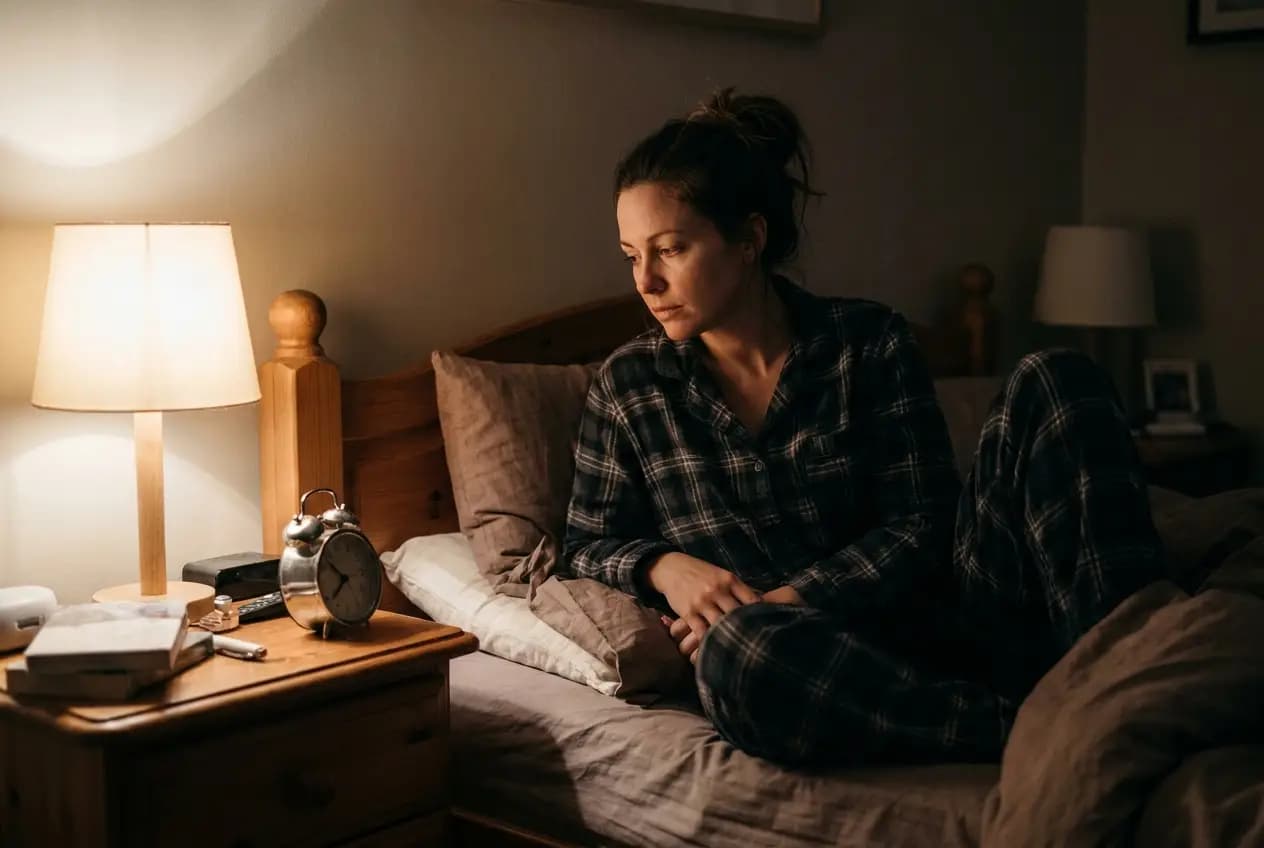
Menopause insomnia is rarely one problem. Typically several things run at once: hot flashes and night sweats jolt you awake, falling progesterone removes a mild natural sedative, an activated stress response turns a 2-minute awakening into a 90-minute one, and the odds of obstructive sleep apnea and restless legs both climb after midlife. Cognitive behavioral therapy for insomnia (CBT-I) is the recognised first-line treatment for chronic insomnia — the American College of Physicians recommends every adult with chronic insomnia get it before a sleeping pill is considered — and it works even when hot flashes are part of the picture. But CBT-I can't unblock an airway or cool a hot flash, which is why treating vasomotor symptoms and screening for apnea belong in the same plan.
In the Study of Women's Health Across the Nation (SWAN), 37% of more than 12,000 women aged 40–55 reported difficulty sleeping, and the rate climbed as women moved deeper into the transition — late perimenopause is the worst stretch for most. If your sleep fell apart in your forties and never came back, you are not doing anything wrong.
Why does menopause break sleep?
Night sweats wake you before you feel them
As estrogen falls, the brain's thermoregulatory "comfort zone" narrows — a tiny rise in core temperature that you'd never have noticed at 35 now triggers a full heat-dump response: vasodilation, sweating, heart rate spike. In sleep-lab studies the arousal often precedes the flash by a couple of minutes, which is why many women wake with a pounding heart and only then feel the heat. You don't need a soaked nightshirt to lose sleep to vasomotor symptoms; you need dozens of micro-arousals you never fully register. See menopause night sweats and hot flashes.
Progesterone was doing quiet work
Progesterone is metabolised into allopregnanolone, which acts on GABA-A receptors — the same broad system that sedatives target. As cycles become erratic and anovulatory, that mild endogenous sedative effect becomes unreliable. Subjectively it feels like sleep got thinner: you're still asleep, but a car door or a partner turning over now ends the night.
The 3 a.m. wake-up: arousal, not "high cortisol"
Cortisol naturally begins rising in the second half of the night. Add a hot flash, a full bladder, or a worry, and the stress system finishes the job — heart rate up, mind fully online, and then the meta-worry ("I have to be up in three hours") that keeps you there. This is conditioned arousal, and it's the part that CBT-I is specifically built to break. Be sceptical of direct-to-consumer saliva "cortisol panels" sold as an explanation: they don't diagnose insomnia and rarely change management. More on the real biology in cortisol and sleep and cortisol and stress explained.
Restless legs and sleep apnea: the two most-missed causes
Restless legs syndrome — a crawling, need-to-move urge in the legs that gets worse in the evening and eases with movement — is more common in women and is often linked to low iron stores. It's worth asking a clinician for iron studies including ferritin, not just a haemoglobin check, because iron can look "normal" while brain iron stores are low.
Obstructive sleep apnea (OSA) is the bigger blind spot. Risk rises sharply after menopause: in the Wisconsin Sleep Cohort, postmenopausal women had roughly 2.6 times the odds of sleep-disordered breathing (and 3.5 times the odds of the more severe form) compared with premenopausal women, even after adjusting for age, body habitus and smoking. Women's OSA also presents differently: the NHLBI notes that instead of the stereotype of loud snoring and witnessed pauses, women more often report insomnia, fatigue, morning headache, anxiety and low mood — which is exactly how they end up treated for insomnia or depression while the airway problem goes unaddressed. See sleep apnea in women.
| What your night looks like | Likely driver | Sensible next step |
|---|---|---|
| Wake hot, damp, heart pounding; kick covers off, then can't resettle | Vasomotor symptoms (night sweats) | Cooling protocol + discuss VMS treatment (hormonal or non-hormonal) |
| Fall asleep fine but wake 3–5x; wake unrefreshed; morning headache; up to pee 2+ times; snoring or gasping | Possible obstructive sleep apnea | Ask for a sleep study (home test or lab) before assuming it's "just menopause" |
| Crawling/urge-to-move legs in the evening, relieved by walking, worse when still | Restless legs syndrome | Clinician review + iron studies including ferritin |
| Lie awake 45+ min, mind racing; dread bedtime; sleep fine on holiday | Conditioned arousal / psychophysiological insomnia | CBT-I — this is its bullseye |
| Waking at 4 a.m. with low mood, no interest in things you used to enjoy | Possible depression (or both) | Talk to a clinician; don't self-treat with sleep aids |
What actually helps — ranked honestly
| Approach | What it does | Evidence | Honest note |
|---|---|---|---|
| CBT-I | Retrains the bed–wakefulness association; consolidates sleep with a scheduled sleep window | Strong — first-line for chronic insomnia | In the MsFLASH trial of women with hot flashes, telephone-delivered CBT-I cut insomnia severity scores by 9.9 points versus 4.7 for menopause education — roughly double. Worth knowing: it did not reduce how frequent or severe the flashes were; it reduced how much they interfered with daily life |
| Treating the hot flashes (menopausal hormone therapy) | Removes the arousal trigger; systemic estrogen is the most effective VMS treatment available | Strong for VMS; moderate for sleep, and mostly via VMS relief | Not a stand-alone insomnia drug. Benefit–risk is most favourable for women under 60 or within 10 years of menopause — a decision for you and your clinician, based on your history |
| Non-hormonal prescription options for VMS | Low-dose paroxetine (the only FDA-approved antidepressant for hot flashes), gabapentin (often used off-label for night-time flashes), and neurokinin-receptor antagonists such as fezolinetant and elinzanetant | Moderate | Real options if hormones aren't suitable. See HRT vs antidepressants for menopause |
| Treating sleep apnea | Keeps the airway open, so sleep stops fragmenting | Strong — if you have it | No amount of sleep hygiene or magnesium fixes an airway. Insomnia and apnea frequently coexist; both need treating |
| Cooling strategies | Reduces the temperature load that triggers flashes and helps you resettle faster | Moderate (mechanistic + practical) | Low cost, no downside — but rarely enough alone for severe VMS |
| Regular exercise, including strength work | Improves sleep quality modestly; protects muscle, bone and daytime energy | Moderate | Not a sedative. Do it for function and bone; take better sleep as a bonus. See strength training for women |
| Magnesium | May help if your intake is genuinely low | Limited/weak | Trials are small and mostly in older adults. It does nothing for hot flashes. Glycinate/citrate are gentler than oxide. RDA for women 31+ is 320 mg/day; the tolerable upper limit for supplemental magnesium is 350 mg/day |
| Melatonin | Shifts circadian timing; mild help falling asleep | Weak for staying asleep | It's a timing signal, not a sedative — it won't hold you asleep through a night sweat. Product content is notoriously inaccurate: one lab analysis of 31 supplements found actual melatonin ranging from 83% below to 478% above the label. Choose third-party verified |
| Alcohol as a "nightcap" | Speeds sleep onset, then fragments the second half of the night | Consistently unhelpful | Also a common hot-flash trigger. Cutting evening alcohol is one of the highest-yield changes in midlife |
| OTC antihistamine sleep aids (diphenhydramine) | Sedating side effect of an allergy drug | Weak, tolerance builds fast | Anticholinergic; grogginess is common and regular use is discouraged in older adults. Not a long-term plan |
CBT-I you can start tonight
CBT-I isn't relaxation tips. Its active ingredients are stimulus control (the bed means sleep) and sleep restriction/compression (temporarily shrinking time in bed so sleep gets denser). Here's the real protocol:
- Fix your wake time. All seven days. Pick a time you can hold on Sunday too. Everything else anchors to this. Use the sleep calculator to work backwards.
- Keep a one-week sleep diary before you change anything. Estimate total sleep (not time in bed) each night. Don't use a wearable's "sleep score" — your own estimate is what the protocol runs on.
- Set your sleep window: average nightly sleep + 30 minutes, and never below 6 hours. Sleeping 5.5 hours across 8.5 hours in bed? Your window is 6 hours. Count back from your fixed wake time: bedtime is later than you'd like. That's the point.
- Bed is for sleep and sex only. No scrolling, no reading email, no "resting my eyes."
- The 20-minute rule, judged by feel. If you're awake and frustrated, get up. Go to another room, keep lights dim, do something boring (fold laundry, read a dull paperback). Return only when sleepy — not when the clock says so. Turn the clock away from you.
- Build a night-sweat reset: a dry top and a small towel within arm's reach so a flash costs you three minutes, not forty.
- Recalculate weekly. If you slept through 85–90% of your window, move bedtime 15 minutes earlier. Repeat until you find your ceiling.
- Anchor the morning: 10–20 minutes of outdoor light soon after waking, and no caffeine after early afternoon.
Fair warning: weeks 1–2 of sleep restriction make daytime sleepiness worse before it gets better. Don't do it unsupervised if you have untreated sleep apnea, bipolar disorder, a seizure disorder, or you drive for a living. Digital CBT-I programmes exist, and the US Department of Veterans Affairs publishes a free CBT-i Coach app that walks you through the same steps. If anxiety is driving the arousal, finding a therapist is a legitimate first move too.
The cooling protocol
- Bedroom at roughly 16–19°C (60–67°F) — cooler than most people keep it.
- Two thin layers instead of one thick duvet, so you can shed one without waking fully. Sharing a bed? Separate duvets end the thermostat war.
- Moisture-wicking sleepwear plus a spare dry set on the chair.
- A fan aimed at your torso, cold water bedside, and a cool pack under the pillow — flip to the cold side rather than getting up.
- A warm (not hot) shower 60–90 minutes before bed: the rebound in skin blood flow helps core temperature drop.
- Log flashes, alcohol, spicy food and stress for two weeks in the menopause symptom diary — most women find two or three personal triggers they can actually act on.
Should you be assessed for sleep apnea?
Ask for a sleep study — a home sleep apnea test is often enough — if two or more of these are true:
- Snoring, gasping or breathing pauses (even if only your partner noticed, or you sleep alone and don't know)
- Waking unrefreshed despite adequate time in bed
- Morning headaches or a dry mouth on waking
- Getting up to urinate two or more times a night
- High blood pressure that's hard to control, or new atrial fibrillation
- Nodding off while reading, in meetings, or — urgently — while driving
Untreated apnea also blunts CBT-I's benefit, so it's worth ruling out first if any of the above apply. Weight change is one risk factor among many, but plenty of women with OSA are lean — do not let a normal BMI talk you (or a clinician) out of testing.
When to see a clinician
- Chronic insomnia: trouble sleeping three or more nights a week for three or more months. That's a diagnosable condition with a first-line treatment — not a personality trait.
- Any apnea red flags above, or falling asleep at the wheel (this is urgent).
- Restless legs symptoms — ask about iron studies with ferritin.
- Hot flashes that are wrecking your nights: ask specifically about hormonal and non-hormonal options and how they map to your own medical history.
- Low mood, hopelessness, or loss of interest lasting two weeks or more — see depression in women. If you're having thoughts of harming yourself, call or text 988 (US Suicide & Crisis Lifeline) or, in the UK, Samaritans on 116 123 — now, not after you've slept on it.
Bring a two-week sleep diary, your list of medications and supplements (including anything from the supplements section), and the pattern you matched in the table above. Never start or stop a prescription on your own. And for what it's worth: fixing menopause insomnia is usually a stack, not a single lever — a cooler room and CBT-I and the right VMS treatment, in that combination.