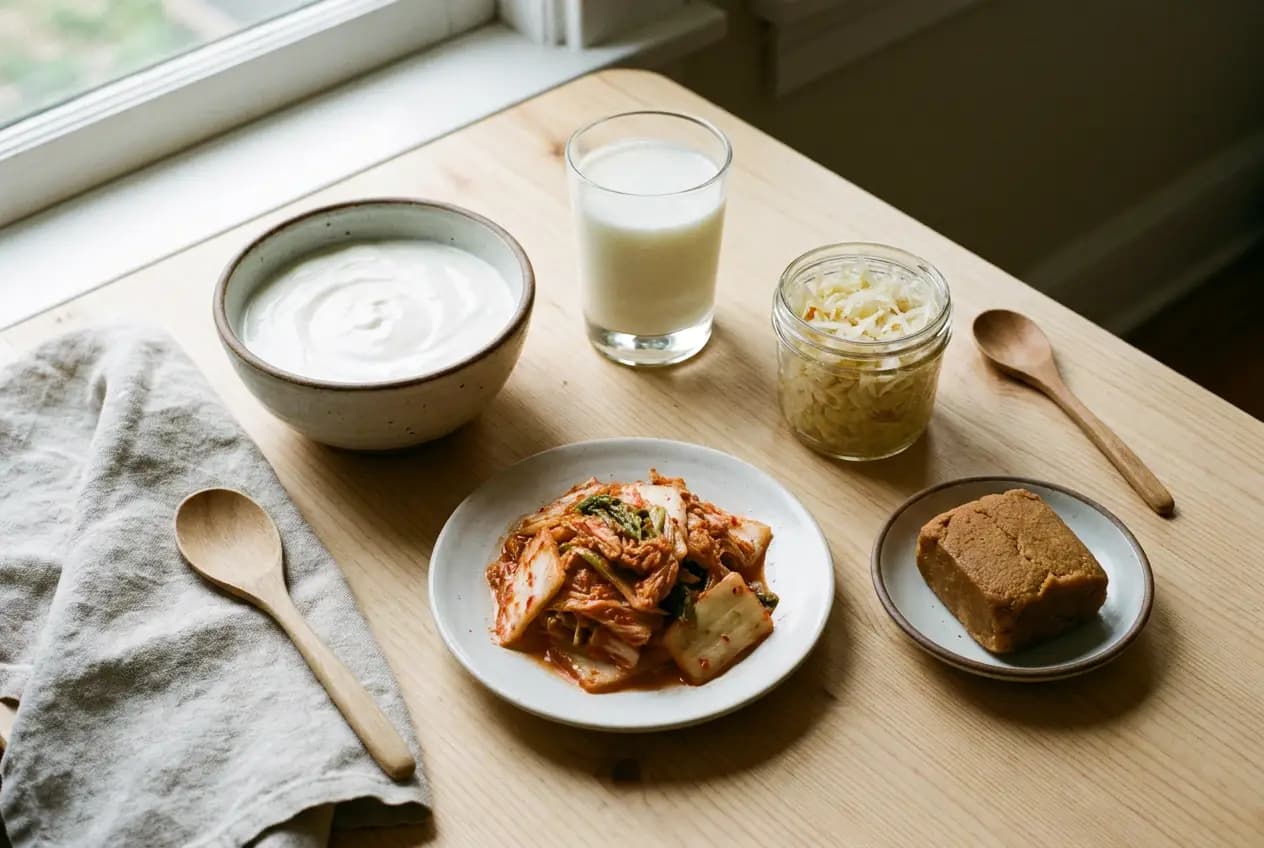
Probiotics — live "good" bacteria found in fermented foods and supplements — are marketed for almost every menopause symptom, from hot flashes to belly fat. The honest picture is narrower but still genuinely useful.
Can probiotics help with menopause?
As estrogen falls during the menopause transition, the balance of bacteria in both the vagina and the gut shifts. That is where probiotics have the most plausible role: supporting vaginal and urinary health and digestion. For hot flashes, weight, mood, and bone, the evidence is early and far weaker. Think of probiotics as a low-risk add-on — not a replacement for proven treatments like vaginal estrogen, and not a fix for the underlying hormonal change that drives most perimenopause symptoms.
The most important thing to understand is that a probiotic's effects are strain-specific. "Lactobacillus" on a label tells you almost nothing; the exact strain — down to the letters and numbers after the species name — is what has (or hasn't) been studied.
Where probiotics may genuinely help
Vaginal and urinary health
A healthy vaginal microbiome is dominated by Lactobacillus bacteria, which produce lactic acid and keep the vagina slightly acidic and protective.[4] As estrogen drops in menopause, Lactobacillus levels fall, the pH rises, and the tissue thins — a cluster of changes clinicians call genitourinary syndrome of menopause.[3] Women then become more prone to bacterial vaginosis (BV), irritation, and recurrent urinary tract infections.
Specific oral strains — the most studied are Lactobacillus rhamnosus GR-1 and Lactobacillus reuteri RC-14 — have reasonable evidence for helping prevent recurrent BV and UTIs when taken alongside standard care. They don't replace vaginal estrogen for dryness and tissue changes, but they are a low-risk complement.
Gut health, bloating, and digestion
Hormone changes can slow gut transit and worsen bloating and irregularity. Probiotics — and the fiber that feeds them — may modestly help some people with bloating and IBS-type symptoms. Results are very individual: a strain that helps one person does little for another, so it is reasonable to try one for 4–8 weeks and judge by how you actually feel.
Best probiotics for menopause: matching strain to goal
Because evidence is strain-specific, the useful question isn't "which brand is best" but "which strain fits my goal." This table summarizes where the evidence is strongest.
| Goal | Best-studied strains | Strength of evidence |
|---|---|---|
| Recurrent BV / vaginal balance | L. rhamnosus GR-1 + L. reuteri RC-14 | Moderate — as an add-on, not a cure |
| Recurrent UTIs | L. rhamnosus GR-1 + L. reuteri RC-14 | Modest, mixed |
| Bloating / digestion | Lactobacillus + Bifidobacterium blends | Variable, individual |
| Bone loss | L. reuteri ATCC PTA 6475 | Preliminary, small trials |
| Hot flashes / weight | No strain has good evidence | Weak / not established |
Where the evidence is weak (despite the marketing)
- Hot flashes: There is scientific interest in the "estrobolome" — gut bacteria that help recycle estrogen — but no good evidence yet that probiotics reduce hot flashes or night sweats.
- Weight and belly fat: Studies are early and inconsistent; probiotics are not a reliable tool for menopause weight changes.
- Bone: A few small trials (for example of L. reuteri ATCC PTA 6475) hint at slowed bone loss in older women, but this is preliminary, not established — proven steps like calcium and vitamin D and weight-bearing exercise come first.
- Mood and sleep: "Psychobiotic" research linking gut bacteria to mood is promising but still early, and probiotics are not a treatment for menopause insomnia.
None of these are reasons to avoid probiotics — just reasons not to expect a hormonal fix from them.
How to choose a probiotic
- Look for named strains, not just "probiotic blend." Evidence is strain-specific, so the exact strain (for example, L. rhamnosus GR-1) matters far more than the genus on the label.
- Check the CFU count (colony-forming units, usually in the billions) and whether the product needs refrigeration to stay viable through its expiry date.
- Match the strain to your goal using the table above — GR-1 and RC-14 for vaginal and urinary health; Lactobacillus and Bifidobacterium blends for general gut support.
- Food first is reasonable. Yogurt with live cultures, kefir, and other fermented foods provide probiotics plus nutrients, and a menopause-friendly diet or Mediterranean pattern already leans this way.
- Choose reputable brands with third-party testing, since supplements aren't tightly regulated and label claims aren't verified before sale.
How to take probiotics — and how long
Most probiotics are taken once daily, and any benefit depends on continued use — the effect fades when you stop, because supplemented strains don't permanently colonize the gut.[1] Give a product a fair trial of about 4 to 8 weeks for digestive goals, and longer if you're using GR-1 and RC-14 to reduce recurrent infections. Mild gas or bloating in the first week is common and usually settles. If nothing has changed after two months, switching strains is more sensible than raising the dose.
Safety and who should be cautious
Probiotics are generally very safe for healthy people; the main side effect is temporary gas or bloating as the gut adjusts. More caution is warranted if you are seriously ill, immunocompromised, being treated for cancer, or have a central venous catheter — check with a clinician first, as rare serious infections have been reported in these groups.[2] Probiotics are a supplement, not a drug, so they shouldn't replace antibiotics when those are genuinely needed. For how they compare with other options, see our overview of the best supplements for menopause.
What the latest evidence synthesis actually found
Individual probiotic studies are easy to cherry-pick, so the more honest question is what happens when researchers pool them. The most recent systematic review on this is worth knowing about before you buy anything.
Tsuboi and colleagues, writing in Maturitas in 2026, pooled nine studies covering 751 postmenopausal women — five of them randomised controlled trials — looking at Lactobacillus-based probiotics for genitourinary syndrome of menopause.[s1] Their findings contain a distinction that matters enormously for anyone standing in a supplement aisle:
| Route | What the pooled evidence showed | What that means for you |
|---|---|---|
| Intravaginal Lactobacillus | A preventive effect for recurrent cystitis in single-arm and prospective cohort studies — but the randomised trials showed mixed or negative results compared with antibiotic prophylaxis. | The more promising route, but not established as better than existing treatment. |
| Oral capsules (what most “menopause probiotics” are) | Evidence described as limited and heterogeneous — the weaker of the two routes in this review. | This is the format almost every product marketed for menopause uses, and it is the one with less supporting evidence. |
The authors' own conclusion is measured: Lactobacillus-based interventions “may represent a complementary therapeutic option for selected women,” with the evidence limited by heterogeneity in study design, formulations, and routes of administration. They call for better randomised trials, particularly of intravaginal formulations.
Read that honestly and it reframes the whole question. The pooled evidence does not support any oral probiotic as a proven treatment for menopause symptoms — it supports it as a reasonable complement for some women, with the strongest signal in a delivery route that most products on the shelf do not use. That is a very different claim from the one on the front of the box, and it is why we recommend by label honesty and verified quality rather than by promised results.
Products we could verify in an independent registry
Most “best probiotic” lists name products the writer never checked. We do the opposite: below are the only menopause-relevant probiotics we could confirm on a public third-party registry as of 18 July 2026. We have not tested them, we hold no relationship with these brands, and this is not a ranking — it is simply the short list of products whose quality claims someone independent has actually checked.
| Product | Independent check | What that does — and doesn’t — mean |
|---|---|---|
| Culturelle Digestive Daily Probiotic (vegetarian capsules) | USP Verified | USP confirmed it contains the organisms and amounts on the label, dissolves properly, and is free of harmful contaminants. It does not mean USP judged it effective for menopause symptoms. |
| trunature Women’s Daily Probiotic Capsules | USP Verified | Same verification standard. A women’s-marketed formula, but “for women’’ on the label is a marketing choice, not a verified clinical claim. |
The honest caveat that matters most: third-party verification tells you the bottle contains what it says. It does not tell you the strains inside were studied for hot flashes, vaginal health, or bone density — and for menopause specifically, strain-level evidence is still thin. If a particular strain matters for your goal, that is a separate question from whether the product is honestly labelled, and both are worth asking.
You can check any product yourself: search the USP Verified products listing or the NSF certified dietary supplements database. Both are free, public, and updated continuously — which is why we cite them instead of asking you to trust our word.
When to see your doctor
Probiotics can support vaginal, urinary, and digestive health, but they shouldn't delay care that works. See a clinician for recurrent UTIs or bacterial vaginosis, or for persistent vaginal dryness, burning, or irritation — where low-dose vaginal estrogen is far more effective. Also get medical advice for symptoms of an active infection (fever, back or flank pain, foul-smelling discharge) and for ongoing changes in digestion or bowel habits. Most importantly, any vaginal bleeding after menopause needs prompt evaluation — it is never something to self-treat with a supplement.
Related: To understand why the microbiome shifts during this stage and where probiotics fit in, see Menopause and Gut Health: Bloating, the Microbiome, and What Helps.