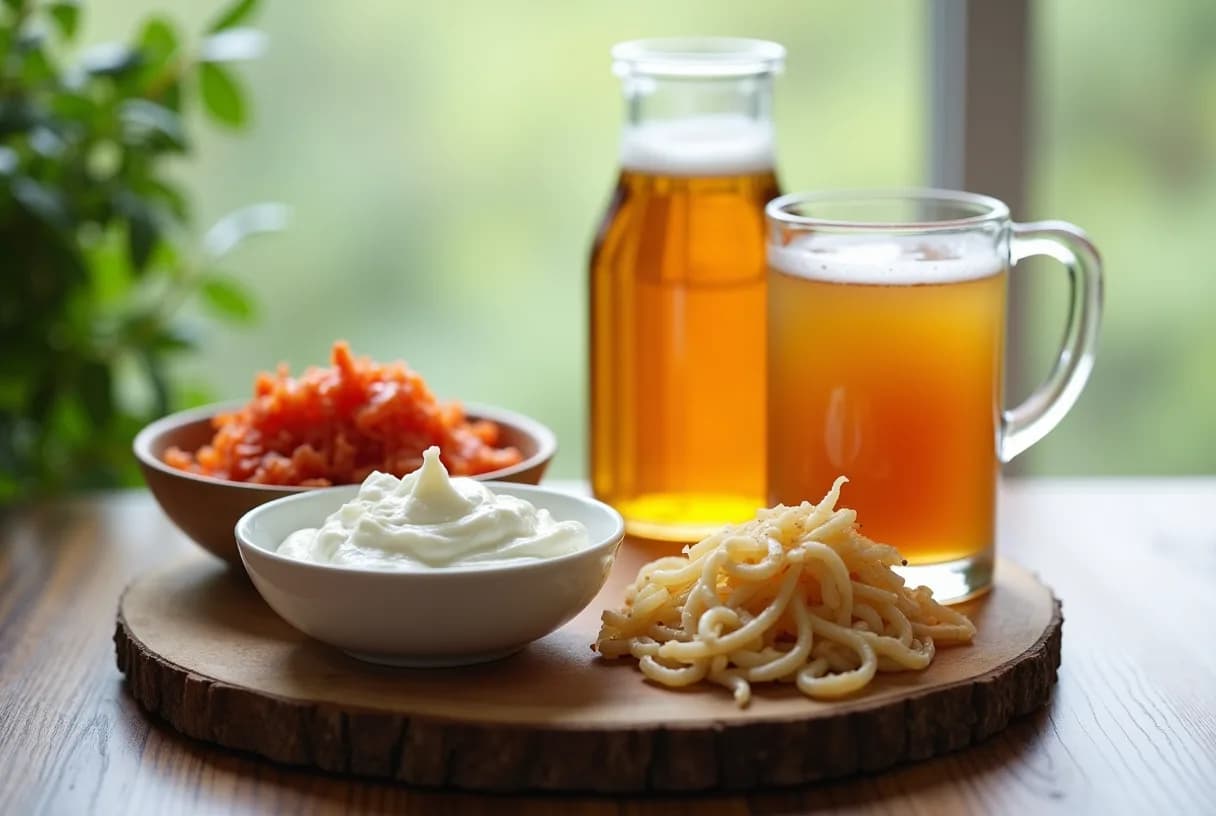
The best probiotic foods are fermented foods that still contain live, active cultures: yogurt and kefir, sauerkraut and kimchi, miso and tempeh, kombucha, and traditional pickles fermented in brine rather than vinegar. To actually get the microbes, choose refrigerated versions labeled "live and active cultures" — heat, canning, and standard pasteurization destroy the bacteria that make these foods worth eating.
Yogurt gets all the attention, but it's just one door into a much bigger, more interesting world of fermented food — most of which humans have eaten for thousands of years. This guide covers what genuinely qualifies as a probiotic food, how those foods differ from the prebiotic fiber that feeds your gut, what the science does and doesn't support, and how to work them into your day without spending it doubled over with gas. For the wider picture on eating for your gut and hormones, see our nutrition guides.
What makes a food a "probiotic food"?
Probiotics are live microorganisms — mostly bacteria, sometimes yeasts — that may offer a health benefit when you eat enough of them. A food earns the "probiotic" label when live cultures are still present and viable by the time it reaches your gut. That's the whole game, and it's where most supermarket products quietly fall short.
Fermentation is how these microbes get there. Bacteria and yeasts feed on the sugars in milk, vegetables, or soybeans and produce acids that preserve the food and give it that characteristic tang. The catch: many fermented foods are heated, canned, or pasteurized after fermenting to extend shelf life, which kills the very cultures you're after. Shelf-stable sauerkraut in a can, most bread, beer and wine, and vinegar-brined pickles are fermented — but they carry no live probiotics. This is why the phrase "live and active cultures," "raw," or "unpasteurized," plus refrigeration, is the single most useful thing to look for on a label.
The best probiotic foods beyond yogurt
Different foods carry different microbes, and variety may matter more than any single "super" food. Here's how the main players compare and how to make sure you're getting the live version.
| Food | What it is | Notable microbes & notes | Tips to get live cultures |
|---|---|---|---|
| Yogurt | Milk fermented by bacterial cultures | Lactobacillus and Streptococcus thermophilus; the most familiar, easy-to-tolerate source | Look for "live and active cultures"; plain versions skip the added sugar |
| Kefir | A tangy, drinkable fermented milk | A more diverse mix of bacteria and yeasts than yogurt; often tolerated by people sensitive to lactose | Choose refrigerated and unsweetened; water kefir is a dairy-free option |
| Sauerkraut | Cabbage fermented in its own salty brine | Lactobacillus species; also supplies fiber and vitamin C | Buy refrigerated and "raw/unpasteurized" — shelf-stable canned kraut has no live cultures |
| Kimchi | Korean fermented vegetables (usually cabbage and radish) with spices | Lactobacillus and other lactic-acid bacteria; can be high in sodium | Refrigerated versions are live; use less if you're watching salt |
| Miso | A savory paste of fermented soybeans | Cultured with koji mold (Aspergillus oryzae) plus bacteria; salty and umami-rich | Stir into food off the heat — boiling kills the microbes; a little goes a long way |
| Tempeh | A firm, nutty cake of fermented whole soybeans | Fermented with Rhizopus mold; high in protein and fiber | Usually cooked (which lowers live cultures) but stays a nutrient-dense, gut-friendly protein |
| Kombucha | Lightly fizzy fermented tea | Made with a "SCOBY" — a symbiotic culture of bacteria and yeast | Look for "raw/unpasteurized"; watch the added sugar and go easy at first |
| Brine-fermented pickles | Cucumbers fermented in salt water, not vinegar | Lactobacillus species; only naturally fermented pickles count | Look for "fermented" and refrigeration — vinegar pickles contain no probiotics |
| Natto & some aged cheeses | Fermented soybeans (natto) and aged, raw-milk cheeses like Gouda or cheddar | Natto supplies Bacillus subtilis and vitamin K2; certain aged cheeses carry live cultures | Labels reading "live cultures" or "aged, raw milk" are your clue |
No single food is "best." Kefir and traditional yogurt tend to be the easiest starting points; sauerkraut and kimchi add fiber and plant variety; miso and tempeh work well in savory, plant-forward meals. Rotating a few is more useful than fixating on one.
Probiotics vs prebiotics: what's the difference?
People mix these up constantly, and the distinction is genuinely useful. Probiotics are the live microbes. Prebiotics are the food those microbes eat — specific types of fiber your own body can't digest, which pass through to your large intestine and fuel the beneficial bacteria already living there. Your gut bacteria (your "microbiome") help finish digestion and even make some vitamins, so feeding them matters as much as adding new ones.
| Probiotics | Prebiotics | |
|---|---|---|
| What it is | Live beneficial bacteria and yeasts | Fibers your body can't digest |
| What it does | Adds helpful microbes to your gut | Feeds the good microbes already there |
| Where you get it | Yogurt, kefir, sauerkraut, kimchi, miso, kombucha | Onions, garlic, leeks, oats, bananas, beans, asparagus |
You want both. Probiotic foods introduce microbes; prebiotic fiber keeps them fed and thriving. Easy prebiotic wins include oats, chia seeds, beans, and onions. If your everyday fiber intake is low, a gradual increase from food is the goal — a fiber supplement is a backup, not a substitute for plants.
Do probiotic foods actually work? An honest look at the evidence
Here's the part the marketing skips: the science is promising but genuinely mixed, and highly individual. Reviewers at the NIH and NHS describe much of the research as limited or inconsistent, and effects appear to be strain-specific — the microbes that help one person's symptom may do nothing for another's.
What has the most support is fairly narrow. There's reasonable evidence that certain probiotics ease some symptoms of irritable bowel syndrome, and they may help restore gut bacteria after a course of antibiotics or a bout of infectious diarrhea. Many people also find fermented foods help with bloating or irregularity — but that's often personal experience, not a guarantee the science can promise you.
Where claims get ahead of the evidence: fermented foods are not a proven fix for weight, mood, immunity, skin, or "detoxing." And they are not a treatment for so-called candida overgrowth — restrictive "candida cleanses" aren't supported by good evidence, and we'd steer you toward a clinician over an internet protocol; see what candida overgrowth actually means. The honest takeaway: probiotic foods are a low-risk, nutritious habit that may help your gut, worth trying while keeping expectations realistic.
How do I start eating probiotic foods without upsetting my stomach?
Adding fermented foods too fast is the most common reason people quit — a sudden flood of new microbes and fiber can trigger gas, bloating, and cramps. Ease in:
- Start small. A couple of tablespoons of sauerkraut or kimchi, half a cup of kefir, or a small glass of kombucha is plenty on day one.
- Build up over one to two weeks. Increase gradually as your gut adjusts; a little transient gas early on is normal and usually settles.
- Pick foods you'll actually enjoy. The best probiotic food is the one you'll eat consistently — stir miso into soup, spoon kraut onto eggs, blend kefir into a smoothie.
- Pair with prebiotic fiber and water. Feeding the microbes and staying hydrated helps everything run more smoothly.
- Give it a few weeks before judging. Benefits, if they come, are gradual — try a food for four to eight weeks and go by how you actually feel. Our how-long-until-it-works tool sets realistic timelines.
Food-first is a sensible default because fermented foods deliver microbes plus fiber, protein, and vitamins. If you'd rather use a supplement — or want named strains for a specific goal — compare options in our best probiotics for women roundup, and see the honest breakdown of probiotics for women.
A note for women at midlife
Gut health takes on an extra dimension in perimenopause and menopause. As estrogen falls, the balance of bacteria in both the gut and the vagina shifts, which can nudge digestion, bloating, and vaginal and urinary comfort. Researchers are actively studying the "estrobolome" — gut bacteria involved in recycling estrogen — though it's early science, not a reason to expect fermented foods to fix hormonal symptoms.
What's fair to say: probiotic foods are a low-risk, nutrient-dense addition at this stage, not a replacement for proven care. For the deeper dive, see menopause and gut health and, if you're weighing supplements, the best probiotics for menopause and what the evidence actually shows.
When to see a doctor
Fermented foods are a wellness habit, not a diagnostic tool. Check in with a clinician if you have:
- Persistent bloating, pain, or a lasting change in bowel habits, or blood in your stool
- Unexplained weight loss, ongoing diarrhea, or symptoms that keep disrupting daily life
- Recurrent urinary or vaginal infections, or any bleeding after menopause — always get this evaluated
- A weakened immune system, a serious illness, or a central venous catheter — check before adding probiotics or fermented foods, as they carry more risk in these situations
Probiotic foods can support a healthy gut, but they shouldn't delay care for symptoms that need a proper look.