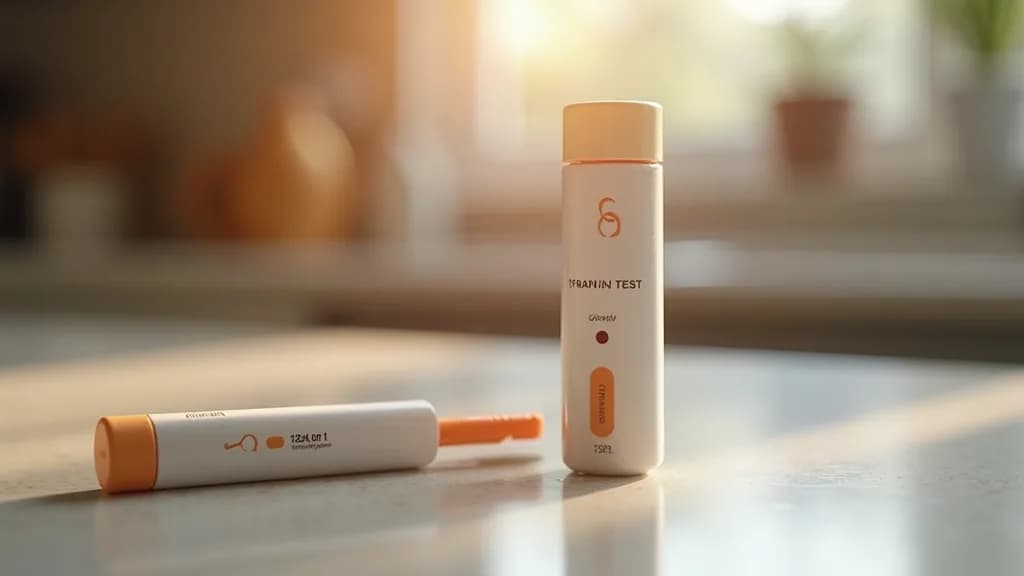
At-home vitamin D tests let you collect a few drops of blood from a finger prick, mail the sample to a lab, and get back a number for 25-hydroxyvitamin D — the same marker a clinic measures to judge your vitamin D status. For screening purposes they are reasonably reliable and genuinely convenient. But a number on a screen is not a treatment plan: the most important rule is that you interpret a low result, and correct it, with a clinician rather than reaching for high-dose capsules on your own.
This guide walks through how these kits work, who is most likely to benefit from checking, how to read the deficient–insufficient–sufficient bands at a high level, how home tests compare with a standard lab draw, and where their honest limits lie. If you want the bigger picture on why this nutrient matters in midlife, see our companion explainer on vitamin D for women.
What an at-home vitamin D test actually measures
Vitamin D circulates in several forms, but the one that best reflects your overall stores is 25-hydroxyvitamin D, often written as 25(OH)D. Your liver makes it from the vitamin D your skin produces in sunlight and from what you eat or supplement. Because it stays in the blood for weeks, it is the standard status marker used by the NIH Office of Dietary Supplements and clinical guidelines alike.
A home kit does not measure this any differently in principle — it just changes how the blood is collected. Instead of a vein draw, you use a small lancet to fill a collection card or microtube with a few drops from your fingertip. Some newer services use an upper-arm device that collects a slightly larger volume. You register the kit, mail it in a prepaid envelope, and a laboratory runs the assay and posts your result to a secure portal.
| Feature | At-home finger-prick | Clinic venous draw |
|---|---|---|
| Sample | Few drops, blood spot or microtube | Vial of blood from a vein |
| Marker measured | 25-hydroxyvitamin D | 25-hydroxyvitamin D |
| Where it's done | Your kitchen table | Lab or clinic |
| Result interpreted by | You, ideally with a clinician | Your clinician |
| Best for | Screening, tracking a trend | Diagnosis, symptoms, follow-up care |
Who is most likely to benefit from testing
Most people with reliable sun exposure and a varied diet do not need routine vitamin D testing. Checking makes more sense when you have reasons to suspect low levels or when a low level would change what you do. The NHS and NIH highlight several groups at higher risk:
- People who spend little time outdoors, or who cover most of their skin
- Those with darker skin, which produces vitamin D more slowly from sunlight
- Adults over 65, whose skin synthesizes less
- People living at higher latitudes through winter months
- Anyone with a condition affecting fat absorption, such as celiac or inflammatory bowel disease, or a history of weight-loss surgery
- People with osteoporosis or bone-health concerns, where status genuinely guides care
For midlife women, bone density and vitamin D often come up together around menopause. Testing can be a reasonable way to see where you stand — but it is a starting point for a conversation, not a verdict on its own.
How to read your result: the broad bands
Results usually arrive in nanomoles per litre (nmol/L) in the UK or nanograms per millilitre (ng/mL) in the US, and most kits label your number as deficient, insufficient, or sufficient. Exact cut-points vary between guidelines, and there is real debate among experts about where the lines sit, so treat these as a general orientation rather than a strict scoring rubric:
- Deficient — clearly low; the level most associated with bone effects, and the one that warrants medical attention.
- Insufficient — a middle zone many labs flag as less than ideal, though its clinical meaning is debated.
- Sufficient / adequate — the range considered adequate for most healthy adults.
Reference ranges can also differ from one laboratory to another, so the exact figure on your report is best read alongside your symptoms, medications, and health history rather than in isolation. Both the Cleveland Clinic and MedlinePlus stress that a single number should be interpreted by a health professional in the context of your overall picture. In other words, the band on your report is a signal to discuss, not a self-diagnosis. Higher is also not automatically better — very high levels carry their own risks, which is why the goal is adequacy, not maximization.
How accurate are home tests versus a lab?
When the finger-prick sample is collected properly and analyzed by an accredited laboratory, home 25(OH)D testing tracks reasonably closely with a conventional venous result — enough to tell whether you are broadly low, borderline, or fine. The bigger sources of error usually sit at the collection step rather than the lab bench:
- Not enough blood on the card or in the tube, which can invalidate the run
- Squeezing the fingertip too hard, which can dilute the spot with tissue fluid
- Delays or heat in transit that degrade the sample
- Assay-to-assay variation — different labs and methods can return slightly different numbers, so mixing providers when tracking over time muddies comparisons
Two practical takeaways follow. First, follow the kit instructions exactly — warm your hands, use the recommended finger, and post the sample promptly. Second, if you are watching a trend over months, try to stick with the same service so the method stays consistent. If a result is surprising, clinically important, or conflicts with how you feel, confirm it with a standard lab test ordered through your clinician.
The honest limits — and one rule that matters most
A home test tells you a number. It cannot tell you why the number is what it is, whether it explains your symptoms, or what to do about it. Fatigue, low mood, and aches have many causes, and a borderline vitamin D reading may be a coincidence rather than the answer. This is why a test complements a clinician's assessment; it does not replace it.
The single most important safety point is this: do not start high-dose or "megadose" vitamin D on the strength of a home result. Vitamin D is fat-soluble, so excess is stored rather than flushed out, and there is a real upper limit. Taking very large amounts over time can push blood calcium too high — a state called hypervitaminosis D — which can cause nausea, kidney problems, and other harm. The Mayo Clinic and NIH both warn that toxicity comes almost entirely from over-supplementing, not from sun or food.
Correcting a genuine deficiency should be clinician-guided. The right dose, form, and duration depend on how low you are, your other medications and conditions, and whether calcium or parathyroid issues are involved — none of which a kit can assess.
A sensible way to use an at-home test, then, is as a screening and monitoring tool: a low-friction way to see roughly where you stand, and a prompt to book a conversation if the result is low or you have risk factors. Bring the report to that appointment. Your clinician can confirm it with a lab draw if needed, check related markers, and recommend a safe, appropriately dosed plan.
How to choose a kit
Because this is a screening test rather than a purchase to obsess over, a short checklist covers most of what matters. Look for a kit whose sample is analyzed by an accredited laboratory that measures 25-hydroxyvitamin D specifically. Prefer clear collection instructions and a return process that gets your sample to the lab quickly. Check that results come with plain-language ranges and, ideally, guidance to review low results with a clinician. Be wary of any product that bundles vitamin D testing with a pre-packaged high-dose supplement regimen — testing and treatment decisions should stay separate.
Finally, remember that no home kit is a substitute for medical care. If you have symptoms that worry you, a bone-health condition, or a result flagged as deficient, that is your cue to see a doctor or pharmacist. For the fuller story on requirements, food sources, and supplementation in midlife, read vitamin D for women.