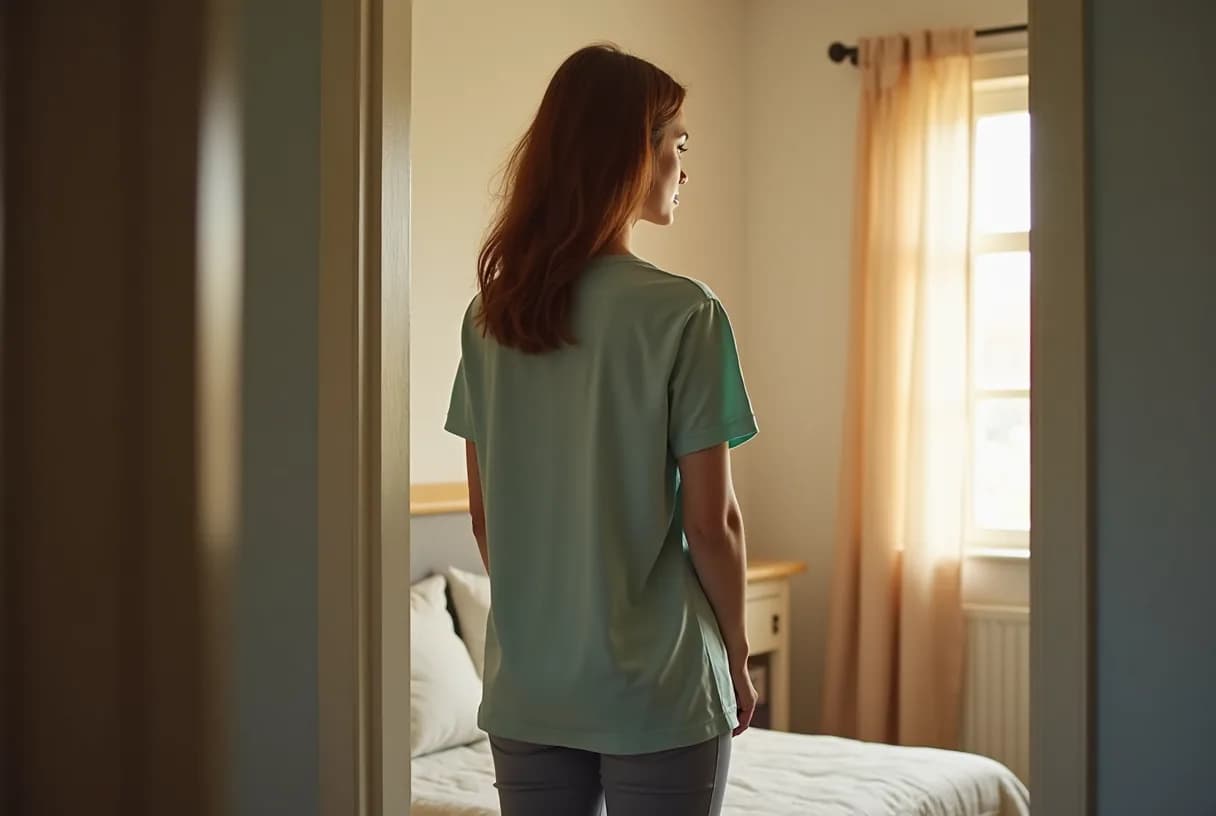
Empty nest syndrome is the grief, disorientation, and loss of daily purpose many parents feel when their last child moves out. It is not a clinical diagnosis — it is not in the DSM-5 — but it is a genuine and well-described transition, and the guilt many women feel about also being relieved is one of its most universal features. The reassuring part: longitudinal research finds the dip is usually temporary, and many parents' wellbeing and marital satisfaction improve after children leave.
What makes this hard to talk about is that two true things sit side by side. The house is quieter and something in you finally exhales. And the person whose breathing you listened for at night is now three states away, and you have no idea what to do at 6pm.
Why it isn't a diagnosis — and why that doesn't make it small
No clinician will write "empty nest syndrome" on your chart. It has no diagnostic criteria and no entry in the DSM-5. If distress is severe enough to need a label, the labels used are adjustment disorder, an anxiety disorder, or major depressive disorder.
That absence is worth understanding rather than resenting. "Not a diagnosis" here means "not a disease" — it does not mean "not real." What you are experiencing is a role transition with several losses stacked into one month: a daily structure, a stream of small purposes, physical proximity to someone you love, and often a large part of how you have introduced yourself for two decades. Grief is the correct response to loss. It does not require a diagnostic code to be legitimate.
Why does empty nest hit women harder?
The research literature is clear that it isn't only mothers who struggle, and it is not universal among mothers either. But several things load the dice.
Identity is more often bound to the caregiving role. Women still perform the majority of the hands-on parenting labour in most households — the appointments, the forms, the emotional monitoring. When that work stops, more of the daily self stops with it. Fathers frequently report the same grief, but often describe it as a loss of connection rather than a loss of role.
The timing collides with perimenopause. A child leaving at 18 puts many mothers somewhere in their mid-forties to mid-fifties — squarely in the menopause transition. This matters mechanically, not just poetically. In the Harvard Study of Moods and Cycles, women with no lifetime history of depression who entered perimenopause were about twice as likely to develop significant depressive symptoms as women who remained premenopausal, even after adjusting for age and for negative life events. The Study of Women's Health Across the Nation (SWAN) points the same way from a different angle: women were two to four times more likely to have a major depressive episode when perimenopausal or early postmenopausal than when premenopausal. Sleep is often already fragmented; anxiety is often already elevated. A hard life event lands on a nervous system with less reserve than usual. If your mood shifts feel out of proportion to the event, read our guides to perimenopause anxiety and menopause mood swings and irritability — the overlap is not a coincidence, and it changes what helps.
It often coincides with other losses. Ageing parents, career plateaus, changing bodies. This is the terrain covered in midlife reappraisal in women, and the empty nest is frequently the event that brings all of it into focus at once.
The relief is normal. Say it out loud.
Many women report a private, slightly shameful pleasure: no more 1am waiting up, no more negotiating over the car, meals that are simply what you feel like eating. Then comes the guilt, which is often worse than the sadness.
Relief is not evidence of deficient love. It is evidence that parenting an adolescent is genuinely effortful and that the effort has ended. Both feelings are reporting on the same fact. Parents who can hold both — grief for what's gone, appetite for what's next — tend to move through the transition faster than those who treat the relief as a moral failing and suppress it.
What the evidence actually says about how this goes
This is where honest reporting is more useful than sympathy. The popular framing of the empty nest as a slide into decline is not what the longitudinal data shows for most people.
Gorchoff, John and Helson's 18-year study of midlife women, published in Psychological Science in 2008, followed women through middle age with assessments in their early forties, early fifties and early sixties. The transition to an empty nest was associated with a significant improvement in marital satisfaction — and, informatively, the improvement ran through greater enjoyment of time with a partner rather than a greater quantity of it. Broader reviews find that most parents experience a temporary sense of loss followed by improved wellbeing, reduced role strain, and a renewed relationship.
Two honest caveats. First, the samples in much of this literature are modest and heavily Western; a 2024 review of the empty-nest literature argues that the loneliness and wellbeing effects differ substantially by cultural context, so the reassuring average may not describe your household. Second, the average conceals real minorities who do badly — particularly couples whose relationship was already strained, where the child was the shared project holding things together, and single parents for whom the departure removes the only other adult presence in the home. If that is you, the population average is not a promise, and it is not a reason to wait it out alone.
One more thing the data quietly says: the nest may not empty on schedule. Pew Research reported in January 2024 that 57% of US adults aged 18–24 were living in a parent's home. Departures are increasingly staggered, reversed, and partial — which can be its own grief, drawn out over years rather than one August afternoon.
| What you might feel | What's underneath it | What tends to help |
|---|---|---|
| Aimless at specific times of day | Loss of structure, not loss of meaning — 6pm was a job | Deliberately fill the hollow slots first: a standing class, a walk, a weekly dinner with someone. Structure before purpose. |
| Grief that arrives in waves | Ordinary bereavement for a real loss | Let it run rather than managing it away. Waves that shorten and space out over weeks are the expected trajectory. |
| Guilt about feeling relieved | A belief that good mothers only grieve | Name the relief to one person who won't flinch. Guilt shrinks fast once it's spoken. |
| Constant worry about their safety | Vigilance with nowhere to land | Agree a realistic contact rhythm together. Checking in on a schedule beats checking up at random. |
| "Who am I now?" | Identity that ran through one role | Return to interests parked years ago, or build one new competence deliberately. Skill-building outperforms rumination. |
| Suddenly alone with your partner | The shared project ended; the relationship needs a new one | Plan things you both actively enjoy, not just co-existence. Enjoyment of shared time is what the research links to improvement. |
| Lonely even around people | Weakened networks after years of child-centred socialising | Rebuild deliberately — friendship doesn't refill on its own. See loneliness and health. |
| Low mood that won't lift at all | Possibly depression rather than adjustment | Get assessed. Talking therapies such as CBT have strong evidence, and treatment decisions are your clinician's to make with you. |
Renegotiating the relationship with your adult child
The most common mistake is trying to keep the old relationship at a distance instead of building a new one. Daily logistics management becomes surveillance when the person is 20 and living independently. Agree explicitly on what contact looks like — many families settle on one predictable call a week plus low-stakes texting — and then hold to it even in the weeks when you want more. Boundaries run both ways. You are allowed to say no to unlimited financial support, to a permanently reserved bedroom, or to being the first call at 2am for a problem they can solve. Adult children generally recalibrate faster than parents expect; the awkward interval is usually months, not years.
What actually helps in the first six months
- Expect an adjustment period and name it. Anticipating three to six unsettled months is protective; expecting to feel fine by week two is not.
- Rebuild routine before you rebuild identity. Meaning tends to follow structure, rarely the other way around.
- Protect sleep aggressively — especially if perimenopausal night sweats are already fragmenting it. Poor sleep amplifies every other symptom on this page.
- Move most days. Exercise has consistent, if modest, effects on depressive symptoms and is one of the few interventions that also helps sleep and bone health at this age.
- Front-load social contact. Make the plans in advance, when you feel capable, for the evenings when you won't.
- Don't make irreversible decisions in month one. Not the house, not the marriage, not the job. Grief is a poor strategist.
When to see a doctor
Normal adjustment moves — bad days interleave with ordinary ones, and the bad days gradually become fewer. Depression doesn't move. Contact a clinician if you have:
- Low mood or loss of interest and pleasure present most of the day, nearly every day, for two weeks or longer — the threshold NIMH describes for a depression diagnosis
- Symptoms interfering with work, self-care, or relationships
- Persistent sleep disturbance, appetite or weight change, or profound fatigue
- Feelings of worthlessness or excessive guilt
- Increasing alcohol use to manage evenings
- Anxiety or panic that is escalating rather than settling
- No improvement at all after several months
If you are having thoughts of suicide or self-harm, get help now. In the US, call or text the 988 Suicide & Crisis Lifeline (988), or chat at 988lifeline.org — free, confidential, 24/7. Go to an emergency department or call 911 if you feel you may act on those thoughts.
Also worth an appointment: if your mood shifted alongside irregular periods, night sweats, or new insomnia, tell your clinician about both together rather than treating them as separate stories. Perimenopausal mood change and situational grief can look identical from the inside and are managed differently. Our guide to depression in women covers how assessment works, and find care can help you locate a clinician; our health tools can help you organise what to raise at the visit.
Screening questionnaires you may be given (such as the PHQ-9) are reference tools that guide a conversation — they are not a diagnosis, and a single score on a bad week means little on its own.
Most parents come out of this well. But "most" is a statistic about a population, not a prediction about you, and nobody has to earn the right to ask for help by suffering long enough first.