Mindfulness meditation produces a real but moderate improvement in anxiety and low mood across dozens of randomized trials — roughly on par with other active treatments such as exercise or medication, not clearly better than them. The evidence for general "stress relief" is weaker and less consistent than the marketing implies. And the programs that were actually tested were demanding: an eight-week course with about 45 minutes of daily home practice. It is not a cure, it does not fix a genuinely overloaded life, and for a minority of people — especially those with trauma histories — sitting quietly with your own mind makes things harder before it makes them easier. Used with clear eyes, it is one of the better-evidenced free tools you have.
What is mindfulness, exactly — and how is it different from relaxation?
Mindfulness is paying deliberate attention to what is happening right now — in your body, your thoughts, your surroundings — without arguing with it. The NHS defines it as "paying attention to what is going on inside and outside ourselves, moment by moment."
That definition matters, because most people confuse mindfulness with relaxation and then conclude they are "bad at it" when they don't feel calm.
- Relaxation techniques — paced breathing, progressive muscle relaxation, a body scan done to unwind — aim at an outcome: lower arousal, slower heart rate, a calmer body. Success means feeling calmer. Those live in breathing exercises for anxiety.
- Mindfulness aims at a relationship: noticing the clenched jaw, the 3 a.m. dread, the loop about your mother's care home, and letting it be there without being run by it. Calm is a frequent side effect, not the target.
This is why an honest first week often feels worse. You are not generating more anxiety; you are noticing the anxiety that was already running in the background. Understanding that difference before you start is the single most useful thing on this page.
What does the evidence actually show?
The reference point is a 2014 JAMA Internal Medicine meta-analysis of 47 randomized trials and 3,515 participants — a review that graded the quality of the meditation research rather than simply pooling it. Its conclusions are more sober than the headlines.
- Moderate-strength evidence that mindfulness meditation programs improve anxiety (effect size 0.38 at eight weeks) and depressive symptoms (0.30). Those numbers sit in the small-to-moderate range — a real shift, not a transformation.
- Low-strength evidence for general stress and distress. This is the claim the wellness industry leans on hardest and the evidence supports least.
- No evidence that meditation outperformed active comparators — drugs, exercise or other behavioural therapies. It is one effective option among several, not the superior one.
Then came the strongest single trial. In a 2023 JAMA Psychiatry randomized trial, 276 adults with a diagnosed anxiety disorder were assigned to an eight-week mindfulness-based stress reduction (MBSR) course or to escitalopram, a standard first-line medication; 208 completed. MBSR was noninferior: both groups improved by nearly the same amount on the primary anxiety measure. One asymmetry is worth knowing — study-related adverse events were reported by 78.6% of the medication group versus 15.4% of the MBSR group. Read the result precisely: it says mindfulness is a credible option, not that anyone should stop or change a prescription. That decision belongs with your prescriber.
| Outcome | Strength of evidence | What that means in practice |
|---|---|---|
| Anxiety symptoms | Moderate | Consistent benefit by 8 weeks; in one trial an 8-week MBSR course matched a first-line anxiety medication |
| Depressive symptoms | Moderate | Reliable small-to-moderate improvement; not a stand-alone treatment for moderate or severe depression |
| Perceived stress and distress | Low | Improves on average, but results are inconsistent across trials and tend to fade when practice stops |
| Chronic pain | Moderate | Small-to-moderate benefit; more consistent for how much pain bothers you than for pain intensity itself |
| Sleep | Insufficient | May ease sleep onset; for insomnia lasting 3+ months, CBT-I is the first-line treatment |
| Hot flash frequency | Not recommended | The Menopause Society's 2023 nonhormone position statement does not recommend mindfulness-based intervention for vasomotor symptoms |
| Attention, positive mood, eating, weight | Insufficient | Popular claims that outrun the trial data |
Does mindfulness help with perimenopause?
Partly — and the nuance saves you six weeks aimed at the wrong target. Mindfulness has not been shown to reduce how many hot flashes you get. The Menopause Society's 2023 nonhormone therapy position statement places mindfulness-based intervention in the "not recommended" column for vasomotor symptoms, alongside yoga, paced respiration and supplements; the behavioural approaches it does recommend for flushes are cognitive behavioural therapy and clinical hypnosis.
What mindfulness plausibly changes is the second layer: the anticipatory dread before a flush in a meeting, the 4 a.m. rumination after a night sweat, the short fuse that broken sleep and midlife load manufacture together. That is the bother, not the biology. If your main complaint is flushes and soaked sheets, start with hot flashes and night sweats. If your main complaint is that everything feels louder than it used to, start here and with perimenopause anxiety.
A 5-minute practice you can do tonight
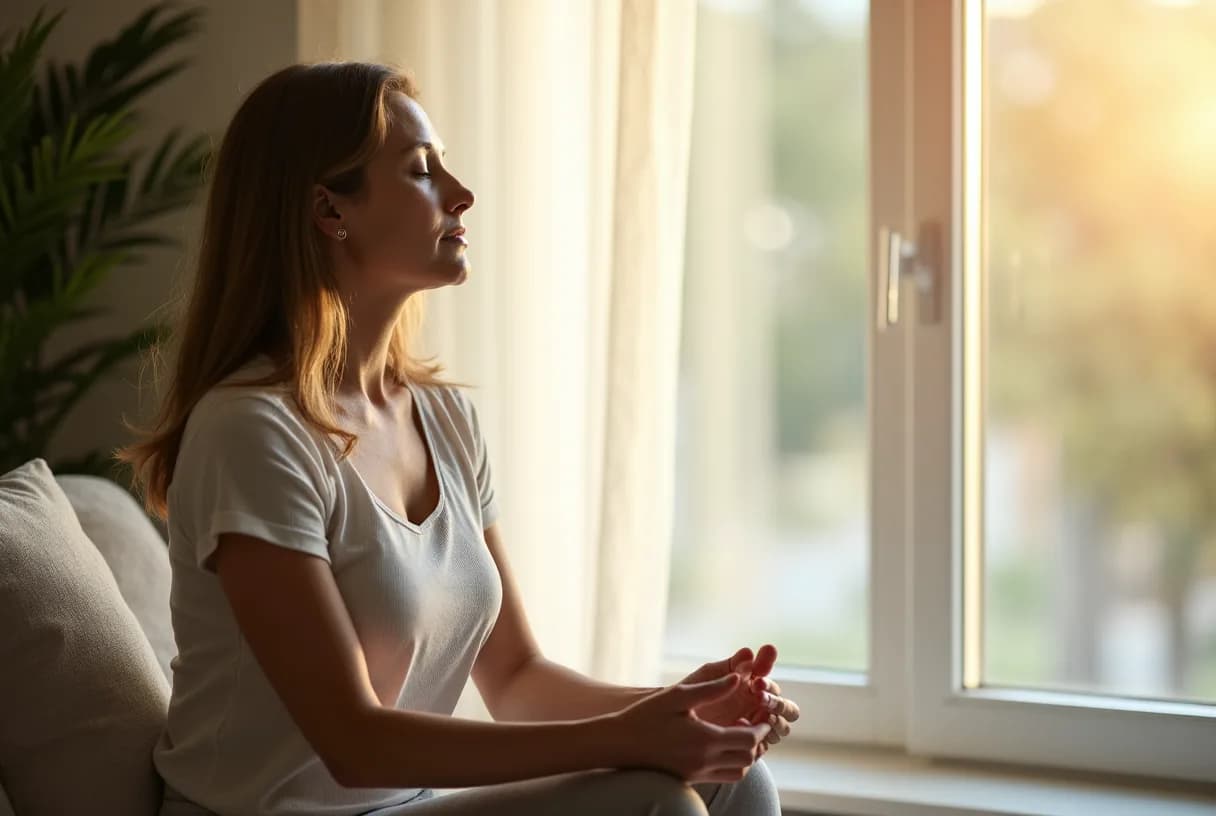
No app, no cushion, no incense. Do it on the edge of your bed, or in a parked car before you walk into the house.
- Set a timer for 5 minutes. Not optional — otherwise you spend the whole session wondering how long it has been.
- Sit upright, feet flat on the floor. Tall spine, soft shoulders, hands resting on your thighs. Eyes closed, or open with a soft downward gaze about a metre in front of you. Eyes open is the better default if you have a trauma history.
- Spend the first 60 seconds on contact points. The weight of your feet on the floor. Your sit-bones on the chair. Your palms on your legs. Nothing to achieve here; you are just landing.
- Move attention to the breath, wherever you feel it most clearly — nostrils, chest or belly. Do not deepen or lengthen it. You are watching the breath, not driving it.
- Count exhales silently, 1 to 10, then start again. When you get to 4 and realise you are mentally rewriting an email, that is the practice. Note "thinking," drop the count, restart at 1.
- Expect to drift 10–20 times in five minutes. Each return is one repetition, the way each rep counts in strength training. The wandering is not the failure. The noticing and returning is the entire exercise.
- Last 30 seconds, widen out. Let sounds come to you — traffic, the fridge, your own breathing. Then open your eyes and stay still for three more breaths before you stand.
Two cues that make this work. If watching your breath makes your chest tighten — common with panic or asthma — move your anchor to your feet, your hands or ambient sound. The breath is not compulsory; it is just convenient. And if you fall asleep every single time, you are probably sleep-deprived rather than bad at meditating, which is information worth acting on: see our sleep hub and menopause insomnia.
What should you expect over eight weeks?
The trials that produced those moderate effects asked for far more than five minutes. A standard MBSR course is eight weekly classes of about 2.5 hours, one day-long silent session, and roughly 45 minutes of home practice a day. Almost nobody does that. Five to fifteen minutes daily is an honest compromise — but it means expecting a smaller effect than the trial data promises, and it means consistency matters more than session length.
| Stage | What most people notice | The trap |
|---|---|---|
| Days 1–7 | Restlessness, boredom, "my mind is far worse than I realised" | Concluding you can't do it. A loud mind is the normal starting condition, not a disqualification |
| Weeks 2–3 | Slightly faster recovery after a difficult call; catching a spiral one beat earlier | Waiting for bliss. The early wins are small and cognitive, not blissful |
| Weeks 4–6 | The gap between trigger and reaction widens; fewer reflex behaviours (scrolling, snapping, checking) | Skipping days once you feel better. The benefit tracks current practice, not past practice |
| Weeks 6–8+ | The point at which trials detect measurable change on anxiety and mood scales | Expecting your circumstances to change. Mindfulness alters how you carry a load, not the load itself |
If you want a straight answer for yourself rather than an average from a trial, measure it: rate your stress 0–10 each evening for two weeks before you start, and again at week eight. Our brain–body check-in and the how long until it works tool are built for exactly this kind of before-and-after.
Who should be cautious with mindfulness?
This is the part the wellness industry omits. In a 2020 systematic review of 83 studies and 6,703 participants, about 8% of people reported an adverse event from meditation. Anxiety was the most common (a third of reported events), then depression (about a quarter) and cognitive anomalies. Others report intrusive memories, panic, or dissociation and a sense of unreality. The authors note these events occurred in people with no previous history of mental health problems, too. Silence, stillness, closed eyes and inward attention are precisely the conditions that can bring a trauma history into the room.
That does not mean people with trauma histories cannot practise. It means the standard instructions are the wrong ones. Trauma-sensitive mindfulness, developed by clinicians and teachers working with PTSD, changes the defaults:
- Eyes open, soft gaze, back to a wall; orient to the room before and after the practice
- Anchors outside the body when needed — sound, the chair beneath you, an object across the room — rather than the breath
- Short sessions of 2–5 minutes, with explicit permission to stop, move, stretch or open your eyes at any moment
- No long silent retreats early on, and no pushing "through" distress on the theory that it will pass
- A trauma-informed teacher or therapist rather than an app on autoplay
Stop, and speak to a clinician, if practice reliably brings flashbacks, detachment or unreality, panic attacks, or a mood that is worse for several days running. The NHS says it plainly: mindfulness "is not right for everyone," and some people find that it does not help them, or that it makes them feel worse. That is a legitimate result, not a personal failing.
When to see a clinician
Mindfulness is a reasonable first move for ordinary stress load. It is not the right lead treatment when:
- Low mood, loss of interest or anxiety are present most days for two weeks or more and are interfering with work, sleep or relationships — that deserves an assessment. See depression in women and understanding anxiety symptoms.
- You have slept badly at least three nights a week for three months or more. Cognitive behavioural therapy for insomnia (CBT-I) is the first-line treatment for chronic insomnia — placed ahead of medication by both the American College of Physicians and the American Academy of Sleep Medicine, and ahead of meditation.
- You are running on empty in a way no five-minute practice touches: how to manage stress goes deeper, and our stress and cortisol hub covers what is and isn't true about "cortisol overload," including the adrenal fatigue claim.
- You already take medication for anxiety or depression. Mindfulness can sit alongside it. Never start, stop or change a dose because of an article — including this one.
If you are having thoughts of harming yourself, call or text 988 (the Suicide & Crisis Lifeline in the US) or your local emergency number now. That is not something to meditate through.
To find someone to work with, our therapy care finder sets out what to ask before you book. And if the search for stress relief has pulled you toward supplements, run each candidate through the supplement scorecard first — magnesium is the most-asked-about option, and we grade the evidence honestly in our magnesium guide. None of it replaces the eight weeks.