Why resistance training comes first, not cardio
\n\nMost restart plans lead with walking because it feels safest. Walking is genuinely valuable — but it does not defend the two tissues you are losing fastest right now.
\n\nAdults lose roughly 3–8% of muscle mass per decade after age 30, and the rate accelerates after menopause. Bone loss is sharper and more time-limited. In the SWAN cohort, the fastest losses cluster in a roughly three-year window that starts about a year before the final period: white women lost bone density at around 2.5% per year at the lumbar spine and 1.8% per year at the femoral neck during that stretch, before the rate slows again. Those rates are not universal — they varied by race and ethnicity in the same cohort (roughly 2.2% spine and 1.4% femoral neck in Black women, and larger femoral neck losses of about 2.1–2.2% in Japanese and Chinese women) — so treat them as the shape of the curve, not your personal number. Either way, that window is not something you can walk your way out of. Loading the skeleton is what signals it to hold on.
\n\nThe most encouraging trial here is LIFTMOR, which randomised postmenopausal women with low bone mass (T-score below −1.0) to eight months of supervised, twice-weekly, 30-minute high-intensity resistance and impact training. The training group improved bone density at the spine and femoral neck relative to a low-intensity home programme. Three honest caveats: the sessions were supervised by people who knew what they were doing; they were genuinely heavy — barbell work in the region of 80–85% of a one-rep maximum, which is a long way from where you will start; and gains in bone density are measured in low single-digit percentages, meaningful but not a substitute for medical treatment if you already have osteoporosis. On safety, the trial's own reporting is reassuring rather than perfect: one adverse event in the high-intensity group, a participant with minor low-back muscle spasms who missed two sessions. Whether you need medication alongside training is a conversation with your clinician, not a training decision.
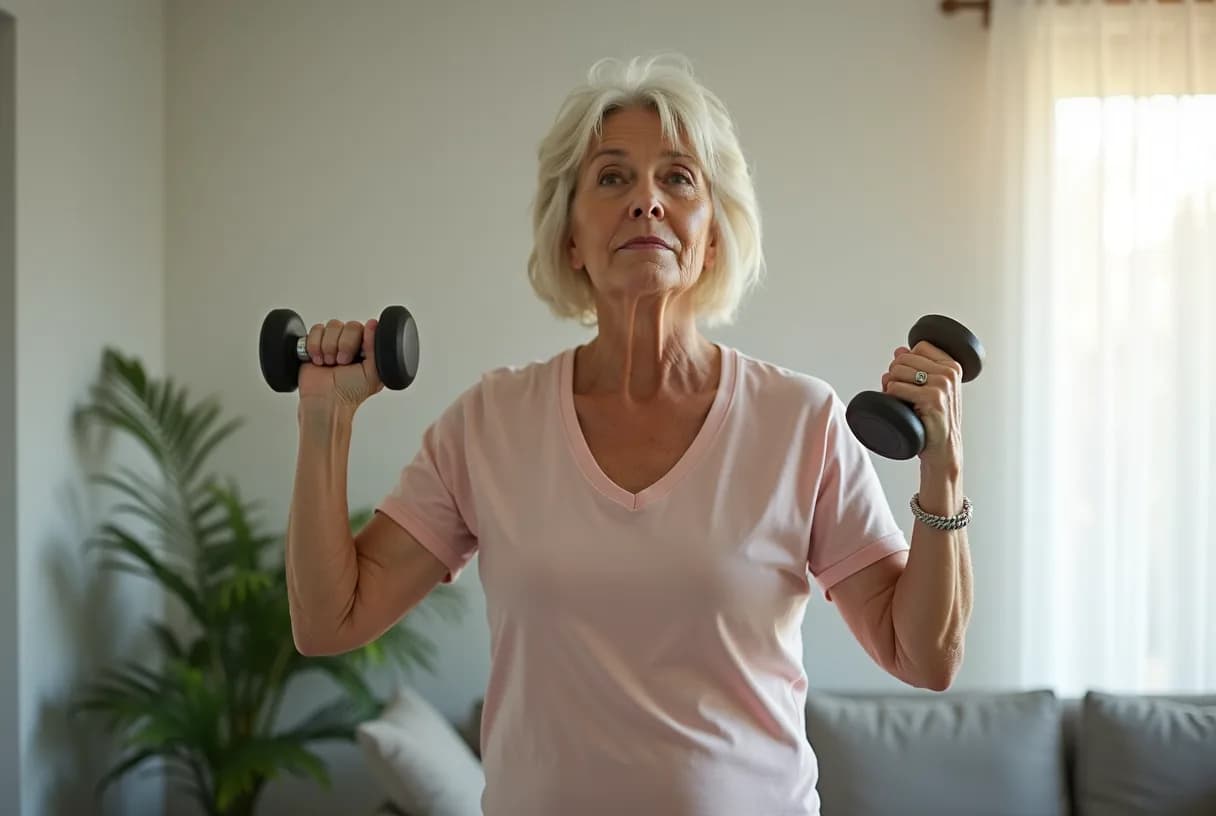
\n\nWhat resistance training reliably does at any starting point: builds strength, improves how easily you get off the floor and carry things, supports blood sugar handling, and — combined with balance work — cuts falls. Start with our guide to strength training for women, and see menopause and bone loss and exercises for bone density for the skeletal side.
\n\nWhat the guidelines actually ask of you
\n\nThe US Physical Activity Guidelines ask adults for 150–300 minutes a week of moderate-intensity aerobic activity, muscle-strengthening work on 2 or more days a week, and — specifically for older adults — multicomponent activity that includes balance. The guidelines also say plainly that when chronic conditions make 150 minutes impossible, you should be as active as your abilities allow. Some is better than none, and the steepest health gains come when someone goes from almost nothing to a little.
\n\nFor aerobic work, easy conversational effort is the right place to live for the first months — see zone 2 cardio. If you prefer counting steps, how many steps per day covers where the evidence for benefit actually plateaus (it is lower than 10,000).
\n\nThe four-week on-ramp
\n\nThe most common restart mistake is not laziness — it is week one being too ambitious, week two hurting, and week three never happening. This progression is deliberately conservative.
\n\n| Week | What to do | How it should feel |
|---|---|---|
| Week 1 | 2 strength sessions of about 20 minutes (sit-to-stand from a chair, wall or counter push-ups, band rows, heel raises, dead bug). One set of 8–10 reps each. Plus a 10-minute walk most days and 1 minute of balance daily. | Easy. You should finish thinking \"that was nothing.\" Mild next-day awareness in the legs is fine; struggling on stairs means you did too much. |
| Week 2 | Same 5 exercises, now 2 sets. Walks to 15–20 minutes. Balance to 2 minutes (stand on one leg near a counter, then narrow stance eyes closed with support nearby). | Working, but you could do more. You should be able to talk in full sentences on the walk. |
| Week 3 | Add load, not sets: hold dumbbells or a loaded bag for sit-to-stands, move push-ups to a lower surface, use a stronger band. Add a hip hinge (hands on hips, or light weight). Walk 20–30 minutes; add one slightly brisker 5-minute stretch. | The last 2 reps should feel genuinely hard while your form stays clean. Breathing hard on the brisk section is expected; chest pressure is not. |
| Week 4 | 3 sets on 2–3 strength days. Aim for 3 walks of 30 minutes plus shorter ones. Balance while doing something else — brushing teeth on one leg. Add 10 minutes of mobility twice a week. | You look forward to two of the sessions and tolerate the third. Recovery by the next day. This is the level you now hold for a month before adding more. |
After week 4, do not add days. Add weight. Two or three well-loaded sessions beat five vague ones, and the extra days are usually what breaks the habit.
\n\nDoes soreness mean it worked?
\n\nNo. Delayed-onset muscle soreness mostly reflects novelty and eccentric loading, not the quality of the training stimulus — you can get very sore from one careless session and build strength for months with barely any soreness. Chasing soreness after 50 mostly buys you missed sessions.
\n\nBetter progress markers: the same weight feels easier, you get out of a low chair without hands, you carry groceries in one trip, you stop bracing on the stair rail. Those are the outcomes that translate into the next twenty years.
\n\nBalance work matters earlier than you think
\n\nFalls are the leading cause of injury in adults 65 and older, and about 1 in 4 report a fall each year. The important part for a 52-year-old: balance is trainable, and the training takes minutes. In 2024 the US Preventive Services Task Force gave exercise interventions a B recommendation for preventing falls in community-dwelling adults 65+ at increased risk, with moderate certainty of a moderate net benefit. The exercise arm of that evidence review drew on 37 randomised trials in just over 16,000 participants (the full review, covering every type of fall-prevention intervention, ran to 83 trials). Reviewers could not isolate one magic exercise type, which is good news: gait work, strength, tai chi and dance all appeared in effective programmes.
\n\nPractical version: one-leg stands at the kitchen counter, heel-to-toe walking down the hallway, standing up without using your hands. Sixty to 120 seconds a day. If your balance is already noticeably poor, or you have had a fall or near-fall, ask about a physical therapy referral rather than self-prescribing — that is exactly the population where supervised programmes showed benefit. Our fracture risk tool can help frame the conversation.
\n\nThe barriers nobody addresses honestly
\n\nJoint pain. Aching hands, hips, knees and shoulders are common in the menopause transition and often misread as \"I'm too broken to exercise.\" In most cases, gradually loaded movement improves joint symptoms rather than worsening them, though pain that is one-sided, swollen, hot, or accompanied by morning stiffness lasting over an hour deserves assessment. See menopause joint pain. Practical adjustments: reduce range of motion before reducing weight, favour machines or bands over free weights early, and give a cranky joint 48 hours rather than skipping the whole week.
\n\nLeaking with impact. If jumping, running or even brisk walking causes leaking, that is a treatable problem, not a reason to stop. Pelvic floor muscle training is the recommended first-line treatment for urinary incontinence in women, and a 2018 Cochrane review found it cures or improves symptoms compared with no treatment — with the caveat that trial programmes were supervised and consistent, which is why self-taught kegels often disappoint. Start with pelvic floor exercises and our bladder and urinary health section, and consider asking for a pelvic floor physical therapist. Meanwhile, train: strength work and walking are usually fine, and impact can wait.
\n\nFatigue. If you are exhausted, the answer is shorter sessions, not skipped ones — 10 minutes counts. But new, persistent, disproportionate fatigue deserves a workup rather than a training plan; low iron and thyroid problems are both common in midlife women and both are found with a blood test.
\n\nGym intimidation and time. Neither is a character flaw. A set of resistance bands, one pair of dumbbells and a sturdy chair covers everything in the table above. If standing exercise feels like too much on day one, start seated — chair exercises are a legitimate entry point, not a consolation prize, and progressing from seated to standing over a few weeks is a perfectly normal path. More options in our fitness section.
\n\nWhat exercise will not do
\n\nOne honest note, because you will see it claimed everywhere: exercise is not an effective treatment for hot flashes. The Menopause Society's 2023 nonhormone therapy position statement does not recommend it for vasomotor symptoms, alongside yoga and cooling techniques, because the trial evidence does not support it. That does not diminish the case for training — muscle, bone, blood pressure, mood, sleep and function are reason enough — but if hot flashes are your main problem, exercise is not the intervention, and effective options exist to discuss with a clinician.
\n\nWhen to see a doctor first
\n\nUnder current ACSM screening logic, most currently inactive people starting light-to-moderate exercise do not need medical clearance — the 2015 update deliberately removed barriers because inactivity is itself the bigger risk. Clearance is aimed at people with symptoms or known disease. Talk to a clinician before you start if any of these apply:
\n\n- \n
- Chest pain, pressure or tightness with exertion; unexplained breathlessness; fainting or near-fainting; or palpitations with dizziness \n
- Known cardiovascular, metabolic (including diabetes) or kidney disease, especially if you plan vigorous exercise \n
- Blood pressure that is uncontrolled or that you have not had checked recently \n
- Surgery within the past 3 months, a recent fracture, or an unexplained fall \n
- Diagnosed osteoporosis or a fragility fracture — high-impact and loaded spinal flexion need individual guidance \n
- New joint swelling, a joint that gives way, or pain that wakes you at night \n
Stop and seek emergency care (call 911 in the US) for chest pain or pressure, pain radiating to the jaw or arm, sudden severe breathlessness, fainting, or sudden weakness or difficulty speaking. Heart attack symptoms in women are more often fatigue, nausea, jaw or back pain and breathlessness than the classic crushing chest pain — do not talk yourself out of being checked because it \"doesn't look like a heart attack.\"
\n\nAnd one that is not about exercise at all: any bleeding after menopause needs evaluation, regardless of how much you are training.
\n]]>