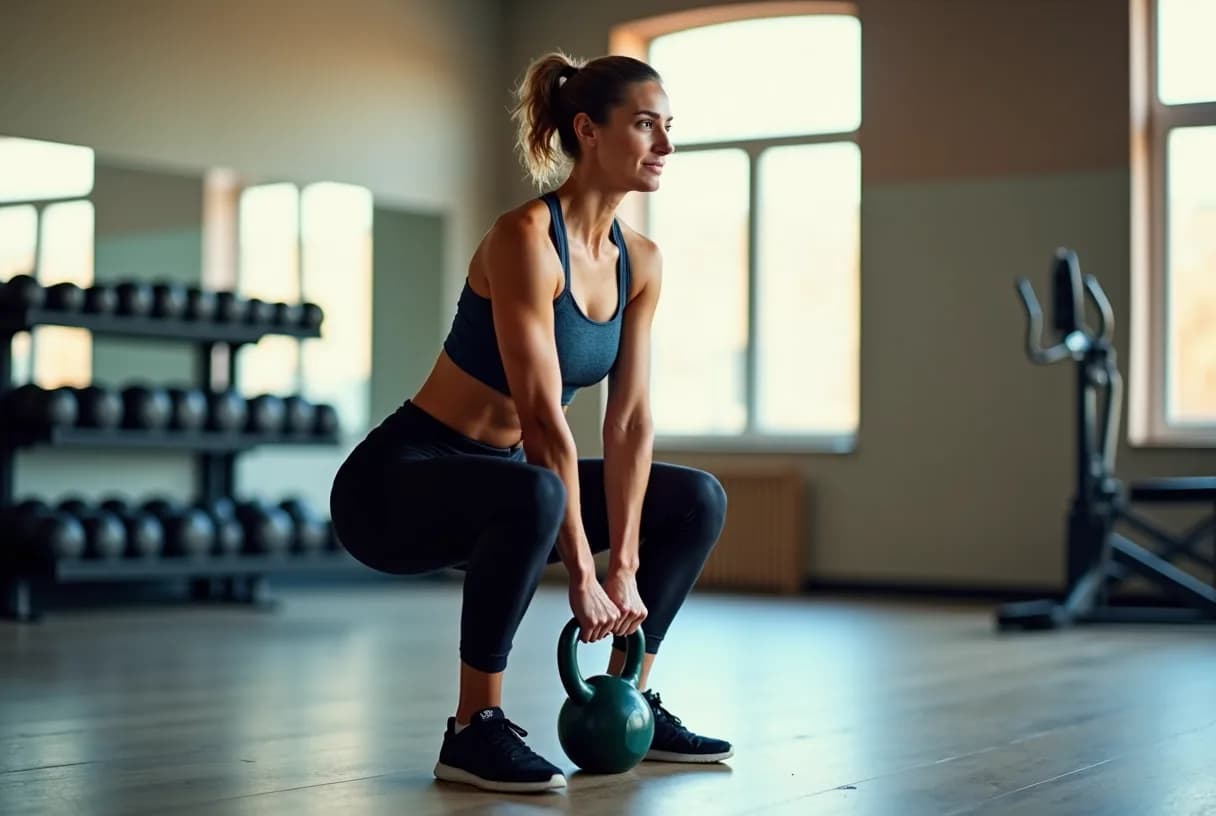
Proper squat form: stand with feet about shoulder-width apart, toes turned out 15–30 degrees, weight spread evenly across the whole foot. Push your hips back and down while your knees travel forward and out over your toes, keep your ribs stacked over your pelvis, and stand by driving the floor away. Squat only as deep as you can go without your lower back rounding — depth follows control, never the reverse. The deadlift is the same idea with a different balance point: hips travel back, shins stay nearly vertical, spine holds its shape while the hips do the work.
Together these two patterns — the squat and the hip hinge — cover most of what your body is asked to do in a day: getting off the toilet, out of a low car seat, up from the floor, lifting a grandchild or a bag of compost. They are also the two exercises that load the hip and spine hard enough to matter for bone. Learning them properly is worth a few weeks of unglamorous practice.
Why these two patterns matter most in midlife
Muscle mass and strength decline gradually from around age 30, and the loss accelerates across the menopause transition, when falling oestrogen removes some of the protection on both muscle and bone. Progressive resistance training is the most reliable way to claw part of that back — no supplement, no diet and no amount of walking substitutes for it. US and UK guidelines both ask adults for muscle-strengthening work on at least 2 days a week, covering all the major muscle groups, on top of aerobic activity.
Squats and deadlifts earn their place because they load the two sites that matter most for fracture: the hip (femoral neck) and the lumbar spine. The clearest evidence comes from the LIFTMOR trial: 101 postmenopausal women with low bone mass (T-score below −1.0) were randomised to eight months of supervised, twice-weekly high-intensity training — deadlift, back squat, overhead press and jumping chin-ups with a drop landing, 5 sets of 5 at above 85% of their one-rep maximum — or to a low-intensity home programme. Lumbar spine bone density rose 2.9% in the training group and fell 1.2% in the controls; femoral neck density held steady (+0.3%) while controls lost 1.9%. Adverse events amounted to one minor back spasm. That is one well-run supervised trial, not a body of literature — call the bone effect moderate evidence. The strength, balance and function gains stand on far firmer ground.
Nothing here is about how your body looks. Strength is a functional and skeletal investment: fewer falls, less fracture risk, easier stairs, more independence at 75. More context in strength training for women, what regular exercise actually does and bone health.
How do you squat with proper form?
Learn it as a box squat — squatting to a chair or bench — so you have a depth target and nothing to be afraid of. Do this tonight, without weight.
- Set the stance. Stand in front of a dining chair, feet roughly shoulder-width, toes out 15–30 degrees. Wear flat shoes or bare feet, not running shoes with a squishy heel.
- Screw the feet in. Without moving them, twist your feet outward into the floor as if standing on two paper plates. You should feel the arches lift and the glutes wake up. This is what stops knees caving in.
- Brace. Breathe into your belly and sides — 360 degrees, not a chest-lift — then tense your midsection as though about to be gently poked in the stomach. Hold that pressure on the way down.
- Descend. Push your hips back and down at the same time, letting the knees travel forward over the middle of the foot. Keep your chest facing forward-down, ribs over pelvis. Take three seconds down.
- Touch, don't sit. Tap the chair with your backside and pause for a beat without relaxing.
- Stand. Drive through the whole foot — mid-foot and heel — and think "push the floor away". Squeeze your glutes at the top rather than leaning back.
Cues that actually work: "spread the floor" (fixes knees caving), "proud chest, ribs down" (fixes the ribcage flaring), "screw the feet" (fixes collapsing arches). Cues that don't: "knees behind toes" and "sit back like into a chair" — both push most people into a good-morning lean that loads the lower back instead of the legs.
How do you do a hip hinge and deadlift?
A hinge is not a squat with a bar in your hands. In a squat the knees bend a lot and the torso stays relatively upright; in a hinge the hips travel backwards, the knees stay softly bent, and the torso comes forward. Most beginners cannot feel the difference, which is why the dowel drill exists.
The dowel drill (do this before you touch a weight)
- Hold a broom handle vertically against your back with one hand behind your neck, one in the small of your back. It should touch three points: head, upper back, tailbone.
- Stand a fist's distance from a wall, facing away. Soften your knees.
- Push your hips straight back until your backside taps the wall, letting your torso tip forward. All three contact points stay on the dowel.
- The moment any point lifts off — usually the tailbone, as the pelvis tucks under — you've hit the end of your hinge range. Stop there and stand back up by squeezing your glutes.
- Ten reps. Step further from the wall each set. Feel it in your hamstrings and glutes, not your lower back.
Then load it: the Romanian deadlift
Hold a dumbbell or kettlebell in each hand, arms straight, weight close to your thighs. Soft knees. Push hips back and let the weights slide down the front of your legs — shins stay nearly vertical. When you feel a firm hamstring stretch, or the weights reach mid-shin, reverse by driving your hips forward. The bar path is a straight vertical line; the weight never drifts away from you.
For a full deadlift from the floor, a trap (hex) bar or an elevated dumbbell is easier to learn on than a straight barbell: it lets you keep a more upright torso, which biomechanics studies link to lower peak loading at the lower back for the same weight lifted. Standing the weight on blocks or a step so it starts at mid-shin height is not cheating — it's the correct starting height for most beginners.
Common squat and deadlift mistakes — and how to fix them
| What goes wrong | What you'll feel or see | Usual cause | Fix |
|---|---|---|---|
| Knees collapse inward (squat) | Knees drift toward each other on the way up; inner-knee ache | Weak glute medius, feet not gripping | "Screw the feet into the floor"; loop a band above the knees and push out against it |
| Heels lift | Rocking onto toes at the bottom | Limited ankle dorsiflexion | Raise heels 1–2 cm on small plates; add calf/ankle mobility; widen stance slightly |
| "Butt wink" — pelvis tucks under at depth | Lower back rounds in the hole | Squatting deeper than your hip range allows | Stop 5 cm higher. Depth is an output of mobility, not a goal |
| Good-morning squat | Hips shoot up first, chest drops, back does the work | Over-cueing "sit back"; quads under-recruited | Let knees travel forward; pause 2 s at the bottom; "chest and hips rise together" |
| Deadlift turns into a squat | Shins slanted, knees way forward, weight drifting from body | Hinge pattern never learned | Wall-tap dowel drill; "vertical shins, weight scrapes the legs" |
| Rounding under load (hinge) | Upper back curls, weight swings away from shins | Load too heavy, or the bar starts too low | Drop the weight ~30%; elevate the start height; "long spine, armpits over the bar" |
| Jerking the weight off the floor | The bar "clangs" then stalls | Slack not taken out before pulling | Pull the slack: pre-tension the arms, "squeeze an orange in your armpits", then push the floor away |
| Holding your breath for every rep | Dizziness, pounding head, red face | Over-bracing on light sets | Brace on the effort, exhale on the way up. Save maximal bracing for genuinely heavy sets |
| Leaking urine or downward pelvic pressure | Small leak, heaviness or bulging at the vulva | Pelvic floor can't match the pressure demand | Reduce load, exhale through the hardest part of the lift, and see the pelvic-floor section below |
How do you start? Bodyweight to goblet to loaded
The mistake is not the barbell. The mistake is arriving at the barbell without the pattern. Two sessions a week, with 48 hours between them:
- Weeks 1–2 — pattern. Box squat to a chair, 3 sets of 8. Wall-tap hinge with a dowel, 3 sets of 10. No weight. You are buying the movement, not training it.
- Weeks 3–4 — first load. Goblet squat: hold one dumbbell or kettlebell (start 4–8 kg) vertically at your chest, elbows tucked. The counterweight in front actually makes the squat easier to do well. 3 sets of 8–10. Add dumbbell Romanian deadlifts, 3 sets of 8, with a weight you could manage for 12–13 reps if pushed.
- Weeks 5–6 — earn the load. Progress goblet squats until the last two reps of each set are genuinely hard but your form doesn't change. Move to a trap-bar or elevated deadlift. CDC guidance for building strength is to work to the point where one more repetition would be difficult — roughly 8–12 reps per set, at least one set and up to three.
- Progression rule. When you can complete every prescribed rep with two "reps in reserve" for two sessions running, add the smallest available increment (often 2–2.5 kg). Slow is fine. Consistency beats intensity, and neither beats not being injured.
Support the work: protein intake matters more than any supplement for building muscle at midlife (run your number with the protein calculator, and see high-protein eating for women). Adequate calcium and vitamin D is the substrate your loaded bone builds with. Creatine has decent evidence as an adjunct to training, not a replacement for it. If standing and loading is not where you are yet, the beginner progressions in strength training for women start lower down; more options in fitness.
When it hurts, stop
Learn the difference between the two sensations you'll meet under a bar:
- Keep going: burning in the working muscle; breathlessness; deep muscular fatigue; soreness 24–48 hours later that eases as you warm up.
- Stop the set now: sharp, stabbing or electrical pain; pain in a joint line rather than a muscle belly; pain that makes you change how you move; any pain that gets worse rep by rep; dizziness, chest tightness or unusual shortness of breath; pins, needles or numbness down a leg or arm; a leak of urine or a sensation of downward pressure in the pelvis.
Stopping a set is not failure — it's data. Log what you were doing, at what weight, and at which rep. That log is what turns a vague "my back hurts" into a fixable problem. Usually the answer is a smaller step: less weight, less depth, a higher start height, or a couple more weeks in the pattern phase.
Back pain after lifting is common and usually settles within a few weeks. NHS advice for ordinary low back pain is to stay active and carry on with daily activities as far as you can, rather than resting in bed — which in practice means walking and lighter loading rather than stopping altogether.
The pelvic floor caveat nobody mentions
Heavy lifting raises intra-abdominal pressure, and if the pelvic floor can't meet that pressure you may leak or feel heaviness. This is common after childbirth and around menopause — and it is treatable, not a reason to give up strength training. Reduce the load, exhale through the effort rather than holding your breath, and work the floor directly: see pelvic floor exercises and, if you feel a bulge or dragging, prolapse-aware training. A pelvic health physiotherapist is the right specialist here, and the NHS refers to them for exactly this.
When to see a clinician
Book an appointment if you have: back or joint pain that hasn't improved after 2–3 weeks of sensible self-care; pain that wakes you at night or doesn't change with position; leg weakness, numbness or pins and needles; a known osteoporosis or osteopenia diagnosis and no supervised programme (a physiotherapist or exercise physiologist should build it — the trial evidence for heavy lifting with low bone mass comes from supervised programmes, and the Royal Osteoporosis Society advises a check first if you have had spinal fractures or many broken bones); recurrent urinary leaking or pelvic heaviness; or a heart condition, uncontrolled high blood pressure or recent surgery.
Seek urgent care for chest pain, fainting, sudden severe back pain after a fall, loss of bladder or bowel control, or numbness around the genitals or inner thighs — these need same-day assessment.
How strong is the evidence, honestly?
Strong: resistance training two or more days a week builds strength, preserves muscle and improves physical function in midlife and older women — this is the backbone of every national guideline. Moderate: heavy, progressive loading (squat, deadlift, overhead press) can improve lumbar spine bone density in postmenopausal women with low bone mass — one good supervised RCT, echoed in direction by later work, but not a deep literature. Weak, and mostly coaching consensus: the specific form cues in this article. There are no randomised trials showing that a 15-degree toe angle prevents injury or that a momentarily rounded back inevitably harms one. What we do have is decades of biomechanical reasoning plus a consistent clinical observation: injuries cluster where load rises faster than skill. Add weight slowly, keep the pattern clean, and you have already removed most of the risk.
Bottom line: practise the box squat and the wall-tap hinge tonight with no weight at all. Add a goblet squat in a fortnight. Your first "real" deadlift can wait a month — the bone and the muscle will still be there, and so will you.