Pilates is a system of slow, controlled, breath-led movements that trains how your trunk stabilizes, how your spine moves segment by segment, and how aware you are of your own alignment. The evidence is decent for low back pain and movement control, and thin-to-absent for the things midlife women are often sold it for: bone density, muscle mass and fat loss. Done well, it is the control layer that makes your strength training safer and your daily movement easier. It is not a replacement for lifting.
What is Pilates, actually?
Joseph Pilates devised the method in the 1920s as "Contrology" — a repertoire of precise exercises emphasizing breath, alignment, and moving from the center of the body outward. Two formats dominate today:
- Mat Pilates — floor-based, bodyweight, no equipment. Free, portable, and where every beginner should start.
- Reformer Pilates — a sliding carriage with spring resistance. Springs can assist a movement as easily as they resist it, so a reformer class is not automatically "harder"; it is more adjustable, and considerably more expensive.
The "core" Pilates trains is not the six-pack muscle. It is the deep trunk system — transversus abdominis, the obliques, the multifidus running along the spine, the diaphragm above and the pelvic floor below — working as a coordinated canister that manages pressure and keeps your spine stable while your limbs move. That is a genuinely useful skill. It is also a narrow one.
What does the evidence actually show — and what does it not?
The most rigorous look at Pilates is a Cochrane systematic review of 10 randomized trials (510 participants) in people with chronic low back pain. Its verdict was carefully worded: low-to-moderate quality evidence that Pilates beats minimal intervention for pain and disability, and no conclusive evidence that it is superior to other forms of exercise. In other words — better than nothing, and no better than the exercise you would actually stick with.
| Claim | Strength of evidence | What that means for you |
|---|---|---|
| Reduces chronic low back pain and disability | Low to moderate (Cochrane, 2015) | A reasonable choice — but not superior to walking, strength work or general exercise. Pick what you'll repeat. |
| Improves trunk control, posture awareness, spinal mobility | Consistent across small trials; low-risk, high face validity | The real payoff. It transfers directly to how you hinge, lift and carry. |
| Improves balance in older adults | Mixed, small studies | Plausible, but dedicated balance work (single-leg stands, tandem walking) is the more direct route. |
| Builds or preserves bone density | No convincing evidence | Mat Pilates does not load bone hard enough. Bone responds to progressive resistance and impact. |
| Builds muscle mass | No — bodyweight mat work plateaus quickly | You cannot progressively overload a mat. Muscle needs added load over time. |
| Flattens the abdomen / burns fat | No — spot reduction isn't a thing, and calorie cost is low | Not the tool for this, and not a useful reason to do it. |
| Fixes pelvic floor symptoms | Weaker and less consistent than direct pelvic floor muscle training | Do targeted training (or see a pelvic-floor PT). Pilates complements; it doesn't substitute. |
Why Pilates still earns a place in a midlife week
Falling estrogen through perimenopause and menopause coincides with real, measurable losses: muscle mass, bone density, and often confidence in the body's stability. Strength training addresses the first two. Pilates addresses something strength training quietly assumes you already have — the ability to find a neutral spine, brace without breath-holding, and move a limb without your pelvis going along for the ride.
That is not a soft benefit. If you cannot keep your ribs down and your pelvis level, a heavy hinge or squat will teach you so the hard way. Twenty minutes of Pilates twice a week is, in practice, twenty minutes of rehearsing the exact positions your heavy lifts demand.
A 6-move beginner mat sequence you can do tonight
About 20 minutes. No equipment, no class, no membership. Move slowly — speed is not the point; control is. If any move produces pain, leaking, or a visible ridge doming down the midline of your abdomen, stop that move and read the pelvic-floor section below.
-
Ribcage breathing — 8 breaths. Lie on your back, knees bent, feet hip-width, hands wrapped around your lower ribs. Inhale through the nose and feel the ribs widen sideways into your hands. Exhale slowly through pursed lips and feel the ribs knit down and the space between your hip bones gently narrow.
Cue: the exhale should feel like a wrap, not a suck-in. Common error: lifting the chest and shoulders on the inhale. -
Pelvic tilt (imprint and release) — 10 reps. Exhale and gently tilt the pelvis so the low back flattens toward the mat. Inhale and return to neutral, where your pubic bone and hip bones sit level like a shallow bowl.
Cue: this is a movement of well under an inch, powered by the low abdominals — not by pressing your feet into the floor. It teaches you where neutral is, which is the whole point. -
Chest lift — 8 reps. Hands behind the head, elbows wide. Exhale, nod the chin slightly, and peel head and shoulder blades off the mat. Inhale to lower.
Cue: exhale on the lift, every time. Modification: if the belly domes into a ridge, or you leak, keep the head down and do the exhale plus a light abdominal wrap only — that is a legitimate exercise, not a failed one. -
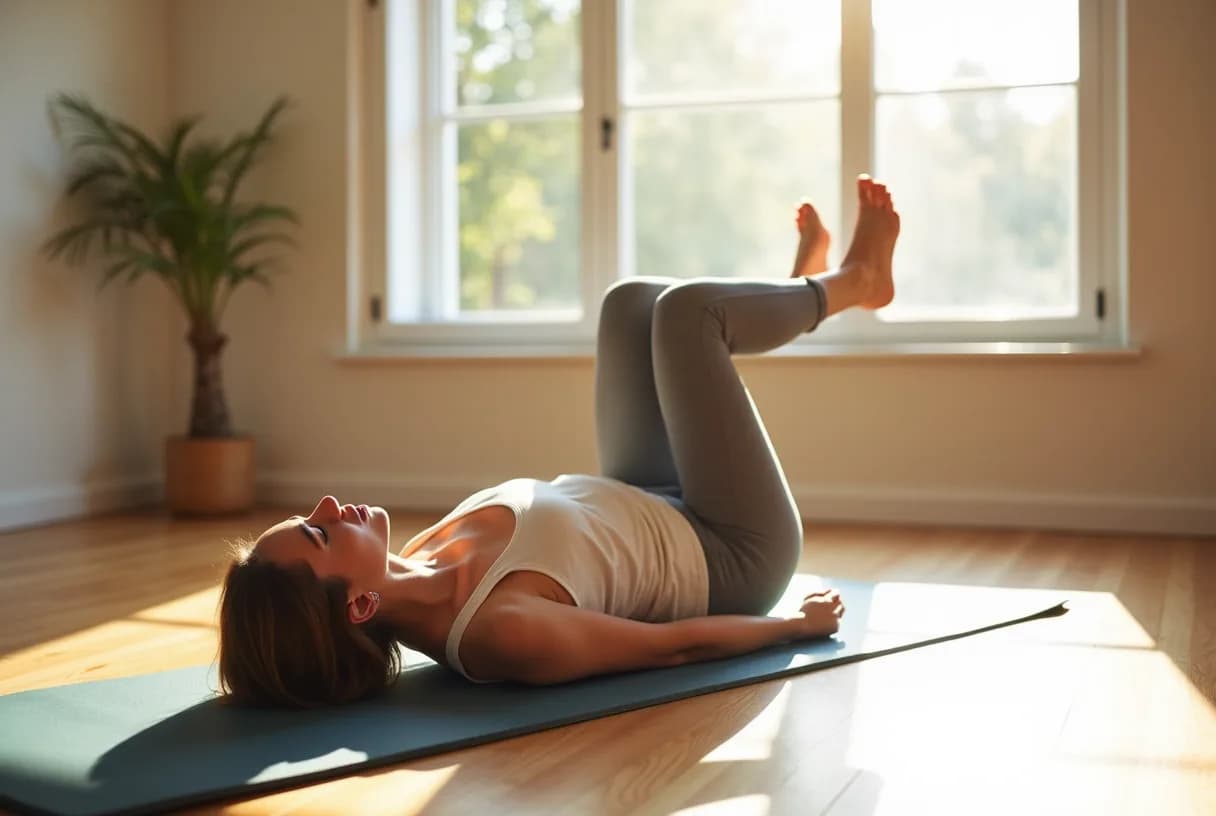
Tabletop toe taps — 10 per side. Bring both legs to tabletop (knees over hips, shins parallel to the floor). Exhale and lower one toe toward the floor; inhale and return. Alternate.
Cue: slide a hand under your low back — the gap under it must not change. Regression: keep one foot on the floor the whole time. -
Bridge — 10 reps. Feet hip-width, arms by your sides. Exhale and roll the pelvis up one vertebra at a time until hips, knees and shoulders form a line. Inhale at the top. Exhale and melt down, vertebra by vertebra.
Cue: press through the whole foot, not the toes; keep the ribs heavy so you don't arch into the low back. This one is real hip extension — glutes and hamstrings do the work. -
Bird dog — 6 per side, 3-second hold. On all fours, wrists under shoulders, knees under hips. Exhale and extend the right arm and left leg to shoulder and hip height. Hold, then return with control.
Cue: imagine balancing a full glass of water on your low back. If it would spill, you've rotated — shorten the reach.
Finish: 6 slow cat-cows, then 30 seconds in child's pose. Dose: two to three sessions a week. If you sit most of the day, this sequence is worth more to you at 7 a.m. than a longer session you never do.
Does Pilates fix a leaking pelvic floor?
Not reliably, and it is worth being blunt about it. A general "core" class is not pelvic floor muscle training — and the evidence gap between the two is stark. In a Cochrane review, women with stress urinary incontinence who trained the pelvic floor directly were about eight times more likely to report cure than women given no treatment or an inactive control: 56% versus 6%. Cochrane graded that high-quality evidence — a full notch above anything Pilates has managed for back pain, and the reason pelvic floor muscle training is first-line care. Give it around three months of near-daily practice, ideally supervised, before judging whether it is working.
Pilates helps at the margins — mainly by teaching you to exhale on effort instead of breath-holding and bearing down, which is exactly the habit that drives pressure down onto the pelvic floor. Two rules make it safer:
- Exhale on the hard part of every movement. Holding your breath under strain pushes intra-abdominal pressure downward.
- Stop gripping. A pelvic floor that never releases is as dysfunctional as one that never contracts. If you clench all day, more clenching is not the fix — and grinding out endless Kegels can fatigue the muscle and leave the leaking no better.
Our guides to pelvic floor exercises and exercising with prolapse cover technique properly.
When to see a pelvic-floor physical therapist
An internal assessment by a pelvic-floor PT is the only way to know whether your floor is weak, overactive, or simply mistimed — and those three need different treatment, not more of the same. Book one if you have any of the following, however normalized it has become:
- Leaking with coughing, sneezing, running or lifting — at any volume
- A sensation of heaviness, dragging, or a bulge in the vagina
- Urgency, or needing to map every toilet on a route
- Pain with sex, tampon use, or a pelvic exam
- Chronic straining or incomplete bowel emptying
- Abdominal doming or coning during core work
- Persistent low back, hip or pubic pain that hasn't responded to general exercise
How do you combine Pilates with strength training?
The federal physical activity guidelines ask adults for 150 to 300 minutes of moderate aerobic activity a week plus muscle-strengthening on two or more days. NIH bone guidance is more specific still: weight-bearing activity and resistance training, because bone adapts to force. Pilates supplies neither adequately. Slot it in as the control and mobility layer around work that actually loads you.
| Day | Session | What it's buying you |
|---|---|---|
| Monday | Full-body strength, 35–45 min (squat, hinge, push, pull, carry) | Muscle, bone, metabolic health |
| Tuesday | Pilates mat sequence, 20 min + 30-min brisk walk | Trunk control, spinal mobility, aerobic minutes |
| Wednesday | Full-body strength, 35–45 min (add load or reps from Monday) | Progressive overload — the non-negotiable bit |
| Thursday | Brisk walk or cycle, 30–40 min + pelvic floor set | Cardiorespiratory fitness, continence |
| Friday | Strength or a Pilates class — whichever you'll actually attend | Consistency beats optimization |
| Weekend | Longer walk or hike; one full rest or gentle-mobility day | Weight-bearing load for bone; recovery |
Two supports make this week work rather than grind. First, enough protein to build on the stimulus — run the numbers with our protein calculator, and see our protein powder roundup if food alone isn't getting you there. Second, a strength program you progress rather than repeat; start with strength training for women. If joints or fatigue are limiting you right now, scale the load and the range of motion — not the frequency. Two short sessions you finish beat one ambitious session you abandon. More on the wider payoff in our fitness hub, and the evidence behind it in the benefits of exercise.
When to see a clinician
Book an appointment before or instead of starting a class if you have:
- Back pain with numbness, tingling, leg weakness, or any change in bladder or bowel control — this is urgent; seek same-day care
- Back pain with fever, unexplained weight loss, night pain that wakes you, or a history of cancer
- Osteoporosis, osteopenia, or a previous vertebral fracture. The classic mat repertoire is full of loaded spinal flexion and rotation — roll-ups, rolling like a ball, spine twist — and osteoporosis clinicians and charities commonly advise caution with repeated end-range flexion and twisting when vertebrae are fragile. That is not a reason to avoid movement, which bone needs; it is a reason to have those moves modified. Tell your instructor before the class, not after, and read up on bone health and calcium and vitamin D.
- A recent abdominal or pelvic surgery, a hernia, or a new bulge
- Dizziness, chest pain or breathlessness on mild exertion
When you do choose a class, ask one question at the door: "Can you modify for pelvic floor symptoms and for osteoporosis?" A good instructor answers immediately and specifically. That answer tells you more about the class than any studio's website will.