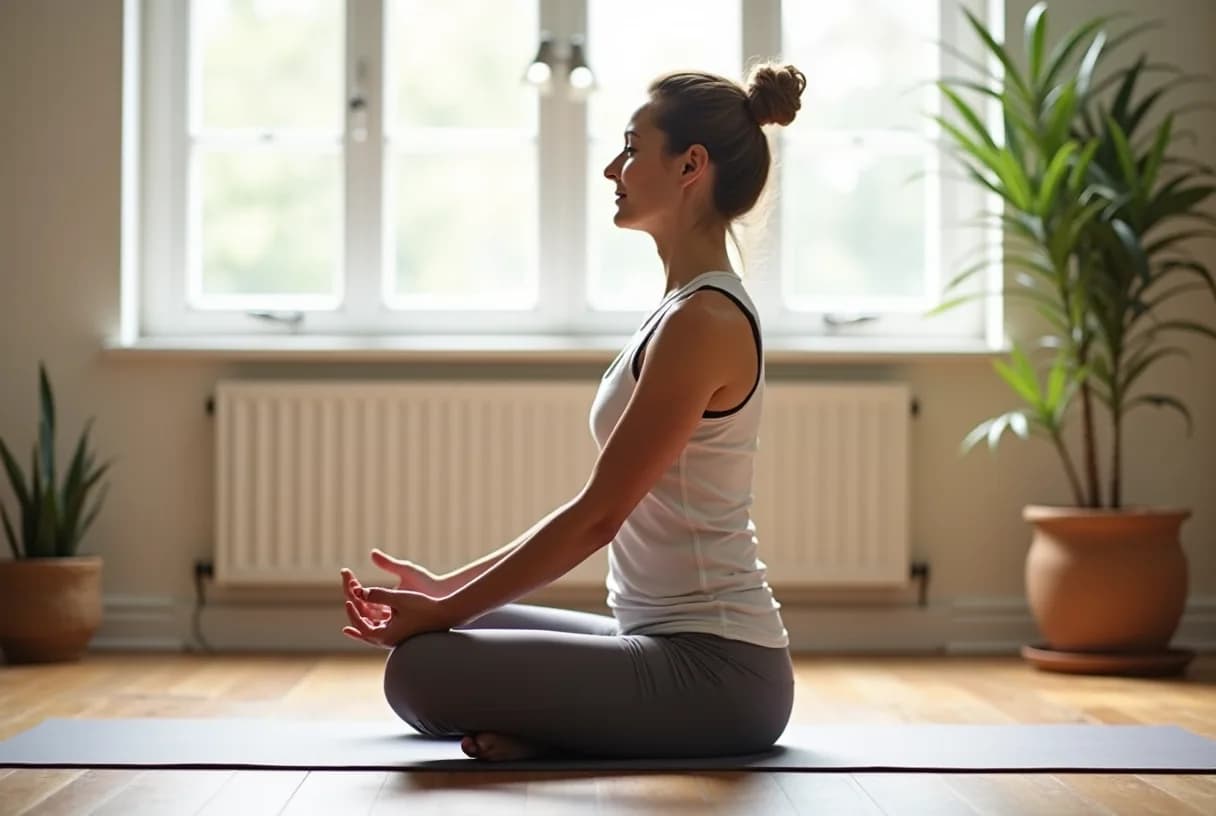
Yoga has reasonable trial evidence for sleep, mood and overall quality of life in midlife women. Its evidence for reducing hot flashes specifically is weak and inconsistent — The Menopause Society's 2023 nonhormone therapy position statement lists yoga as "not recommended" for vasomotor symptoms. Yoga also does not build bone or much muscle the way progressive resistance training does. It is a genuinely useful part of a midlife routine, not a substitute for treatment of significant symptoms.
That summary will annoy people on both sides. Yoga studios promise hot flash relief they can't deliver; sceptics dismiss a practice that has replicated benefits for the symptoms many women actually find hardest to live with — broken sleep, a nervous system stuck in the "on" position, and the sense that your body has become unfamiliar. Both positions miss what the trials show. Here is what they show.
What has yoga actually been tested on?
The literature is larger than most people assume — a 2025 systematic review in the International Journal of Nursing Studies pooled 24 randomised trials in 2,028 peri- and postmenopausal women — but it is not uniformly strong. Almost every outcome is self-reported, participants obviously know whether they were assigned to yoga, and "yoga" in these trials ranges from gentle 60-minute restorative classes to vigorous 90-minute Hatha sessions with home practice. That heterogeneity is why pooled effect sizes come with wide confidence intervals and why reviewers keep flagging risk of bias.
So the table below grades evidence honestly rather than optimistically. "Reasonable" means several randomised trials point the same way. "Modest/mixed" means trials disagree or effects shrink when yoga is compared against another form of exercise rather than against doing nothing.
| Symptom or outcome | Does yoga help? | Evidence strength |
|---|---|---|
| Sleep quality / insomnia symptoms | Yes, modestly. In MsFLASH, Insomnia Severity Index scores fell by 4.4 points with yoga versus 3.1 with usual activity (p=0.007); pooled reviews agree on the direction. | Reasonable — consistent across trials, small effect size |
| Anxiety and stress | Mixed. MsFLASH found no significant between-group difference in anxiety (p=0.182). The favourable signal comes from pooled menopause reviews and the wider yoga literature, where anxiety is one of the better-supported outcomes — but the best single menopause trial was null. | Modest / mixed |
| Depressive symptoms | Probably small benefit. MsFLASH showed a trend (p=0.028) that did not meet its threshold for secondary outcomes; pooled reviews find a benefit. | Modest / mixed |
| Overall menopause-related quality of life | Yes, on total symptom scores — driven mainly by the psychological and somatic subscales. | Reasonable, though inflated by comparison against no-treatment controls |
| Hot flashes and night sweats (frequency) | Largely no. MsFLASH found a difference of −0.3 hot flashes per day (p=0.119) — statistically and practically nothing. Benefits mostly vanish when yoga is compared with other exercise. | Weak / negative — "not recommended" per The Menopause Society (Level II) |
| Hot flash bother | No difference found in MsFLASH (p=0.417). | Weak |
| Joint stiffness and mobility | Likely helpful for stiffness and function, extrapolating from stronger yoga-for-pain data in back and knee pain. | Reasonable but indirect (not menopause-specific) |
| Balance and fall risk | Plausible benefit; balance work is built into most styles. | Modest |
| Bone mineral density | Not established. Trials are small, short and inconsistent. | Weak — do not rely on yoga for bone |
| Muscle mass and strength | Minimal beyond the first few weeks. Bodyweight load doesn't progress. | Weak versus resistance training |
Why does The Menopause Society say "not recommended" for hot flashes?
This is the line that surprises people, so it is worth quoting the reasoning. The 2023 statement reviewed the Cochrane exercise reviews, the MsFLASH trials and yoga-specific meta-analyses, and concluded that yoga had limited benefit compared with exercise for vasomotor symptoms and no benefit compared with no treatment. Its verdict: "Although there are other health benefits associated with exercise or yoga, the evidence of those interventions for the treatment of VMS is sparse. (Level II; not recommended)"
Read that sentence carefully — it is not saying yoga is useless. It is saying yoga is not a hot flash treatment. That distinction matters, because a woman having fifteen disruptive vasomotor episodes a day who is told to try yoga instead of being offered evaluation is being under-treated. The same statement lists cognitive behavioural therapy, clinical hypnosis, certain antidepressants, gabapentin and fezolinetant as evidence-supported non-hormonal options, and hormone therapy remains the most effective treatment for vasomotor symptoms in appropriate candidates. If hot flashes are your main problem, start with the full menu of menopause treatment options and the evidence on whether hormone therapy is safe for you — those are prescriber conversations, and what fits depends on your history.
One nuance from a pooled MsFLASH analysis is genuinely useful: women whose hot flashes came bundled with insomnia tended to do best with CBT for insomnia, while those with the most bothersome flashes did best with estradiol. Matching the intervention to the dominant complaint beats picking one thing and hoping — a conversation to have with your clinician, not a self-selection exercise.
Which style of yoga for which goal?
Restorative and yin — long holds, props, minimal exertion. This is the style most aligned with the sleep and relaxation evidence. If you are practising in the evening to unwind a wired nervous system, this is the one.
Hatha and gentle/slow flow — the format used in most menopause trials, including MsFLASH's twelve weekly 90-minute classes with daily home practice. A reasonable default if you want the researched dose.
Vinyasa and power yoga — genuinely demanding cardiovascularly, and the closest yoga gets to strength work. Still not a substitute for lifting: bodyweight load stays constant while your muscles adapt, which is the opposite of progressive overload. Treat it as conditioning.
Hot yoga — approach with real caution in midlife. In research commissioned by the American Council on Exercise measuring core temperature during 90-minute Bikram classes in a room at 105°F, seven of twenty participants exceeded 103°F, against a conventional heat-illness threshold of around 104°F. No one in that small study became ill, but the margin is thin, and if you are already having vasomotor symptoms, deliberately raising core temperature is working against yourself. The risk profile is worse over 40 and worse again with cardiovascular disease or a tendency to dehydrate.
Chair yoga — a legitimate option, not a consolation prize, if mobility, dizziness or joint pain limits floor work.
What yoga will not do for your bones or muscles
Bone loss accelerates sharply in the years around the final period, and muscle mass declines alongside it. Yoga does not meaningfully counter either. The bone-density trials are small, short and contradictory, and no serious guideline treats yoga as osteoporosis prevention. The interventions with real evidence are progressive resistance training and impact loading — see strength training for women and exercise for bone density. If you want a mat-based practice that at least tracks strength progression more explicitly, Pilates in midlife is a reasonable neighbour, with similar limits.
The practical version: yoga two or three times a week is a fine complement to two weekly resistance sessions. It is a poor replacement for them.
What to modify at midlife
Joints. Stiffness, aching hands and shoulders and a slower warm-up are common in perimenopause — see menopause joint pain. Warm up longer than you used to, and stop treating end-range depth as the goal. Blocks and straps are not a downgrade.
Osteoporosis or osteopenia: the specific rule. If a DXA scan has shown low bone density, avoid loaded or forceful deep spinal flexion — deep forward folds, seated forward bends, plough, roll-ups and any crunch-style movement that rounds the spine under load. A Mayo Clinic case series (Sinaki, 2013) documented vertebral compression fractures in people with osteopenia or osteoporosis after yoga positions involving spinal flexion, and older trial work in women with spinal osteoporosis found markedly more new vertebral fractures among those doing flexion exercises than extension exercises. Extension-biased and neutral-spine work is the safer direction. Tell your teacher before class, not after, and read osteoporosis treatment alongside it. If you don't know your risk, our bone fracture risk check is a starting point for the conversation, not a diagnosis.
Dizziness and blood pressure. Move slowly out of inversions and deep folds. New or recurrent dizziness deserves a medical explanation rather than a modification.
Where does breathwork actually fit?
Slow breathing is the ingredient most likely to explain yoga's sleep and relaxation effects — and it is also where an honest guide has to hold two facts at once. Paced respiration as a hot flash treatment has been tested properly and failed; The Menopause Society grades it Level I evidence, not recommended, on the strength of trials in which it was no better than shallow breathing or usual care. But for arousal, stress and getting back to sleep at 3am, slow-breathing practice is cheap, portable and reasonably supported. Our guide to breathing exercises for anxiety covers technique, and if the core problem is broken sleep rather than stress, menopause insomnia explains why CBT for insomnia outperforms almost everything else.
A realistic starting plan
Two to three sessions a week, 30 to 60 minutes, is the dose most trials used and roughly what people sustain. Choose gentle or slow-flow to begin. Tell the teacher your age bracket, joint issues and bone status before the first class — a good one will adapt, and a teacher who won't is telling you something useful. Give it eight to twelve weeks before judging: that is the window in which trial benefits appeared. Judge it on sleep, mood and how your body feels, not on hot flash count, because that is not what it does.
When to see a doctor
Yoga is not the right answer to any of the following, and delay causes harm:
- Any vaginal bleeding after 12 months without a period. This needs prompt evaluation — roughly nine in ten women diagnosed with endometrial cancer present with postmenopausal bleeding, and ACOG's 2026 update now recommends both transvaginal ultrasound and endometrial tissue sampling at initial evaluation for most patients, after evidence that ultrasound alone misses a meaningful share of cancers. See postmenopausal bleeding and book an appointment rather than watching it.
- Chest pain, pressure, jaw or arm pain, sudden breathlessness, or a racing heart with faintness. Anxiety and cardiac events overlap, and women's presentations are often atypical. Call 911 or go to emergency care — do not talk yourself out of it.
- Sudden severe back pain, loss of height, or new spinal deformity, especially after a fold or fall — possible vertebral fracture.
- Hot flashes, night sweats or sleep disruption that are wrecking your daily function. This warrants a treatment discussion, not a longer savasana.
- Persistent low mood, hopelessness, or anxiety you can't switch off. If you are thinking about harming yourself, call or text 988 in the US (Suicide & Crisis Lifeline) — available 24/7.
- New dizziness, fainting, unexplained fatigue or breathlessness on mild exertion — anaemia, thyroid disease and cardiac causes all need ruling out.
Nothing here is medical advice for your situation, and no article can tell you whether to start, stop or change any medication — that is your clinician's decision with your history in front of them. What this article can do is stop you spending a year on the mat waiting for hot flashes to resolve when a different conversation would have helped faster.