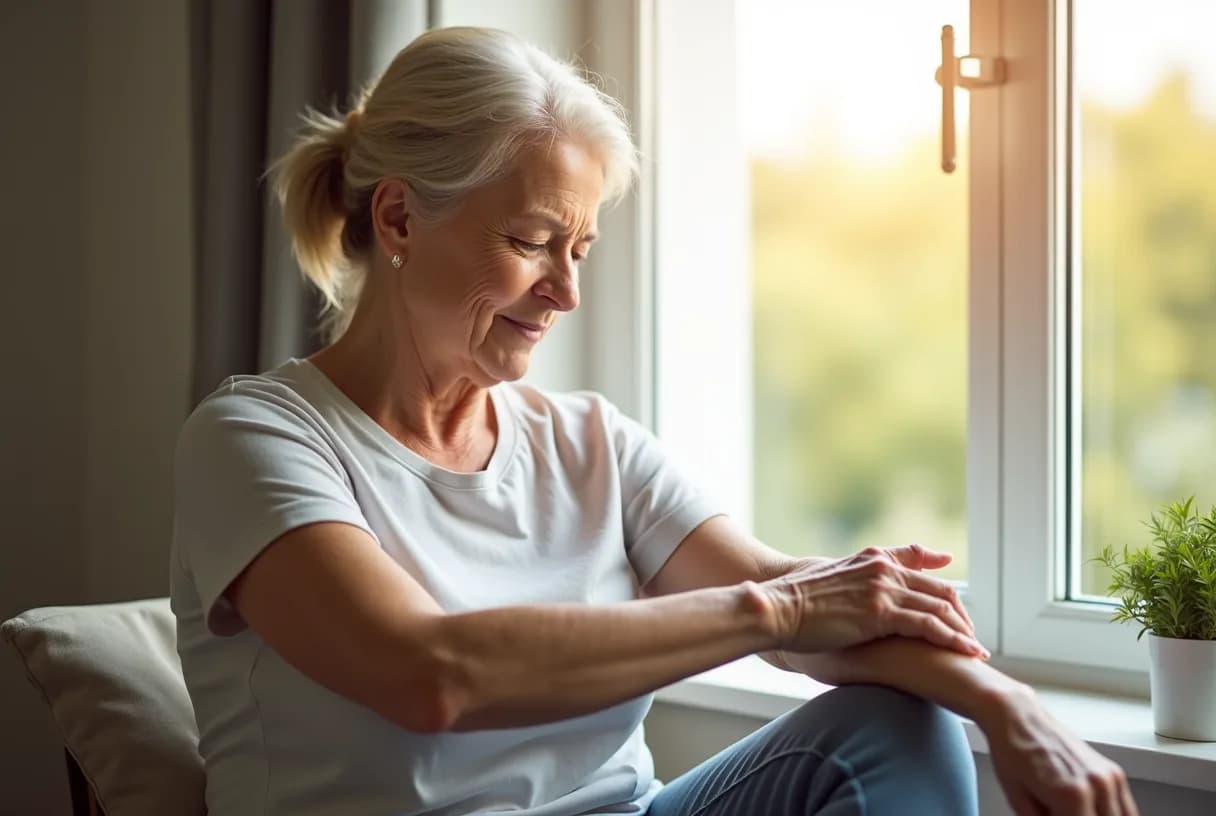
Formication is the medical name for feeling insects crawling on — or under — your skin when nothing is there. It is a recognised, if uncommon and badly under-discussed, symptom of perimenopause and menopause, and it tends to cluster with hot flushes, tingling and the "electric shock" sensations some women describe. It is classed as a paraesthesia: a false nerve signal, not an infestation and not imagination. But it is not always hormonal, and some of the other causes matter a great deal — so it should never be waved through as "just your hormones" without a look at the alternatives.
The word comes from formica, Latin for ant. That is exactly how women describe it: ants under the skin, a spider running across the shoulder blade, something moving on the scalp at 2am. If you have been told this is anxiety, or that you are imagining it, you have been badly served. The sensation is real. What is not real is the insect.
What does formication actually feel like?
Women who report it in midlife describe a fairly consistent pattern:
- A crawling, creeping or "something is moving" sensation, most often on the arms, legs, scalp, back or face
- Skin that feels like it is being walked on, brushed, or bitten — with nothing visible
- Worse in the evening and at night, in bed, and in the quiet
- Often arriving at the same time as a hot flush, or in the sweaty, chilled aftermath of one
- Frequently accompanied by tingling, pins and needles, numb patches, or brief zapping sensations
- An overwhelming urge to scratch, rub or slap the area — which can leave scratch marks that then get read as "evidence" of a skin problem
Unlike ordinary menopausal itching, formication is not primarily itchy. Itch says "scratch me". Formication says "get it off me". That distinction is worth spelling out to a clinician, because it changes what they should be thinking about.
Is crawling skin really a menopause symptom?
Yes — and we should be honest about how strong that evidence is. Formication appears on symptom lists from menopause organisations and in clinical descriptions of the menopause transition, and it shows up reliably in what women actually report. What it does not have is a large body of dedicated research. There are no big trials on menopausal formication, no prevalence figure you can trust, and no treatment studied specifically for it. Most of what is written about it — including this article — reasons from the wider science of estrogen and nerves.
So: real symptom, thin evidence base. The mechanism below is a hypothesis, not settled fact. Anyone who tells you exactly what percentage of menopausal women get it, or promises a specific fix, is inventing certainty that does not exist. That is different from saying it is not happening.
Why would falling estrogen make your skin crawl?
The best current explanation has three strands, and none of them requires anything to be wrong with your skin. All three are inferred from what is known about estrogen, nerves and skin — none has been tested directly in menopausal formication.
- Estrogen influences how peripheral nerves fire. Estrogen receptors sit on sensory nerves and in the nerve pathways that carry touch, temperature and pain signals. As levels fall and swing, the threshold at which those nerves fire appears to shift — so ordinary background input (clothing, air movement, a hair, your own pulse) can be misread as movement on the skin. This is the same family of misfiring thought to lie behind the tingling, numbness and brief electric-shock sensations many women get in perimenopause.
- Estrogen keeps skin hydrated and thick. Estrogen supports collagen, oil production and the skin's water-holding capacity, and skin collagen falls sharply in the first years after menopause. Skin gets drier, thinner and more reactive in the years around menopause, and dry, twitchy skin is a noisier surface for a sensitised nerve to read. See how menopause changes your skin.
- It rides along with vasomotor symptoms. Formication very often turns up with hot flushes and night sweats — the same thermoregulatory storm that produces flushing also produces sweating, chilling and skin sensations. Women whose hot flushes improve often notice the crawling improves too.
Practical implication: treating the menopause, not the skin, is usually the higher-yield move.
What else causes formication? (This is the part that matters)
Crawling skin is a neurological symptom, and neurological symptoms have a differential. Several of these causes are common in midlife women, and several are eminently treatable — but only if someone looks.
| Cause | Clues that point to it | How it's usually checked |
|---|---|---|
| Vitamin B12 deficiency | Tingling/crawling in a glove-and-stocking pattern, unsteadiness, sore tongue, fatigue, memory fog. Higher risk with metformin, acid-reducing drugs, vegan diet, or coeliac disease | Serum B12 (and folate); sometimes methylmalonic acid if borderline |
| Iron deficiency / low ferritin | Fatigue, breathlessness, restless legs and crawling sensations in the legs at night. Very common with heavy perimenopausal bleeding | Full blood count plus ferritin — a normal haemoglobin does not rule it out |
| Diabetes or prediabetes (diabetic neuropathy) | Crawling, burning or numbness starting in the feet and moving up, symmetrical, worse at night; thirst, frequent urination, unexplained weight change | HbA1c or fasting glucose; foot sensation testing |
| Thyroid disease | Overlaps heavily with menopause: fatigue, cold intolerance, dry skin, hair loss, weight change, carpal tunnel-type tingling | TSH, with free T4 if abnormal |
| Shingles (before the rash appears) | One-sided, in a band or stripe on one side of the trunk, face or limb; crawling, burning or intense sensitivity that comes first, with rash appearing days later | Clinical — this is time-critical; antivirals work best started early |
| Medications | Started or changed within weeks of the sensation: some antidepressants (and antidepressant withdrawal), stimulants, opioids, some antibiotics, chemotherapy agents, statins, and drugs used for osteoporosis | Timeline review with the prescriber — do not stop anything yourself |
| Alcohol | Crawling/tingling in heavier drinkers (alcohol-related neuropathy) — and also during withdrawal after cutting down abruptly | Honest history; B12/folate/thiamine often low alongside |
| Skin conditions and true infestation | Scabies, lice, eczema, urticaria: there is something to see — burrows, rash, bites in a pattern, other household members itching too | Skin examination; scabies is easy to miss and easy to treat |
| Delusional infestation | Persistent crawling with an unshakeable conviction that real organisms are present, often with collected "specimens" (skin flakes, lint) brought to appointments, and skin damage from digging | Needs dermatology and psychiatric assessment together — see below |
If you have never had bloods done for this, that is the first ask: full blood count, ferritin, B12, folate, TSH and HbA1c. That single panel covers most of the treatable non-hormonal causes. Our lab results explainer can help you read them once you have them.
When crawling skin becomes a fixed belief in infestation
There is a distinct condition — delusional infestation (also called delusional parasitosis) — in which a person is genuinely and unshakeably convinced that insects, mites or fibres are living in their skin, despite repeated negative examinations. It is more common in women and its peak onset is in midlife and later, which is precisely why it belongs in this article rather than in a footnote.
This is not the same as menopausal formication, where a woman knows perfectly well there are no insects and simply wants to know why her skin feels that way. The difference is belief, not sensation. Delusional infestation causes real suffering and real skin injury from picking, and it responds poorly to reassurance and dermatological creams. It needs a clinician who will treat both the skin and the underlying condition — usually dermatology working alongside psychiatry, and often with medication that is not a dermatological one. Saying so is not an insult; it is the only route to actual relief, and it is worth insisting on if repeated skin swabs and samples keep coming back clear.
What actually helps menopausal formication?
No treatment has been trialled specifically for this symptom. What follows is reasoned from the mechanism and from what helps related menopausal skin and nerve symptoms — offered honestly as sensible rather than proven.
- Treat the menopause, not the skin. If formication comes with hot flushes, night sweats and disturbed sleep, the sensible target is the whole vasomotor picture. Hormone therapy is the most effective treatment for vasomotor symptoms, and women often report skin sensations settling alongside — but that is observation, not trial data. Non-hormonal options exist too. Whether any of this is right for you depends on your age, time since menopause and medical history, and that is a conversation for a prescriber, not a decision to make from an article; read how the treatment options compare first so the conversation is a real one.
- Rehydrate the skin barrier. Thick, fragrance-free emollient applied to damp skin after a lukewarm (not hot) shower, twice daily. Drop soap and long hot baths — both strip the barrier and make skin noisier.
- Cool the skin and the room. Cotton or bamboo nightwear, a cool bedroom, a fan, a cold pack or a cool damp cloth on the crawling area at the moment it starts. Cooling seems to interrupt the sensation in a way scratching does not.
- Protect the skin from your own hands. Keep nails short. Rub, press or cool instead of scratching. Skin damage recruits genuine itch on top of the false crawling, and the two feed each other.
- Fix the boring deficiencies. Low iron and low B12 are common in midlife women and both cause nerve symptoms. Treat what the blood tests find, with your clinician deciding the dose — see iron deficiency symptoms and B12 for women. Do not supplement blind: iron in particular should not be taken without a test, because excess iron is harmful.
- Guard sleep. Formication is loudest at night, and exhaustion lowers the threshold for every sensory symptom. Menopause insomnia is worth treating in its own right.
- Look at alcohol and caffeine in the evening. Both are plausible amplifiers — alcohol through nerve and sleep effects, caffeine through arousal. A two-week experiment costs nothing.
How to get taken seriously when you describe it
This symptom gets dismissed more than almost any other in menopause, partly because it sounds alarming when said out loud. Language helps.
- Use the word formication, and add: "I know there is nothing on my skin — this is a nerve sensation, not an infestation."
- Say where it is, whether it is one-sided or both sides, when it started, and what else started at the same time (flushes, a new medication, heavy periods).
- Ask directly: "Can we check ferritin, B12, folate, TSH and HbA1c?"
- Take a symptom record. The menopause symptom score and the doctor report generator turn a vague complaint into a document.
When to see a doctor
Book an appointment for any new crawling-skin sensation that has lasted more than a couple of weeks. This is a symptom that deserves basic blood tests before anyone attributes it to hormones.
Seek same-day or urgent medical care if:
- The sensation is on one side only, in a band or stripe — especially with pain, burning or blistering, or near an eye. This can be shingles, and antiviral treatment is recommended within 72 hours of the rash appearing, so it should not wait.
- There is new weakness, loss of coordination, trouble walking, facial droop, slurred speech or new visual loss.
- There is numbness spreading upward from the feet, or new loss of bladder or bowel control.
- You have started a new medication in the past few weeks and the sensation began with it — call the prescriber; do not stop it yourself.
- You are drinking heavily and cutting down suddenly — withdrawal can be dangerous and needs medical supervision.
- You are picking, digging or breaking the skin, or you feel certain that something living is in your skin. This deserves care, not embarrassment, and there is effective treatment.
And separately, because it comes up in the same appointments: any bleeding after menopause — even one episode, even a pink smear, even if you are on HRT and were told to expect some — is never something to watch and wait on. Around 1 in 10 women with postmenopausal bleeding turn out to have endometrial cancer; most causes are benign, but that is never assumed until it has been checked. Nor should you ignore a new watery, blood-tinged or foul-smelling discharge after menopause, which can be the first sign of endometrial cancer even without frank bleeding. Both need prompt gynaecological assessment. A single reassuring scan does not close the question either: if bleeding continues or recurs, a thin lining on ultrasound is not the end of it and you should go back. There is also no population screening test for endometrial cancer — a smear test looks for cervical changes and will not find it — so symptoms are the only warning system there is. If you have both crawling skin and postmenopausal bleeding, the bleeding is the one that must be booked first. More at gynecologic health.
The short version
Crawling skin at midlife is a real sensation with a real name. It is probably a nerve symptom of falling estrogen, it usually travels with hot flushes, and treating the menopause is the most logical route to relief — though "probably" is the honest word, because nobody has studied it properly. But it is also a symptom that B12 deficiency, low ferritin, thyroid disease, diabetes, shingles, alcohol and a handful of medications can produce — so it earns a blood test, not a shrug. And you are not imagining it.