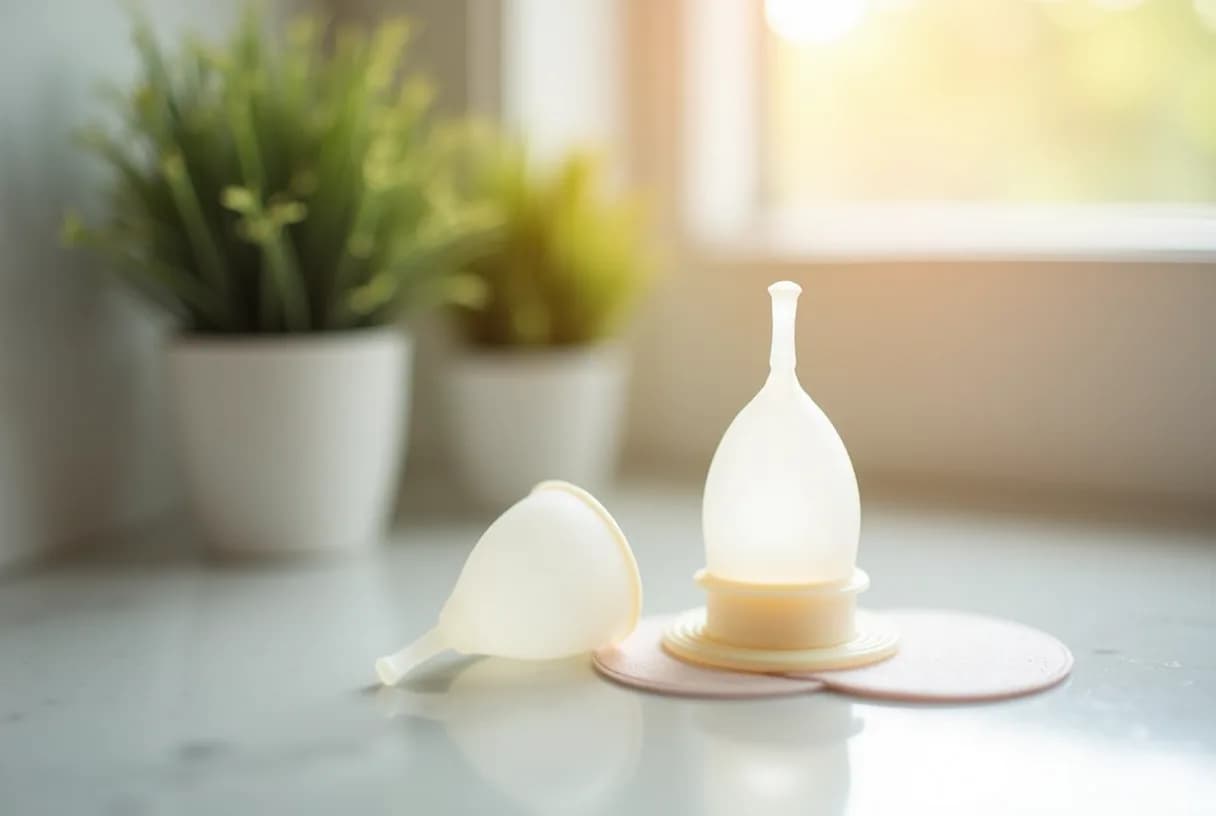
The short version: A menstrual disc and a menstrual cup both collect blood instead of absorbing it, but they sit in different places. A disc sits higher up, in the wide pocket behind your pubic bone (the vaginal fornix), and is held in place by your own anatomy. A cup sits lower in the vaginal canal and holds itself with a light suction seal. Because a disc sits above the vaginal canal rather than inside it, it is the only internal option you can wear during penetrative period sex. Both hold more and can stay in longer (up to 12 hours) than a tampon (8 hours maximum), and a cup or reusable disc lasts for years, while tampons and pads are thrown away after one use.
Cup vs. disc vs. tampon vs. pad: the full comparison
Every product below does the same job in a different way. Collection products (cups and discs) pool blood and are emptied; absorption products (tampons and pads) soak it up and are replaced. Here is how the four stack up on the things people actually decide on.
| Feature | Menstrual cup | Menstrual disc | Tampon | Pad |
|---|---|---|---|---|
| Where it sits | Lower vaginal canal, below the cervix | Vaginal fornix, tucked behind the pubic bone (highest) | Inside the vaginal canal | Outside the body, in your underwear |
| Collects or absorbs | Collects | Collects | Absorbs | Absorbs |
| Typical capacity | ~20–30 ml (roughly 3–5 regular tampons) | ~30–70 ml (the highest) | Regular ~5 ml, super ~10 ml (absorbency-rated) | External; high-capacity overnight versions available |
| Maximum wear time | Up to 12 hours | Up to 12 hours | No more than 8 hours (change every 4–8) | Change every ~4 hours or when soaked |
| Reusable? | Yes — medical silicone, lasts years | Reusable silicone versions (years) or single-use discs | No — single use | Mostly single-use (washable cloth pads exist) |
| Period sex? | No | Yes — mess-free penetrative sex | No | No (external only) |
| Cost per year | ~$5–15 amortized (one $20–40 cup) | Reusable ~$20–40 once; disposable ~$40–80/yr | ~$40–120/yr | ~$40–120/yr |
| Learning curve | Moderate — folding and getting the seal | Moderate — tucking the rim behind the pubic bone | Low | None |
| Best for | Reusable, low-waste, heavy flow, 12-hour wear | Highest capacity, period sex, a low cervix, or people who leak with cups | Convenience, familiarity, sport and swimming | Overnight, after childbirth, teens, or anyone who prefers nothing internal |
What's the real difference between a menstrual cup and a disc?
The confusion is understandable, because both are reusable, both collect rather than absorb, and both can be worn far longer than a tampon. The difference is placement and how they stay put.
- A cup is bell-shaped and sits low in the vaginal canal, just below the cervix. It pops open and forms a light suction seal against the vaginal walls, which is what keeps it from leaking. You check that seal by running a finger around the base.
- A disc is a flat, flexible ring with a soft membrane and sits much higher, angled back and up so the front rim tucks behind your pubic bone in the vaginal fornix. It is held by your anatomy, not suction.
Those two facts drive almost every practical trade-off. Because the disc sits higher and wider, it usually holds the most and many people genuinely cannot feel it. Because it isn't sealed by suction, it can quietly release a little blood when you bear down on the toilet — called “auto-emptying” — which some people love and others find messy at removal. A cup, by contrast, is easier to confirm is leak-proof and often easier to lift out without spilling. If you have a low cervix, or you keep leaking with cups, a disc is the natural next thing to try; if you want the simplest reusable option to learn, most people start with a cup.
Can you actually have period sex with a menstrual disc?
Yes — this is the disc's headline feature. Because it sits above the vaginal canal rather than filling it, a disc leaves room for penetrative sex while holding back the flow, so it can make period sex much less messy. Cups and tampons both occupy the canal and must be removed first.
Two honest caveats. A disc is not birth control and does not protect against sexually transmitted infections, so it does nothing to change your usual contraception plan. And some couples notice the disc during deep penetration; if it's uncomfortable, a different size or brand often solves it. If sex is regularly painful with or without a disc, that's worth raising with a clinician rather than working around — see our guide to period pain and pelvic discomfort.
How to insert and remove a menstrual cup
Inserting a cup
- Wash your hands and rinse the cup. For a brand-new cup, sterilize it first by boiling for 5–10 minutes.
- Fold it to make it small. The two most common folds are the “C-fold” (flatten and fold in half) and the “punch-down” fold (push one rim down into the base).
- Get comfortable — sit on the toilet, squat, or stand with one foot up — and relax your pelvic floor.
- Guide the folded cup in, aiming toward your tailbone (back and down), not straight up.
- Let it spring open. Rotate it a quarter-turn or run a finger around the base to confirm it has fully opened and sealed. The base should feel round, and any stem should sit just inside you.
Removing a cup
- Wash your hands, relax, and gently bear down with your pelvic-floor muscles to bring the cup lower.
- Pinch the base to break the suction seal — don't pull on the stem alone, or you'll fight the suction.
- Ease it out slowly, keeping it upright so it doesn't tip.
- Empty it, rinse or wipe it, and reinsert. Between cycles, wash and then sterilize it by boiling for 5–10 minutes; store it somewhere breathable.
How to insert and remove a menstrual disc
Inserting a disc
- Wash your hands. Pinch the disc in half lengthwise so the rim narrows to about the width of a tampon.
- Relax and, keeping it pinched, slide it in and back toward your tailbone as far as it comfortably goes.
- With a clean finger, push the front rim up behind your pubic bone. That tuck is what locks it in place — if it feels like it wants to slip out, the rim isn't tucked far enough.
Removing a disc
- Wash your hands and relax your pelvic floor; sitting on the toilet is the tidiest spot for your first few tries.
- Slide a finger in until you feel the front rim behind the pubic bone.
- Hook your finger under the rim and pull down and out slowly, keeping the disc level with the floor so it doesn't tip its contents.
- Disposable discs go in the bin (never the toilet). Reusable discs get rinsed and reused, then washed and sterilized between cycles like a cup.
Which holds the most for heavy periods?
If capacity is your deciding factor, the order is usually disc first (about 30–70 ml), then cup (about 20–30 ml), then a super or super-plus tampon. Collection products win here partly because they hold several tampons' worth and partly because you're not clock-watching every couple of hours. Many people who bleed heavily switch to a disc specifically so they can get through a workday or a night's sleep without changing.
Capacity can mask a bigger question, though. Reaching for the highest-absorbency product every cycle can be a sign of heavy menstrual bleeding that deserves a look. As a rough guide: if you regularly soak through protection in two hours or less, need to change overnight, or pass clots larger than a quarter, that's a conversation to have with a clinician — no cup or disc fixes the underlying cause. Noticing what's normal for you also helps: a sudden, lasting change in how heavy your period is, or new large clots, is worth mentioning to a clinician even if it turns out to be nothing.
Is it safe? Toxic shock syndrome and when to change your product
All four products are considered safe when used as directed. The rare but serious risk to know about is toxic shock syndrome (TSS) — a sudden, life-threatening reaction to toxins from certain Staphylococcus or Streptococcus bacteria. TSS has historically been linked most to high-absorbency tampons left in too long, but it has also been reported, rarely, with cups and discs. You lower the risk the same way for all of them:
- Use the lowest absorbency or capacity that actually gets you through the interval you want.
- Wash your hands before and after insertion and removal.
- Don't exceed the wear time — never leave a tampon in more than 8 hours, and empty a cup or disc within 12.
- Don't reinsert a cup or disc without rinsing it, and replace tampons and pads rather than “topping up.”
When to get medical help
Call for emergency care and remove the device right away if, during your period, you develop several of these together:
- A sudden high fever, often with chills
- Vomiting or diarrhea
- Dizziness, fainting, or a racing heart (signs of low blood pressure)
- A widespread rash that looks like sunburn, especially on the palms and soles
- Muscle aches or confusion
Non-emergency reasons to see your clinician: you truly can't remove a device, you have persistent burning, itching, unusual discharge, or odor, or you keep getting urinary or vaginal infections after switching products. Ongoing irritation is worth checking — see our vaginal health section for what's normal and what isn't.
Cost and sustainability: what you actually save
Over a lifetime, a person who menstruates may use thousands of disposable tampons and pads. At roughly $40–120 a year, that adds up to a few thousand dollars — and a corresponding pile of packaging, applicators, and plastic-backed pads in landfill.
A reusable cup or disc changes both numbers. One costs about $20–40 and, cared for properly, lasts for years, so the amortized cost drops to a few dollars a year — and a single reusable product replaces the hundreds of disposables you'd otherwise buy. Disposable discs sit in the middle: they behave like a disc but cost like tampons and generate similar waste. If low waste is your priority, a reusable cup or reusable disc is the clear winner; if you want the disc's period-sex convenience only occasionally, disposables can be a bridge. When a reusable product becomes discolored, sticky, cracked, or starts to smell even after cleaning, replace it. For help weighing specific products, browse our buyer's guides.
So, which one is right for you?
There's no universal winner — the “best” product is the one that matches your body and your day. A quick way to choose:
- Want the simplest reusable option to learn? Start with a cup.
- Want period sex, the highest capacity, or you leak with cups? Try a disc.
- Value familiarity, or you're new to internal products? A tampon is the gentlest on-ramp.
- Prefer nothing internal, or need overnight or postpartum coverage? A pad is right.
Give any new internal product two or three full cycles before you judge it — the learning curve is real, and most “this doesn't work for me” moments are really placement moments. Tracking your flow across a couple of months with our period and ovulation tracker makes it obvious which days need the most capacity. And if you want the bigger picture on cycles, symptoms, and what's normal, start with our complete menstrual health guide or explore the full menstrual health library.