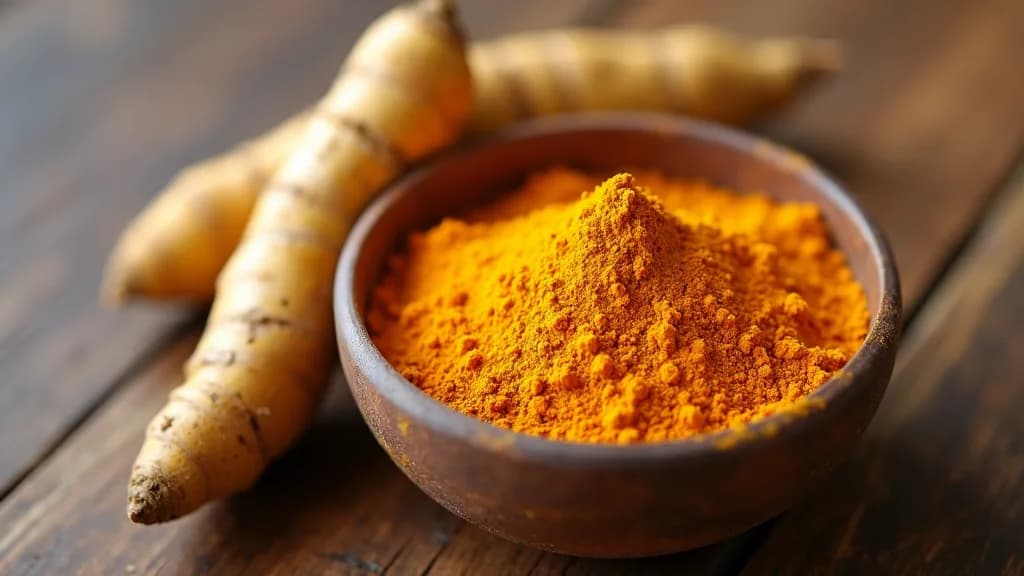
Turmeric is the golden-yellow spice at the heart of curry powder; curcumin is the plant compound inside it that most of the research is really about. When people talk about turmeric's health benefits, they usually mean curcumin (and its close relatives, the curcuminoids), which have been studied mainly for their anti-inflammatory and antioxidant activity. The honest summary: the science is promising in places, genuinely modest in others, and complicated everywhere by the fact that curcumin is hard for the body to absorb.
This guide separates what turmeric is marketed to do from what it has actually been shown to do, explains the bioavailability problem that shapes every supplement on the shelf, and flags the safety points that matter, especially if you take medication or are navigating perimenopause and menopause, when joint aches and inflammation questions come up often.
Turmeric vs. curcumin: not the same thing
The distinction is the single most useful thing to understand. Dried turmeric root is only a few percent curcuminoids by weight, so the small amount you sprinkle on food delivers a modest dose of the active compound. Concentrated curcumin extracts in capsules can pack many times more, often standardized to a high percentage of curcuminoids. That is why "I cook with turmeric" and "I take a high-absorption curcumin supplement" are two very different exposures, with different potential effects and different risks.
Culinary turmeric used in normal cooking amounts is widely considered safe and is treated as a food. Concentrated supplements are where the meaningful benefits and the meaningful cautions both live.
What the evidence actually shows
Inflammation and joint pain
The strongest signal for curcumin is in inflammation-related joint discomfort, particularly osteoarthritis. Several trials suggest curcumin supplements may reduce knee pain and stiffness for some people. That is encouraging, but the trials are often small and short, and they use different products and doses, which makes it hard to say precisely how well it works or for whom. The U.S. National Center for Complementary and Integrative Health describes the evidence on turmeric for conditions like osteoarthritis as limited and not yet conclusive. Think of curcumin as a reasonable adjunct some people find helpful, not a proven replacement for standard arthritis care.
Curcumin is better described as "shown to help modestly in some studies" than "clinically proven to treat" any condition. The gap between those two phrases is where most marketing lives.
Other commonly marketed uses
Curcumin is also promoted for heart health, metabolic markers, mood, skin, and more. Here the evidence is thinner and more preliminary. Laboratory and early human studies hint at effects on inflammatory markers, but these do not reliably translate into meaningful changes in how people feel or in hard health outcomes. The National Center for Complementary and Integrative Health notes that turmeric has not been convincingly shown to treat any specific health condition, which is a fair anchor for expectations.
The hype-check
Turmeric is often marketed as a cure-all for everything from cancer to Alzheimer's disease. Those claims run far ahead of the evidence. Curcumin behaves in the lab in ways that make it interesting to researchers, but it is also chemically unstable and poorly absorbed, which means test-tube results frequently fail to hold up in living people. Be skeptical of any product promising dramatic, whole-body transformation.
The absorption problem
Curcumin has a well-known weakness: on its own, it is poorly absorbed, rapidly metabolized, and quickly cleared from the body. Take a plain curcumin capsule and much of it may simply pass through. This "bioavailability problem" is why manufacturers add absorption enhancers, most famously piperine, a compound from black pepper that can substantially increase how much curcumin reaches the bloodstream. Other formulations use fats, phospholipids, or micronized and nanoparticle delivery systems to improve uptake.
Two practical consequences follow. First, dose numbers on labels are not directly comparable across products, because a "high-absorption" formula may deliver far more usable curcumin per milligram than a standard one. Second, the same piperine that boosts absorption of curcumin can also boost absorption of certain medications, which is a safety consideration rather than a bonus.
Forms and general dosing ranges
There is no official recommended dose for curcumin, and products vary widely. The table below is a general orientation, not a prescription.
| Form | What it is | Practical notes |
|---|---|---|
| Culinary turmeric | Ground spice used in cooking | Low curcumin content; treated as food; generally safe in normal amounts |
| Standard curcumin extract | Concentrated curcuminoids in capsules | Poorly absorbed alone; look at the standardized percentage |
| Curcumin + piperine | Extract paired with black-pepper compound | Better absorption; piperine can also affect drug levels |
| Enhanced-delivery formulas | Phospholipid, micronized, or nanoparticle curcumin | Marketed for higher uptake; quality and claims vary |
Doses used in studies commonly fall in a broad range of a few hundred milligrams to around one to two grams of curcuminoids per day, often split across the day and taken with food. Because formulations differ so much in absorption, more milligrams do not automatically mean better, and higher intakes are exactly where side effects and interactions become more likely. If you are considering regular, higher-dose use, that is a conversation to have with a clinician rather than a decision to make from a label.
Safety, side effects, and who should be cautious
In food amounts, turmeric is well tolerated. Concentrated supplements can cause digestive upset such as nausea, bloating, or diarrhea in some people, especially at higher doses. Beyond that, several specific cautions deserve attention:
- Blood thinners and antiplatelet drugs: Curcumin may affect clotting and could add to the effect of medications like warfarin or antiplatelet agents, potentially raising bleeding risk. This also matters around surgery.
- Other medications: Curcumin, and especially piperine-containing formulas, may alter how the body handles certain drugs, including some for diabetes and others processed by the liver. Higher blood levels of a medication can mean stronger effects or more side effects.
- Gallbladder problems: Turmeric can stimulate the gallbladder, so people with gallstones or bile-duct obstruction may want to avoid supplemental doses, as it could worsen symptoms.
- Pregnancy and breastfeeding: Turmeric as a spice in food is generally considered fine, but medicinal or high-dose supplement amounts are not well studied in pregnancy and are best avoided unless a clinician advises otherwise.
- Liver concerns and rare reactions: Rare cases of liver injury have been linked to some turmeric or curcumin supplements. Stop and seek care if you notice yellowing skin or eyes, dark urine, unusual fatigue, or right-upper-abdomen pain.
- Supplement quality: Supplements are not tightly regulated the way prescription drugs are. Choose products from reputable brands, ideally with independent third-party testing, since contamination and inaccurate labeling do occur.
Remember too that "high-absorption" supplements are not the same as the turmeric in your spice rack. Enjoying turmeric in cooking is a low-risk pleasure. Taking a concentrated, absorption-boosted extract every day is a genuine health decision worth reviewing with a professional.
A sensible way to think about it
If joint discomfort is your reason for interest, curcumin is a plausible thing to try under guidance, with realistic expectations: it may take the edge off for some, it will not work for everyone, and it does not replace evaluation of what is causing the pain. If you are chasing broader promises about heart, brain, or "detox" benefits, the evidence does not yet justify the marketing. Give any trial several weeks, watch how you feel, and stop if you notice side effects.
Above all, talk to a clinician before starting regular high-dose curcumin if you are pregnant, take any prescription medication, have gallbladder or liver problems, or are heading into surgery. Turmeric is a lovely, well-studied spice with a modest, real place in the supplement conversation, and it earns more trust when we describe it honestly rather than oversell it.