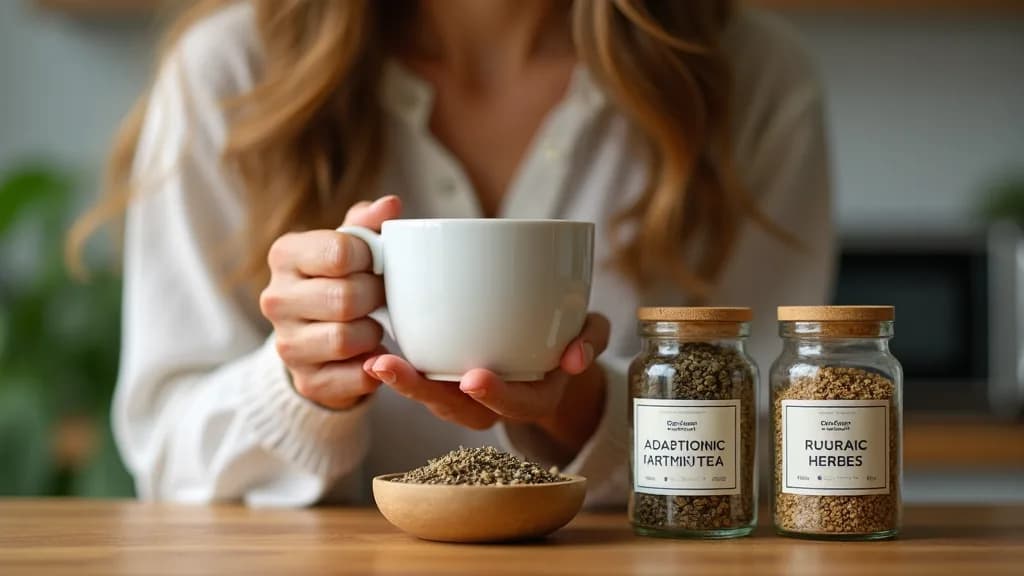
Adaptogens are plants — most famously ashwagandha, rhodiola, holy basil (tulsi) and ginseng — sold on the promise that they help your body "adapt to" and resist stress. The honest summary: the evidence is modest but real that ashwagandha can ease short-term stress and improve sleep, while support for the others is thinner or preliminary. None is a cure, quality varies widely, and a few carry genuine safety cautions that matter in midlife.
What "adaptogen" actually means
"Adaptogen" is a term coined by mid-20th-century researchers, not a formal pharmacological category recognized the way, say, "antihistamine" is. The idea is that certain herbs help the body maintain balance under physical or mental stress — nudging the stress-response system rather than sedating or stimulating it directly. It is a useful marketing story, and there is some biological plausibility, but the label alone tells you nothing about whether a given product works or is safe.
Most adaptogens are botanicals with long histories in Ayurvedic and traditional Chinese medicine. Modern interest focuses on their possible effects on the hypothalamic-pituitary-adrenal (HPA) axis — the network that governs cortisol, your main stress hormone. For a deeper look at that mechanism, see our guide to ashwagandha and cortisol.
What the evidence actually shows
Here is where honesty matters most. Research on adaptogens is uneven: some herbs have several small human trials, others rest largely on lab and animal work or tradition. Small studies, short durations and industry funding are common, so treat even the more promising findings as encouraging rather than settled.
| Herb | Commonly marketed for | What the evidence looks like |
|---|---|---|
| Ashwagandha (Withania somnifera) | Stress, anxiety, sleep | Strongest of the group, but still limited to small, mostly short-term trials suggesting modest benefit for perceived stress and sleep. |
| Rhodiola (Rhodiola rosea) | Fatigue, mental stamina | Preliminary; a handful of small studies hint at reduced fatigue, but results are mixed and quality is inconsistent. |
| Holy basil / tulsi | Stress, mood | Early-stage; a few small trials and traditional use, not enough to draw firm conclusions. |
| Ginseng (Asian/American) | Energy, fatigue | Studied for years with inconsistent results; any effect on stress or energy appears small. |
Ashwagandha: the best-supported, and still modest
If any adaptogen has earned cautious optimism, it is ashwagandha. Several small randomized trials report reductions in self-rated stress and anxiety, and some point to better sleep quality. The NIH Office of Dietary Supplements notes that these studies are generally short and small, so we cannot yet say how well it works, for whom, or for how long it is safe. Most of the trials used roughly 500–600 mg a day of a standardized extract, but a studied dose is not a proven one — more is not better. "Shown to help a little in small studies" is a fair reading — not "clinically proven to relieve stress."
Rhodiola, holy basil and ginseng: promising stories, thinner proof
Rhodiola is often sold for fatigue and burnout, and a few small studies are suggestive — but the trials are inconsistent and easy to over-read. Holy basil rests largely on traditional use and early research. Ginseng has been studied for decades with mixed, generally small effects. For all three, the marketing runs well ahead of the science.
An honest hype-check
Wellness marketing tends to make three moves worth resisting. First, it treats "adaptogen" as if it were a proven drug class — it is not. Second, it borrows the language of clinical research ("clinically studied," "standardized") to imply far more certainty than small, short trials support. Third, it promises to "balance hormones" or "lower cortisol" as though these were simple dials. Your stress physiology is not a dial, and a supplement that meaningfully changed a hormone system would also carry meaningful risks.
A realistic expectation: if an adaptogen helps you at all, the effect is likely to be modest and gradual, layered on top of — never instead of — sleep, movement, and the ordinary basics of stress management. As the NHS notes about herbal products generally, "natural" does not mean risk-free or well-tested.
Quality and standardization: the real weak link
Even setting the science aside, there is a practical problem: supplements are not regulated as tightly as medicines. As the NIH Office of Dietary Supplements explains, products are not required to prove they work — or even to verify their contents — before sale, and the actual amount of active compound can differ from the label. Two bottles labeled "ashwagandha" may contain different plant parts, extract strengths, and standardization — which makes it hard to compare studies to store shelves, or one product to another.
- Look for third-party testing. Independent verification (for example, USP, NSF, or ConsumerLab marks) checks that what is on the label is in the bottle. It does not prove the herb works, but it reduces the odds of contamination or mislabeling.
- Check the exact species and extract. "Ginseng," for instance, can mean several different plants. The plant part and standardization matter as much as the name.
- Be skeptical of proprietary blends. If a label hides doses inside a "stress complex," you cannot know what you are taking.
- More is not better. Higher doses can mean more side effects, not more benefit.
Safety: what women should know before trying an adaptogen
This is the part that gets glossed over in wellness content. Ashwagandha in particular has cautions that matter, and several apply disproportionately to women in midlife, who are more likely to take thyroid medication or manage autoimmune thyroid conditions.
- Thyroid medication and thyroid disease. Ashwagandha may raise thyroid hormone levels, which can interfere with thyroid medication and may not suit people with autoimmune thyroid disease. If you take levothyroxine or have Hashimoto's or Graves' disease, talk to your clinician first.
- Liver problems. There have been reports of liver injury linked to ashwagandha products. Anyone with liver disease — or who develops symptoms like unusual fatigue, dark urine, or yellowing of the skin or eyes — should stop and seek medical advice.
- Pregnancy and breastfeeding. Ashwagandha is not advised in pregnancy, and there is not enough safety information to recommend it while breastfeeding.
- Other medications and conditions. Adaptogens can interact with sedatives, blood-sugar and blood-pressure medicines, immune-modulating drugs and others. Because supplement quality varies, is only loosely regulated, and interactions are not fully mapped, a conversation with a pharmacist or clinician is the safest first step — especially if you take any prescription medicine.
- Autoimmune conditions. Herbs promoted to "boost" or "modulate" immunity deserve extra caution if you have an autoimmune condition; discuss them with your clinician.
A useful rule: any supplement powerful enough to change how you feel is powerful enough to interact with a medicine or a condition. That is a reason to involve a clinician, not to skip one.
When stress is more than stress
Adaptogens are not a treatment for depression, an anxiety disorder, or burnout that has tipped into something harder to manage. If low mood, worry, or exhaustion is interfering with your daily life, that deserves real care, not a supplement. Talk to your doctor or a mental-health professional. If you are in crisis or having thoughts of harming yourself, get help right away — in the US you can call or text 988 (Suicide and Crisis Lifeline) any time, day or night.
How to decide, sensibly
If you are curious and otherwise healthy, an adaptogen is unlikely to be the thing that transforms your stress — but a well-tested product, at a sensible dose, tried for a defined period, is a low-stakes experiment for many people. A grounded approach:
- Start with the basics. Sleep, regular movement, and social and mental-health support have far stronger evidence for stress and mood than any adaptogen. During perimenopause and menopause, when sleep and mood often wobble, these foundations matter most.
- Pick one product, one variable. Trying several supplements at once makes it impossible to tell what — if anything — is helping or causing side effects.
- Give it a defined trial. Decide in advance how long you will try it and what "better" would look like, then reassess honestly.
- Loop in your clinician or pharmacist. Especially if you take thyroid, blood-pressure, blood-sugar, sedative or immune medications, or have liver or autoimmune disease.
- Stop if something feels off. New symptoms are a signal to pause and get advice, not to push through.
The bottom line
Adaptogens are not magic, but they are not nothing either. Ashwagandha has the most credible — if still modest and preliminary — evidence for short-term stress and sleep; rhodiola, holy basil and ginseng are more marketing than proof for now. The bigger issues are practical: inconsistent product quality, loose regulation, and real interactions with thyroid medication, liver health and pregnancy. Treat these herbs as a small, optional add-on to well-tested stress basics, choose third-party-tested products, and talk to a clinician before you start — particularly if you take any other medicine.
Related: If you're exploring botanicals for inflammation and midlife wellbeing, see how one of the most-studied kitchen spices measures up in Turmeric and Curcumin: Benefits, Evidence, and Cautions.