Ashwagandha is the most-searched supplement in the stress-and-cortisol space, marketed everywhere as a calming "adaptogen." This is the honest, safety-first companion to our focused review of ashwagandha for cortisol: here we dig into what the evidence really supports and, just as importantly, the safety details the hype tends to skip.
What is ashwagandha?
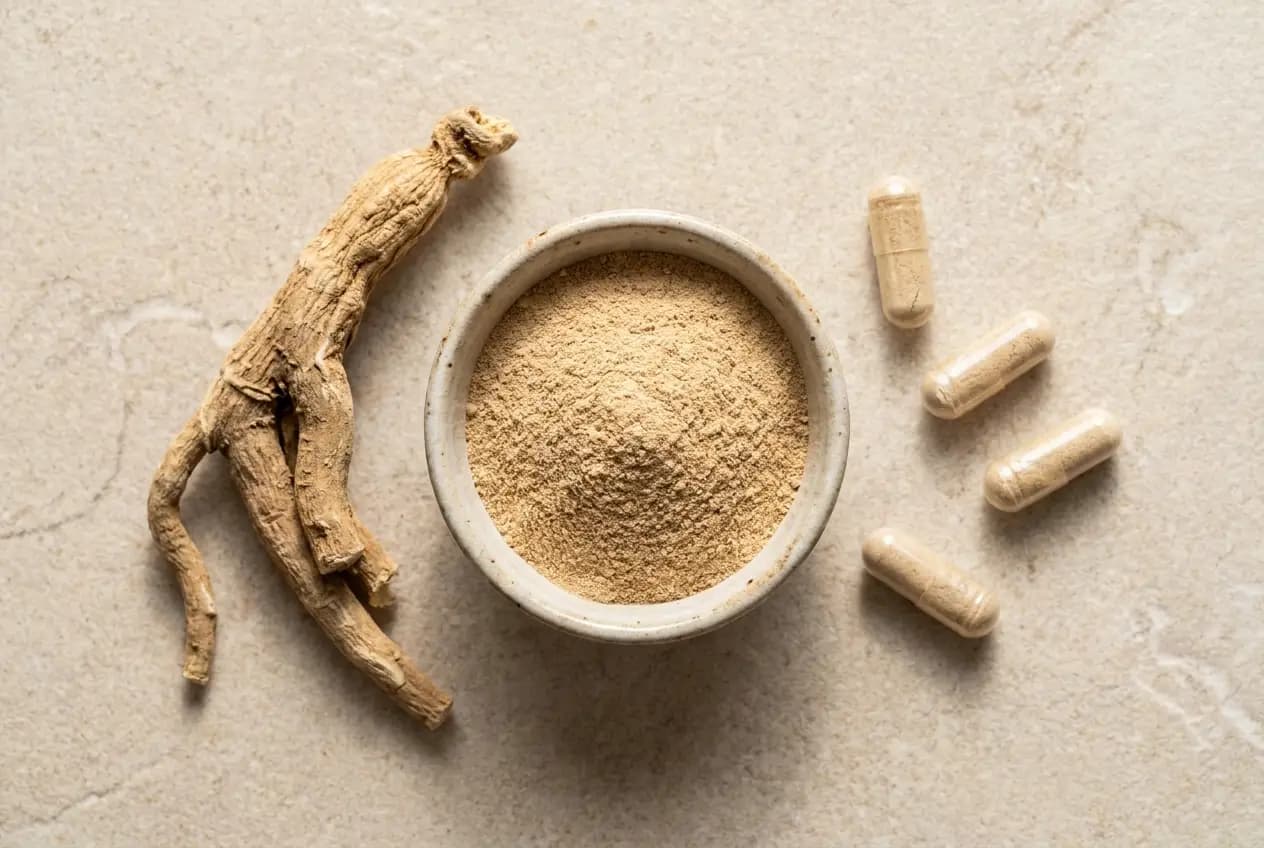
Ashwagandha (Withania somnifera) is a small shrub whose root has been used for centuries in Ayurvedic traditional medicine. Today it is sold as a capsule, powder or tincture and promoted as an adaptogen — a loosely defined wellness term for substances claimed to help the body "resist stress." That label is popular in marketing, but it is not a precise medical category, so treat any "adaptogen" claim as a starting point for questions, not proof of benefit.
Does ashwagandha work for stress and cortisol?
Here is the honest picture. A number of small-to-moderate randomised controlled trials have tested standardised ashwagandha root extracts against placebo, usually over 6 to 12 weeks. Several reported modest improvements in self-rated stress and anxiety, and some measured lower morning cortisol in the ashwagandha group. On the surface, that sounds encouraging — but the caveats are real and worth stating plainly:
- The studies are mostly small and short — often a few dozen to a couple of hundred people over a few weeks. That cannot tell us about long-term effects.
- Many are industry-funded or use a specific branded extract, which can bias results toward the positive.
- Quality and design vary widely, and stress and anxiety scores are subjective and prone to placebo effects.
- Results are not consistent across every trial or outcome.
So the fair summary is: ashwagandha may modestly lower perceived stress, anxiety and cortisol for some people over a few weeks or months — but the evidence is preliminary, not definitive. It is promising-but-not-proven, and it is not a cure for stress, anxiety or any cortisol problem. Remember, too, that cortisol is a vital hormone with a natural daily rhythm; you cannot "flush" or "reset" it, and a healthy person does not need to lower it (see our cortisol detox myth explainer and what cortisol is).
The foundations beat any supplement
This is the part the marketing skips. No supplement — ashwagandha included — outperforms the basics for managing stress and a healthy stress response:
- Sleep is the single biggest lever. Poor sleep drives stress and disrupts your circadian rhythm (see cortisol and sleep and why sleep matters).
- Regular movement reliably reduces stress and improves mood — more so than any pill (benefits of exercise).
- Day-to-day stress management — breathing, boundaries, time outdoors, social connection and, when needed, talking therapy.
If you want a structured plan, start with our guide on how to lower cortisol. A supplement, at best, is a small add-on to those foundations — never a replacement.
How ashwagandha is used
Studies typically use a standardised root extract (sometimes standardised to a set percentage of compounds called withanolides), taken daily for several weeks. Forms and strengths on the shelf vary enormously, and that inconsistency is one reason results are hard to compare. We do not give prescriptive dosing here, because the right choice — if any — depends on your health, your medications and your goals. A pharmacist or clinician can advise on whether it is sensible for you and at what amount, and this is genuinely worth doing before you start.
Is ashwagandha safe? The most important section
For most healthy adults, short-term ashwagandha is generally well tolerated, with mild side effects such as stomach upset, drowsiness or loose stools. But "natural" does not mean "harmless," and there are specific situations where caution — or avoidance — is warranted.
Who should be especially careful or avoid it
| Situation | Why it matters |
|---|---|
| Thyroid medication or thyroid disease | Ashwagandha may interact with thyroid medicines, and has been reported to raise thyroid hormone levels in some people — so it could push levels too high. Use caution if you have a thyroid condition, watch for overactive-thyroid symptoms, and check with your prescriber first. |
| Pregnancy or breastfeeding | Not advised — it is generally considered unsafe in pregnancy, and there is too little safety data while breastfeeding. |
| Autoimmune conditions | It may stimulate the immune system, which can be a concern in autoimmune disease. |
| Sedatives or sleep medication | It may add to drowsiness and increase the sedative effect. Avoid driving or operating machinery until you know how it affects you. |
| Diabetes or blood-pressure medication | It may lower blood sugar and blood pressure, which can add to the effect of these medicines. Monitor and discuss with your prescriber (see type 2 diabetes). |
| Scheduled surgery | Because of its sedative effect, many clinicians advise stopping it well before surgery (commonly about two weeks). Tell your surgical team about any supplements. |
| Immunosuppressant medication | Possible interaction; check with your prescriber first. |
| Liver problems | There are rare reports of liver injury linked to ashwagandha products. Stop and seek care for warning signs (below). |
Signs of a liver problem — stop and seek care
Rarely, ashwagandha has been linked to liver injury. Stop taking it and seek medical care promptly if you notice yellowing of the skin or eyes (jaundice), dark urine, unusual tiredness, nausea, loss of appetite or pain in the upper-right abdomen.
Supplements are not tightly regulated
In most countries, supplements are not reviewed for safety and effectiveness before sale the way medicines are. Purity, dose and quality vary between products, and some have been found to contain contaminants or amounts that differ from the label. If you do try it, choosing a product with independent third-party testing reduces — but does not eliminate — that risk.
How ashwagandha fits the bigger picture
Ashwagandha sits within a wider supplement story that we cover honestly in our guide to cortisol supplements. The same rule applies across the board: limited, mixed evidence, real safety caveats, and no product that "balances your hormones." Whole-diet patterns deserve the same realism — there is no single food or pill that lowers cortisol on its own (see foods that lower cortisol).
Context matters, too. Many symptoms people blame on "high cortisol" — fatigue, low mood, weight changes, poor sleep — are nonspecific and overlap with stress, perimenopause, thyroid problems and anxiety. (See high cortisol symptoms for why those signs alone do not prove a cortisol disorder.) Anxiety in particular is its own condition, not just "too much cortisol," and it is very treatable with the right help (see understanding anxiety). Reaching for a supplement can delay finding the real cause. Note also that "adrenal fatigue" is not a recognised medical diagnosis; genuine cortisol disorders involving the adrenal glands — Cushing's syndrome (too much cortisol) and Addison's disease (too little) — are uncommon, serious and diagnosed by a clinician with tests.
When to see your doctor
Talk to a clinician or pharmacist before starting ashwagandha, and especially if you are:
- Pregnant or breastfeeding, or trying to conceive.
- Taking any regular medication — particularly thyroid medicine, sedatives, diabetes or blood-pressure medicines, or immunosuppressants.
- Living with a thyroid, liver or autoimmune condition, or have surgery coming up.
Stop and seek urgent care for signs of liver trouble (jaundice, dark urine, severe tiredness, upper-right abdominal pain). Seek urgent medical help, too, for possible adrenal insufficiency (Addison's) — severe weakness, dizziness or fainting, vomiting, abdominal pain, confusion, or very low blood pressure, which can become a medical emergency. And book a routine appointment if persistent stress, low mood, anxiety, fatigue or sleep problems are affecting your daily life — these are worth assessing properly rather than self-treating with a supplement.
If you are having thoughts of harming yourself or feel unable to keep yourself safe, this is an emergency. Contact your local emergency services or a suicide-and-crisis helpline right away, or go to your nearest emergency department. You deserve support, and help is available. Ashwagandha may have a small place for some people, but the foundations and a proper diagnosis come first.