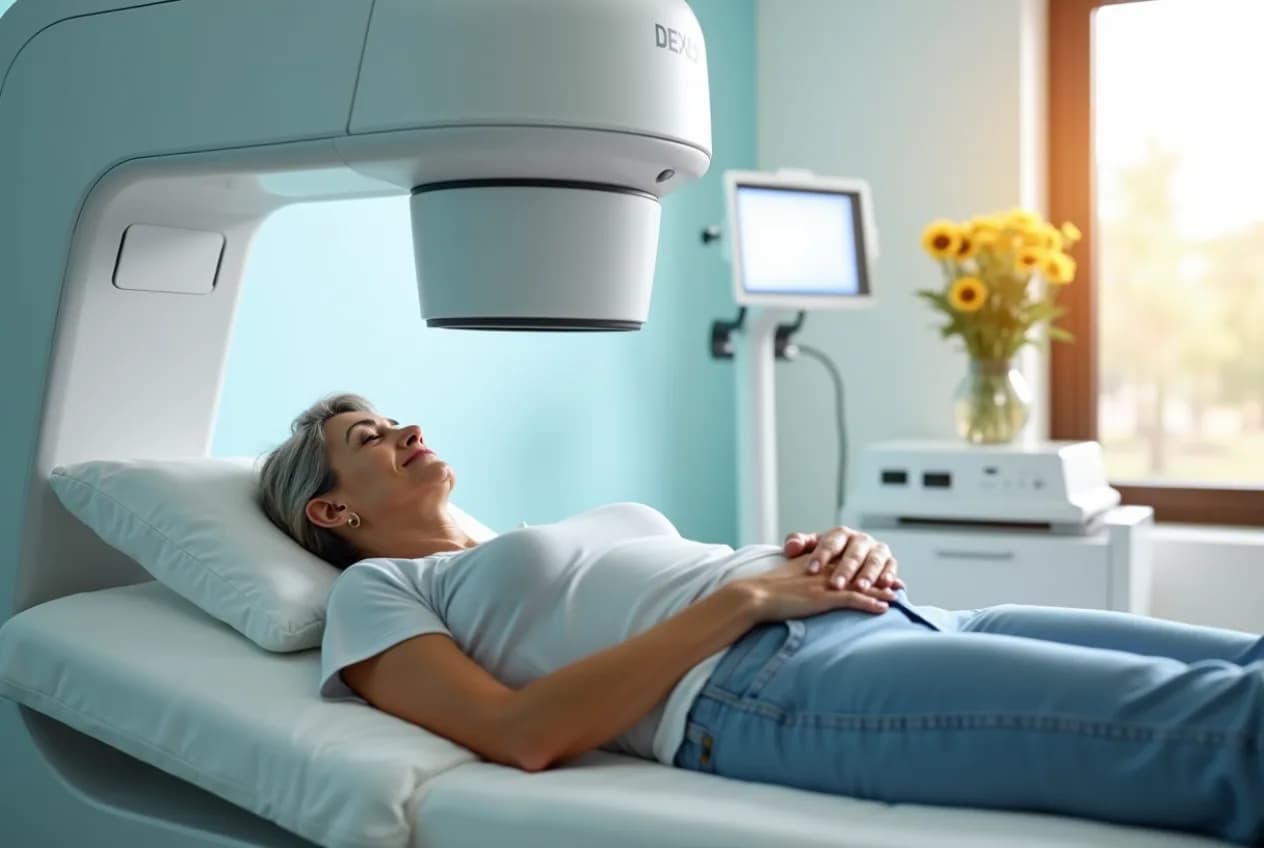
Short answer: a DEXA (also written DXA) scan is the medical reference standard for diagnosing osteoporosis. It uses a low-dose X-ray to measure how dense your bones are at the hip and spine and reports the result as a T-score. Most "at-home bone health" tests do something quite different: they measure bone-turnover markers in blood or urine, or use heel ultrasound. These can be interesting, but they cannot produce a diagnostic T-score and cannot diagnose osteoporosis. For that, you still need a DXA scan.
The quick comparison
| Test | What it measures | Can it diagnose osteoporosis? | When it is useful | Cost and access |
|---|---|---|---|---|
| DEXA / DXA scan | Bone mineral density at the hip and spine, reported as a T-score. | Yes — it is the reference standard. A T-score of -2.5 or lower means osteoporosis. | Screening women 65+ (and younger postmenopausal women with risk factors), diagnosing osteoporosis, and tracking bone density over time. | Ordered by a clinician; free on the NHS when indicated and usually covered by US insurance for those who meet criteria. Self-pay prices vary. |
| At-home bone-turnover or heel-ultrasound tests | Bone-turnover markers (e.g. CTX, P1NP) show the rate of remodeling; heel ultrasound estimates density at a peripheral site. | No — they cannot produce a diagnostic hip-and-spine T-score. | Raising awareness or flagging possible low bone density; turnover markers may help clinicians monitor treatment. | Bought directly by the consumer and paid out of pocket; prices vary. A low result should be confirmed with DXA. |
What a DEXA (DXA) scan measures
DEXA stands for dual-energy X-ray absorptiometry. A central DXA scan measures bone mineral density (BMD) at the hip and lower spine, the sites where fractures do the most damage. The scan is quick, painless, and uses a very low dose of radiation.
Your result comes back as a T-score, which compares your bone density with that of a healthy young adult. Broadly:
- -1.0 or above: normal bone density.
- Between -1.0 and -2.5: low bone mass, sometimes called osteopenia.
- -2.5 or lower: osteoporosis.
Because it directly measures density at the hip and spine, DXA is the test that guidelines rely on to diagnose osteoporosis and to track bone density over time. Clinicians often combine the T-score with a fracture-risk tool (such as FRAX) to estimate your chance of breaking a bone. Our bone-fracture-risk tool and the bone-health hub can help you understand where you stand before an appointment.
What at-home "bone health" tests actually measure
Bone-turnover markers
Some direct-to-consumer kits measure bone-turnover markers in a finger-prick blood sample or in urine, for example CTX (a marker of bone breakdown) and P1NP (a marker of bone formation). These show how fast your bone is being remodeled right now, not how much bone you actually have. Levels swing with the time of day, whether you have eaten, and recent exercise, so they are hard to interpret on their own. Clinicians mainly use them to watch how someone is responding to treatment, not to make the initial diagnosis.
Heel (peripheral) ultrasound
Other tests, often offered at pharmacies, health fairs, or as portable kits, use quantitative ultrasound (QUS) at the heel. This estimates bone quality at a peripheral site and can flag people who might have low bone density. But it does not give the hip-and-spine T-score used for diagnosis. A low heel-ultrasound result is treated as a prompt to arrange a proper central DXA scan, not as a diagnosis in itself.
So are at-home tests useless?
No, but it is important to be clear about what they can and cannot do. At their best, at-home tests raise awareness and may nudge someone toward a conversation with their clinician. What they cannot do is confirm or rule out osteoporosis. If an at-home result worries you, the sensible next step is a DXA scan, not a treatment decision. An at-home test is not a substitute for a DXA scan.
Cost and access
A DXA scan is ordered by a clinician. It is free on the NHS when indicated and is usually covered by insurance in the US for people who meet screening criteria; self-pay prices vary by clinic. At-home turnover-marker kits and heel-ultrasound screens are bought directly and paid out of pocket, with prices that vary widely. Spending money on an at-home test that cannot diagnose osteoporosis, when a covered DXA may be available to you, is worth weighing up.
Who should get a DXA scan?
Major guidelines recommend bone-density screening with DXA for all women aged 65 and over, and for younger postmenopausal women who have risk factors such as low body weight, smoking, a family history of hip fracture, or a previous fragility fracture. Because the drop in estrogen around menopause speeds up bone loss, the years around this transition are a sensible time to ask about your bone health. You can read more about the stages of menopause and about bone-supporting nutrition such as calcium and vitamin D.
Bone density, fracture risk, and any treatment are individual decisions. This article is general information, not medical advice, so talk to your clinician about which test is right for you and how to read the results.