If your clinician has suggested a bone density test, you may be wondering what the scan involves and what the numbers mean. The good news: a DEXA scan is fast and painless, and your T-score is far easier to read than it first looks. Here is what a bone density scan measures, how to interpret your results, and why one number is never the whole story.
What is a DEXA scan?
A DEXA scan (also written DXA, short for dual-energy X-ray absorptiometry) is the standard bone density test. It is a quick, painless, low-radiation X-ray that measures your bone mineral density — essentially, how much mineral is packed into your bones, which reflects their strength. The scan usually focuses on the hip and lower spine, the sites where fragility fractures matter most.
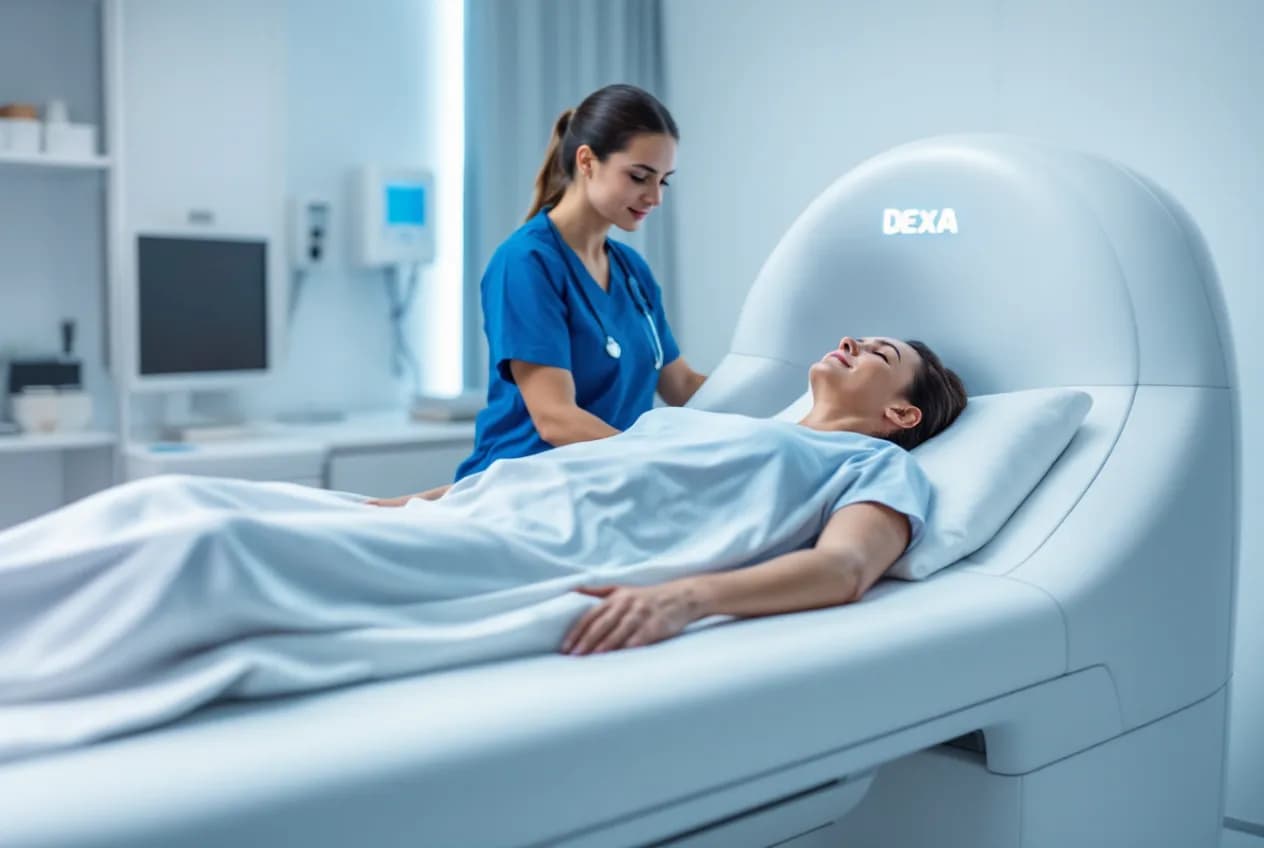
The radiation dose is very low, often comparable to a day or two of normal background exposure. You lie on a padded table while a scanning arm passes overhead. There are no needles, no enclosed tunnel, and most scans take only 10 to 20 minutes.
How the test is done
One of the easiest parts of a bone density scan is the preparation, because there usually isn't any. You can eat and drink normally beforehand. A few practical notes:
- Wear comfortable, loose clothing without metal zips, buttons, or clasps near the hip and spine.
- You may be asked to skip calcium supplements for about 24 hours beforehand, since undissolved tablets can affect the reading.
- Tell the technician if you have recently had a barium study, contrast dye, or could be pregnant.
You stay fully clothed, lie still for a few minutes, and that's it. There is no recovery time and you can drive yourself home.
Understanding your T-score
Your DEXA scan results are reported mainly as a T-score. This compares your bone density with that of a healthy young adult at peak bone mass. Each whole number is one standard deviation away from that reference point — the more negative the number, the lower your bone density.
| T-score | What it means |
|---|---|
| -1.0 and above | Normal bone density |
| Between -1.0 and -2.5 | Osteopenia (lower-than-normal bone density) |
| -2.5 or lower | Osteoporosis |
It helps to keep osteopenia in perspective: it is not a disease and not a guarantee that osteoporosis will follow. Many people in this range never need medication; the result simply flags that bone health deserves attention. Diagnosis also isn't purely about the number — osteoporosis can be diagnosed clinically if you break a bone from a minor fall, whatever your T-score says.
What about the Z-score?
Your report may also list a Z-score, which compares your bone density with other people of your same age, sex, and body size rather than a young adult. A notably low Z-score can prompt a clinician to look for an underlying cause of bone loss beyond aging. For most postmenopausal women, though, the T-score is the number that guides screening decisions.
Why menopause changes the picture
Estrogen helps protect bone, so the natural drop during the menopause transition speeds up bone loss — which is a large part of why osteoporosis is far more common in women. Bone loss can accelerate in the years around your final period, sometimes before any test is ordered. If you want the fuller story, see menopause and bone loss and how it relates to low-estrogen symptoms. For some women, hormone therapy can help protect bone, but it is an individualized decision weighing personal benefits and risks with a clinician.
Who should be screened, and when
Bone density screening is generally recommended for:
- All women aged 65 and older.
- Postmenopausal women younger than 65 with added risk factors, such as early or surgical menopause, a previous fragility fracture, low body weight, smoking, long-term steroid use, or a family history of hip fracture.
If you went through menopause early, that alone can be a reason to screen sooner. Men with risk factors and anyone on long-term bone-thinning medication may also be screened. Your clinician decides timing based on your overall picture, not age in isolation.
The FRAX tool and putting the score in context
A T-score is most useful when combined with your other risk factors. The widely used FRAX tool does exactly that: it blends your bone density (or even just clinical factors) with age, weight, smoking, prior fractures, and family history to estimate your 10-year probability of a major or hip fracture. Two people with the same T-score can have quite different fracture risks once these are weighed — which is why the score is one input, not a verdict.
This is also where prevention fits in. Whatever your number, the everyday basics support bone health:
- Calcium and vitamin D. Calcium is best obtained from food, and more is not better; most adult women are guided toward roughly 1,000-1,200 mg of calcium a day from diet first. There is genuine debate about whether high-dose calcium supplements modestly affect heart risk, so supplement only to fill a gap, not to exceed it. Vitamin D (commonly around 600-800 IU a day for older adults) helps your body use calcium, but mega-dosing does not build extra bone and can cause harm — aim for sufficiency, not megadoses.
- Weight-bearing and strength exercise. Regular loading and muscle work help maintain bone and, importantly, prevent falls. Exercise alone won't reverse established osteoporosis, and if your spine is fragile, some high-impact moves and forward-bending or crunch-type flexion can be unsafe — get individualized guidance first.
- Not smoking and keeping alcohol moderate, both of which support bone over time.
If treatment is warranted, see osteoporosis treatment options. Medications such as bisphosphonates and denosumab are clinician decisions; their rare side effects (jaw osteonecrosis and atypical thigh-bone fracture) get a lot of attention, but for people who genuinely need treatment the fracture-prevention benefits usually outweigh these uncommon risks.
How often is it repeated?
A bone density test is usually not repeated every year. Depending on your result and risk, follow-up scans are often spaced around two years apart, and sometimes longer if your bones are healthy and stable. Bone changes slowly, so scanning too frequently rarely adds useful information and can simply pick up measurement noise rather than real change. Your clinician sets the interval based on your T-score, your FRAX risk, and whether you are on treatment.
When to talk to a healthcare provider
Your DEXA scan results should always be interpreted with a clinician alongside your overall fracture risk — not read in isolation from a printout. When you discuss your scan, it helps to ask:
- What does my specific T-score mean for my fracture risk?
- What is my FRAX score, and does it suggest treatment, monitoring, or simply healthy habits?
- What should I do next, and when should I be rescanned?
Speak with a clinician promptly if you have lost height, developed a stooped posture, had back pain that came on suddenly, or broken a bone from a minor fall — these can signal a fracture that needs assessment. Osteoporosis is usually diagnosed by a bone-density scan rather than by symptoms, so a test is the clearest way to know where you stand. Your T-score is a useful starting point for that conversation, not the final word on your bone health.
Related: a side-by-side look at osteoporosis medication options — if your T-score points toward treatment, this matrix outlines how the main drug classes differ so you can discuss them with your clinician.
A density result is only half of a fracture-risk picture. The other half is FRAX, which combines your density with age, weight, previous fractures and family history to estimate ten-year fracture probability — and which has some blind spots worth knowing before you trust the number.