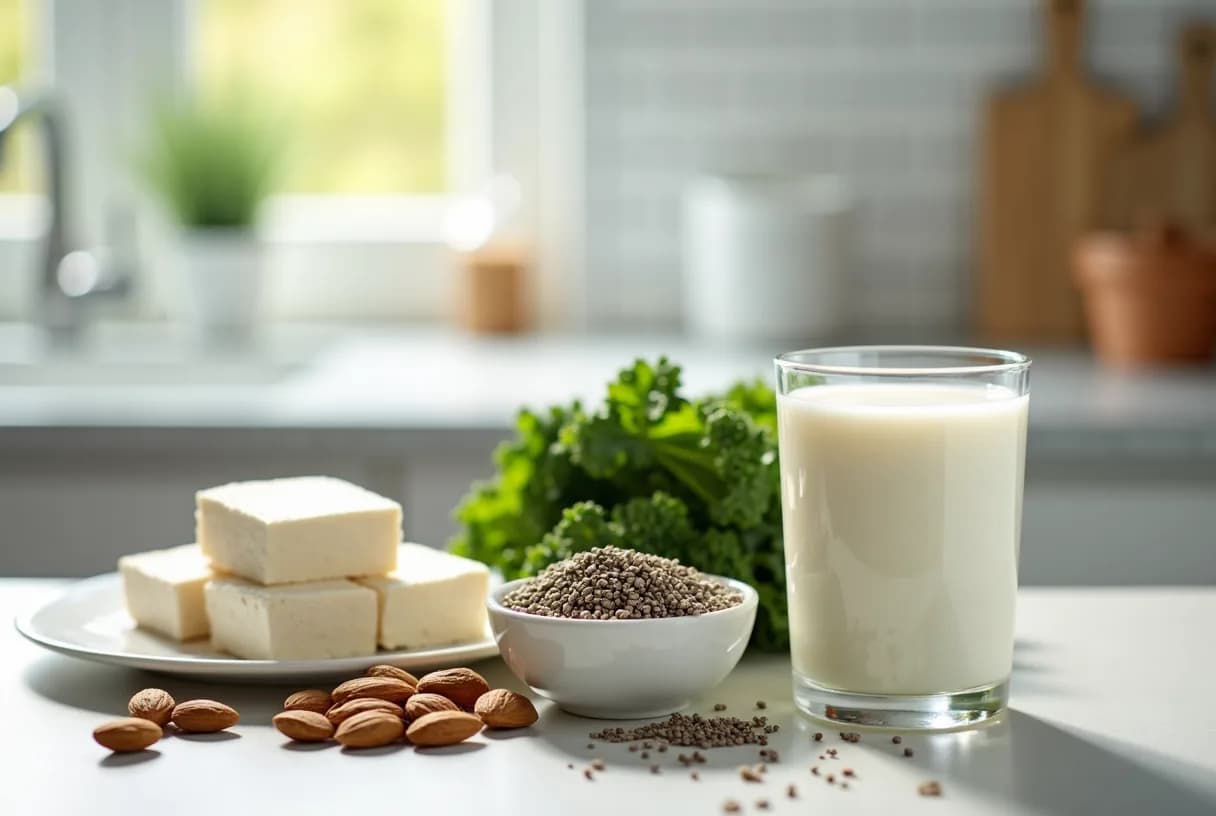
Women aged 19–50 need about 1,000 mg of calcium a day; from age 51 the target rises to 1,200 mg. You get there fastest with a few concentrated sources — a cup of plain yogurt (415 mg), 1.5 oz of cheddar (307 mg), 3 oz of canned sardines eaten with the bones (325 mg), half a cup of calcium-set tofu (253 mg), or a well-shaken glass of fortified plant milk (300–450 mg) — spread across the day rather than taken in one hit. Leafy greens count too, but only the low-oxalate ones: kale and bok choy are well absorbed, spinach essentially is not.
How much calcium do women actually need?
These are the US Recommended Dietary Allowances from the NIH Office of Dietary Supplements (ODS). They refer to total calcium — food plus supplements — not food alone.
| Age | Recommended daily amount | Upper limit (total, food + supplements) |
|---|---|---|
| 14–18 | 1,300 mg | 3,000 mg |
| 19–50 | 1,000 mg | 2,500 mg |
| 51 and over | 1,200 mg | 2,000 mg |
| Pregnant or breastfeeding, 19+ | 1,000 mg | 2,500 mg |
One honest caveat before you treat 1,200 mg as a law of physics: national targets disagree. The UK's reference intake for adults is 700 mg, and the NHS considers that achievable from an ordinary diet. The gap exists because different expert panels made different assumptions about calcium balance studies, not because one country's bones are different. The practical read: somewhere in the 700–1,200 mg range from food is a reasonable landing zone for most women, and there is no evidence that pushing well above your requirement buys extra bone.
Which foods are actually worth counting?
Milligrams on a label are not milligrams in your skeleton. What matters is absorbed calcium — the fraction that survives your gut. ODS puts absorption at about 5% for spinach and roughly 30% for dairy and fortified foods, while balance studies put low-oxalate greens such as bok choy above 50%. A food's real contribution can therefore be many times better or worse than its raw number suggests. The right-hand column below is the one to plan around.
| Food | Realistic serving | Calcium (mg) | Approx. absorbed | Roughly absorbed (mg) |
|---|---|---|---|---|
| Plain low-fat yogurt | 1 cup (8 oz) | 415 | ~30% | ~125 |
| Calcium-fortified orange juice | 1 cup | ~350 | ~35% | ~120 |
| Canned sardines, with bones | 3 oz (about one tin) | 325 | ~30% (est.) | ~95 |
| Cheddar cheese | 1.5 oz (a matchbox) | 307 | ~30% | ~90 |
| Fortified soy, oat or almond milk | 1 cup, shaken | 300–450 (check label) | ~24% | ~70–110 |
| Cow's milk (any fat level) | 1 cup | 275–300 | ~30% | ~85–90 |
| Tofu set with calcium sulfate | ½ cup, firm | 253 | ~31% | ~80 |
| Canned pink salmon, with bones | 3 oz | 181 | ~30% (est.) | ~55 |
| Bok choy, cooked | 1 cup | ~160 | ~54% | ~85 |
| Chia seeds | 2 tbsp | ~150 (ODS lists 76 mg per tbsp) | Not well studied | Count conservatively |
| White beans, canned | ½ cup | ~95 | ~22% | ~20 |
| Kale, cooked | 1 cup | ~95 | ~40–50% | ~40–45 |
| Almonds | 1 oz (about 23) | 76 | ~21% | ~16 |
| Spinach, cooked | 1 cup | 245 | ~5% | ~12 |
Three things the table won't tell you:
- Fortified drinks separate. The added calcium settles at the bottom of the carton — the Bone Health & Osteoporosis Foundation makes a point of telling people to shake the container well. An unshaken pour can deliver a fraction of what the label promises.
- Plant milks are not interchangeable. Fortification is voluntary. Some organic and "barista" lines contain almost no calcium at all. Read the actual label, not the category.
- The bones are the point. Canned sardines and salmon are calcium foods only because the bones are softened and edible. Boneless fillets contribute almost nothing.
Why doesn't spinach count as a calcium food?
Spinach is loaded with oxalate, which binds calcium into a compound your gut cannot take up. In human absorption studies, roughly 5% of spinach's calcium is absorbed, against about 40–50% for kale, ~54% for bok choy, and ~30% for milk and other dairy. So a cup of cooked spinach that shows 245 mg on paper delivers around 12 mg you can actually use — you would need roughly ten cups of it to match the usable calcium in a single cup of yogurt. The NHS is unusually blunt for a government page: it lists green leafy vegetables as a calcium source, then adds "but not spinach."
Spinach is still an excellent food (folate, vitamin K, dietary nitrate). It is simply not a calcium food. The same discount, more mildly, applies to almonds, beans and chia, where oxalate and phytate blunt absorption: count them, don't build on them. Cruciferous greens — kale, bok choy, broccoli, turnip greens, collards — are low in oxalate, and they are the leafy greens that genuinely move your number.
One counterintuitive point if you have ever had a kidney stone: the National Kidney Foundation advises people who form calcium oxalate stones not to reduce the calcium in their diet. Calcium eaten with an oxalate-containing meal binds oxalate in the gut, so less of it reaches the kidney. The intake it recommends for preventing calcium stones is the same 1,000–1,200 mg a day, from food, taken with meals. Cutting calcium to prevent stones is an old idea that backfired.
Does it matter when you eat calcium?
Yes — and this is the most actionable thing on the page. Absorption efficiency falls as the size of a single dose rises. ODS is specific about it: calcium is absorbed best in amounts of 500 mg or less at one time, and the body takes up about 36% of a 300 mg dose but only about 28% of a 1,000 mg dose. Three modest servings across a day therefore beat one large hit — which is exactly the argument against relying on a single big supplement, and exactly why a yogurt-plus-cheese-plus-sardines pattern works so well.
Two more absorption levers:
- Vitamin D. Vitamin D is required for calcium to be absorbed by active transport in the gut; without enough of it you take up a smaller share of whatever calcium you eat. The two are a pair, not alternatives — see our guide to calcium and vitamin D for bones and the signs of vitamin D deficiency.
- Medication timing. Calcium blocks the absorption of iron, levothyroxine, and several antibiotics (tetracyclines, fluoroquinolones). That is a spacing problem, not a reason to stop anything: keep taking your prescription and ask your pharmacist how far to separate it from calcium-heavy meals or supplements. Our interaction checker and the piece on the best time to take iron cover the common clashes. Never change a prescribed medicine on the basis of an article.
What does a 1,200 mg day actually look like?
Two worked days that clear the target without a single supplement.
Dairy-based day (~1,190 mg):
- Breakfast: 1 cup plain yogurt, with chia stirred in — 415 mg (chia not counted)
- Lunch: 1.5 oz cheddar in a sandwich — 307 mg
- Across the day: 1 cup of milk in coffee or tea — 300 mg
- Dinner: 1 cup cooked kale — 95 mg
- Snack: 1 oz almonds — 76 mg
Dairy-free day (~1,310 mg):
- Breakfast: 1 cup shaken fortified soy milk over cereal — 300 mg
- Mid-morning: a small glass (½ cup) of fortified orange juice — 175 mg
- Lunch: canned sardines (3 oz) on toast, with ½ cup canned white beans in a side salad — 325 + 95 = 420 mg
- Dinner: ½ cup calcium-set tofu stir-fried with 1 cup bok choy — 253 + 160 = 413 mg
Notice that in both days no single eating occasion exceeds about 500 mg — the calcium is spread, which is what your gut prefers. The dairy-free day lands comfortably above 1,200 mg, and that is the point: going without dairy is not the obstacle people assume, as long as the tofu is calcium-set and the carton gets shaken. If you want the meals rather than the arithmetic, our recipes and nutrition sections are built around these foods.
Food first, then supplement — and why more isn't better
The correct use of a calcium supplement is to close a measured gap, not to replace food. Add up a typical day using the table above. If you land at 800 mg and your target is 1,200 mg, you need roughly 400 mg — not 1,000 mg "to be safe."
Why the restraint? The evidence for supplemental calcium is genuinely weaker than the marketing:
- The US Preventive Services Task Force recommends against daily supplementation with 1,000 mg or less of calcium plus 400 IU or less of vitamin D for the primary prevention of fractures in community-dwelling postmenopausal women (Grade D, 2018), and finds the evidence for higher doses insufficient to judge either way (Grade I); the recommendation is currently being updated. That verdict is about supplements in generally healthy women. It is not an argument against dietary calcium, and it does not apply to women being treated for osteoporosis.
- In the Women's Health Initiative trial, calcium plus vitamin D supplements raised the risk of kidney stones by about 17% (hazard ratio 1.17).
- A possible cardiovascular signal from calcium supplements has been argued over for more than a decade, and the NIH's own assessment is that the evidence remains inconclusive. No such signal has been found for calcium from food. That asymmetry is the strongest argument for the food-first rule.
- The Bone Health & Osteoporosis Foundation is blunt about it: there is no added benefit to taking more calcium than you need, and doing so may bring constipation, kidney stones, and perhaps excess heart calcification.
If you do supplement: calcium carbonate is cheap but depends on stomach acid, so it is taken with food — and it dissolves less well if you are on a long-term acid-suppressing drug. Calcium citrate is absorbed with or without food and is the usual choice for people on acid suppression or after bariatric surgery. Either way, split it into doses of 500 mg or less, and take the amount your clinician or pharmacist agrees you actually need. Our supplement scorecard, supplements hub and ingredient explainers cover forms and dosing, while calcium vs magnesium and vitamin K2 answer the two most common "what else should I take?" questions. Calcium is only one lever, though — loading your bones and understanding menopausal bone loss matter at least as much.
What your blood calcium result does — and doesn't — tell you
This trips people up, so it is worth being precise: a serum calcium result on a routine panel is not a measure of your calcium intake. ODS says it plainly — blood levels are under such tight homeostatic control that they do not reflect nutritional status. Your body defends blood calcium within a narrow range at almost any cost, including dissolving bone to do it. You can eat 400 mg a day for a decade, lose real bone density, and still have a perfectly normal calcium level. A normal result is not permission to stop paying attention.
It runs the other way too. A calcium that comes back high is a clue, not a diagnosis. The most common outpatient explanation is primary hyperparathyroidism, but thiazide diuretics, lithium, dehydration, high-dose supplements and other conditions all move the number. Serum calcium in healthy people typically runs around 8.8–10.4 mg/dL — but reference ranges differ between laboratories and assays, so the same blood can read "borderline" at one lab and "normal" at another. Always read your result against the range printed on your own report, and remember that one reading, interpreted by someone who knows your medications, symptoms and history, is worth more than any range you find online. Our lab results decoder explains what the panel is showing; it does not replace the person reading it.
And if you want a number that actually tracks bone, it is a DXA scan, not a blood test: a bone mineral density scan is the one common test that reflects your cumulative calcium status over a lifetime. The fracture risk check and our bone health hub cover who should be scanned, and when.
When to see a doctor
Seek urgent, same-day care if you have:
- Numbness or tingling around the mouth, fingers or toes; muscle cramps, twitching, or spasms of the hands and feet — these can signal a genuinely low blood calcium.
- Confusion, unusual drowsiness, extreme thirst and urination, persistent vomiting or severe constipation — especially if you already know your calcium is high.
- A bone that breaks after a minor fall or with no clear trauma, or sudden severe back pain with loss of height (a possible vertebral fracture).
Book an appointment — don't wait it out — if:
- Your calcium came back outside the reference range on any blood test, even mildly, even once. It needs repeating and interpreting alongside PTH and vitamin D, by a clinician. Do not assume a borderline result is nothing because you feel well.
- You have had a kidney stone, coeliac disease, inflammatory bowel disease, or bariatric surgery; or you take long-term steroids or acid-suppressing drugs. All of these change how much calcium you absorb and how much bone you keep.
- You went through menopause before 45, or a parent broke a hip.
- You genuinely cannot get near 700–800 mg a day from food (dairy-free, lactose intolerant, poor appetite, restricted eating).
- You are adding calcium while taking levothyroxine, iron, or antibiotics — get the timing checked.
Nothing on this page is a reason to start, stop, or change a prescription, and no article can tell you a result is "fine." Bring the number to your clinician.
The bottom line
Aim for 1,000 mg a day (1,200 mg from 51). Get it from food. Spread it across meals in servings under about 500 mg. Lean on dairy, calcium-set tofu, canned fish with the bones, shaken fortified drinks, kale and bok choy — and stop counting spinach. Use a supplement only to close the gap you have actually measured. That is the whole method, and it beats any pill you can buy.