The best time to take an iron supplement is in the morning, on an empty stomach, with something containing vitamin C — and well away from tea, coffee, dairy, calcium supplements and antacids. In an isotope-tracer study in iron-depleted women, coffee reduced absorption of a 100 mg iron dose by 54%, a breakfast meal reduced it by 66%, 80 mg of vitamin C increased it by 30%, and an afternoon dose absorbed 37% less than the identical morning dose. Absorption is not a footnote to iron therapy; it is most of the therapy. And the newest evidence adds a twist that almost no supplement label mentions: taking iron every other day, in one morning dose, can absorb better than taking it daily or splitting it.
None of what follows is a regimen. Iron dosing, and the decision to take iron at all, belongs with a clinician — for reasons we spell out at the end.
Why does timing matter so much with iron?
Supplemental iron is non-haem iron — the same chemical form found in plants, and a form your gut absorbs poorly and inconsistently. Depending on what else is in your stomach, absorption of a given dose can swing from a few per cent to the high teens. Haem iron from meat is absorbed far more reliably, which is why food iron and supplement iron behave differently (see foods high in iron).
That means every cup of tea, every splash of milk, every antacid is not a minor nuisance. It is a lever on how much of your tablet actually reaches your bloodstream. A woman who takes her iron with breakfast tea and toast may be absorbing a small fraction of what a woman taking the identical tablet in water with orange juice absorbs. Same product, same dose, wildly different outcome — and the first woman is the one who concludes "iron doesn't work for me."
Vitamin C: the one enhancer that reliably earns its place
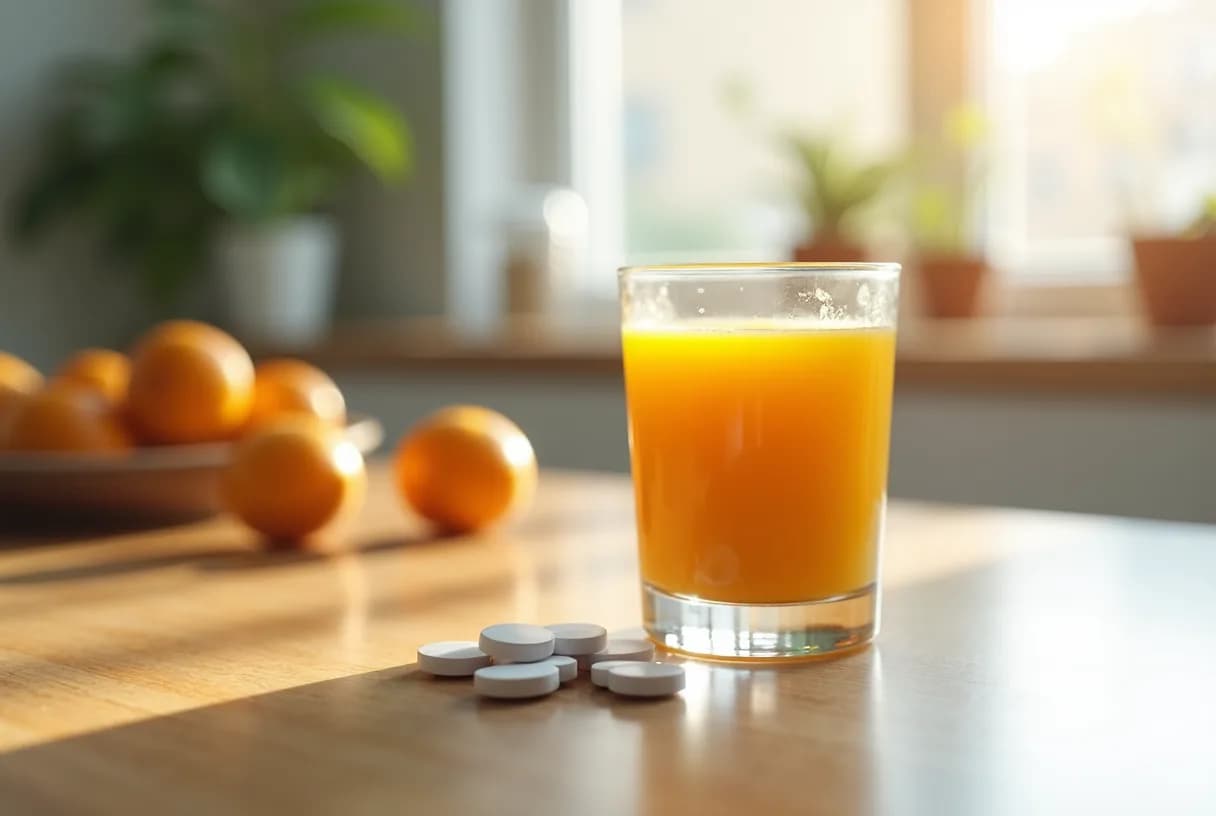
Ascorbic acid keeps iron in its more soluble ferrous state and helps it survive the alkaline environment of the upper small intestine. It also partially rescues iron from the compounds that would otherwise bind it. In the 2023 American Journal of Hematology isotope study — 34 iron-depleted women, 100 mg doses of iron as ferrous fumarate, absorption traced with stable iron isotopes — 80 mg of ascorbic acid increased fractional absorption by 30%, and raising the dose to 500 mg added nothing further. In other words, a normal glass of orange juice does the whole job and a mega-dose is wasted. Evidence grade: strong. This is one of the few "supplement hacks" that holds up in controlled human absorption studies.
Practical translation: a small glass of orange juice, or another vitamin-C-containing drink, alongside the tablet. Not a separate expensive "iron + C complex" — the vitamin C in your kitchen works identically.
What blocks iron absorption — and what most women are unknowingly stacking against themselves
The inhibitor list is short, boring and devastating. Polyphenols in tea and coffee bind non-haem iron into complexes your gut cannot take up. Calcium — from milk, yoghurt, calcium tablets — competes with iron. Antacids and acid-suppressing drugs (proton pump inhibitors such as omeprazole, and H2 blockers) reduce the stomach acid iron needs to dissolve in the first place, which is why long-term PPI use is itself associated with iron deficiency. Phytates in wholegrains, bran, nuts and legumes bind iron too.
Now picture a typical morning: an iron tablet swallowed with breakfast, a bowl of bran cereal, milk, and a mug of tea. That is four inhibitors in one sitting. In the isotope study above, the breakfast condition still contained 250 mL of orange juice — roughly 90 mg of vitamin C — and absorption was still two-thirds lower. Vitamin C cannot rescue a dose you have buried in a meal.
| What it is | Effect on iron absorption | Typical separation discussed in guidance | Notes |
|---|---|---|---|
| Vitamin C (orange juice, ~80 mg) | Increases absorption (+30% in the 2023 isotope study) | Take together | 500 mg was no better than 80 mg — no need to mega-dose |
| Coffee | Large decrease (−54% in that study) | Around 1–2 hours either side | It is the polyphenols, not the caffeine — decaf inhibits too |
| Tea (black and green) | Large decrease; tannins bind iron | Around 1–2 hours either side | A cup with a meal can cut non-haem iron uptake dramatically |
| Milk, yoghurt, calcium supplements | Meaningful decrease — calcium competes directly | Around 2 hours | Includes calcium-fortified plant milks and calcium+D tablets |
| Antacids, PPIs (e.g. omeprazole), H2 blockers | Decrease — less stomach acid means less iron dissolved | Discuss with a clinician; do not stop acid medication yourself | Long-term acid suppression is a recognised contributor to iron deficiency |
| Wholegrain, bran, legumes, nuts (phytates) | Decrease | Take iron between meals if tolerated | Vitamin C partially offsets phytate inhibition |
| Levothyroxine (thyroid medication) | Iron reduces levothyroxine absorption | Commonly ≥4 hours apart | Genuinely matters — see levothyroxine and supplements |
| Tetracycline and quinolone antibiotics | Absorption of both the antibiotic and the iron is reduced | Separation advised; ask the prescriber | Iron binds these antibiotics in the gut |
| A full meal (any breakfast) | Large decrease (−66% in that study) | Empty stomach if tolerated | If nausea forces you to eat, some absorption beats none |
You can sanity-check your own combination in our interaction checker, and the broader pairing question is covered in vitamins you should not take together.
Should iron be taken every other day instead of every day?
This is the part that changes practice, and it is missing from almost every consumer page.
Iron absorption is governed by hepcidin, a liver hormone that acts as the gut's iron gate. A dose of oral iron raises hepcidin, and that rise persists for roughly 24 hours — during which the next dose is partly locked out. Dose daily, or split morning and evening, and you are effectively fighting a hormone you just triggered. Hepcidin also runs higher later in the day, which is part of why the same dose absorbs worse in the afternoon even on an empty stomach.
Nicole Stoffel and colleagues tested this directly in two open-label randomised trials in iron-depleted women (Lancet Haematology, 2017). Cumulative fractional absorption was 21.8% with alternate-day dosing versus 16.3% with consecutive-day dosing, and total absorbed iron was higher (175.3 mg vs 131.0 mg) despite fewer doses. Single morning doses beat twice-daily split doses. A follow-up trial in women with iron-deficiency anaemia (Haematologica, 2020) reproduced the alternate-day absorption advantage.
Honesty about the limits: a larger, longer randomised double-blind trial in 150 iron-depleted women (von Siebenthal et al., eClinicalMedicine, 2023) found that at equal total iron doses, alternate-day dosing did not produce higher serum ferritin than consecutive-day dosing — but it did reduce iron deficiency at six months and caused fewer gastrointestinal side effects. So the fair summary is: alternate-day dosing absorbs a higher fraction, is at least as effective overall, and is better tolerated. Evidence grade: good and improving. The 2021 British Society of Gastroenterology guideline already lists every-other-day dosing as an option where daily iron is not tolerated.
What this does not mean: it is not an instruction to halve your regimen. Someone with severe anaemia, active bleeding, or an upcoming operation may need a different approach entirely. Bring the alternate-day evidence to your clinician as a question — "would every-other-day dosing suit me?" — not as a decision you have already made.
Ferrous sulfate, gluconate, bisglycinate — does the form matter?
Labels sell "gentle iron" hard. Here is the honest grading.
- Ferrous sulfate — the cheapest, best-studied, and the reference standard in almost every trial. It works. Its reputation for causing nausea, constipation and dark stools is deserved, but a great deal of that is dose-related rather than molecule-related.
- Ferrous fumarate and ferrous gluconate — also effective ferrous salts, and treated as interchangeable first-line options in the BSG guideline. Gluconate contains less elemental iron per tablet, which is often why it "feels gentler": you are taking less iron, not a kinder iron.
- Ferrous bisglycinate (chelated, "gentle" iron) — the most interesting of the alternatives. Randomised trials, mostly in pregnancy and paediatrics, suggest lower elemental doses of bisglycinate perform comparably to higher doses of ferrous sulfate, with fewer GI complaints. Evidence grade: moderate — the trials are real but often small, industry-linked, and conducted in specific populations. It is a reasonable option for people who cannot tolerate sulfate; it is not a proven upgrade for everyone, and it costs more.
- Iron in multivitamins and "wellness" blends — usually a token amount, frequently bundled with calcium, which is self-defeating.
Read the elemental iron figure, not the compound weight. "325 mg ferrous sulfate" is about 65 mg elemental iron; a 100 mg ferrous gluconate tablet supplies far less. Two products can look identical on the front of the box and differ several-fold in the only number that matters. Our guide to iron supplements breaks the label maths down.
How long before iron works — and why do so many women stop too early?
Two clocks run at different speeds, and confusing them is the classic mistake.
Haemoglobin responds in weeks. The BSG guideline treats a haemoglobin rise of at least 10 g/L within about two weeks as a prompt, measurable response — and as a strong clue that the anaemia really was iron deficiency. Energy often lifts around the same time.
Ferritin — your iron store — takes months. Normalising haemoglobin only refills the circulating tank; the reserve is still empty. This is why the same guideline advises continuing treatment for around three months after haemoglobin normalises, to replenish marrow stores. Stop when you "feel better," and you walk away with a normal blood count and an empty larder — deficient again within months, and convinced iron never worked.
If fatigue is the reason you are here, the store, not the blood count, is usually the thing to watch. See low ferritin and iron deficiency in women, and you can put your own numbers in context with our lab results explainer.
Do not self-diagnose iron deficiency, and do not self-treat
This is the section the supplement industry would rather you skipped.
Iron is not a harmless "energy vitamin." There is no efficient route for your body to excrete excess iron, and taking it when you are not deficient causes accumulation. In people with haemochromatosis — an inherited iron-loading condition many carry without knowing — supplemental iron is actively harmful. Acute iron overdose is dangerous, and iron tablets are one of the leading causes of fatal poisoning in young children; store them where children cannot reach them.
Equally important: iron deficiency anaemia in an adult is a finding, not a diagnosis. It means iron is being lost or not absorbed, and the cause matters. In women, heavy periods are the usual explanation — but coeliac disease, gastrointestinal bleeding and, in postmenopausal women, bowel and gynaecological cancers are all on the list. Swallowing a supplement can normalise the blood count while the reason for it goes uninvestigated. That is not a shortcut. That is a delayed diagnosis.
When to see a doctor
Talk to a clinician — do not simply start, stop, or change an iron supplement on your own — if any of the following apply.
- You think you are iron deficient but have never had ferritin and a full blood count tested. Test first, then treat. An at-home iron and ferritin test can be a starting point, but abnormal results need a clinician.
- You have been taking iron for 4–8 weeks with no improvement in symptoms or blood counts — this needs review, not a bigger dose.
- Your periods are heavy — soaking through protection hourly, flooding, clots larger than a 10p coin — or you have any bleeding after menopause.
- You have blood in your stool, black tarry stools, unexplained weight loss, a change in bowel habit, or a family history of bowel cancer or coeliac disease.
- You are pregnant, trying to conceive, or breastfeeding.
- You take levothyroxine, an antacid or PPI, an antibiotic, or any regular medication — timing may need adjusting, and that is a conversation with the prescriber.
- You have a diagnosis of haemochromatosis, thalassaemia, or any condition involving iron loading, or a relative who does.
- Side effects — constipation, nausea, cramping — are making the treatment unbearable. There are alternatives: a different form, a lower dose, alternate-day dosing, or intravenous iron.
- Severe symptoms — chest pain, breathlessness at rest, fainting, a racing heart — need urgent assessment, not a supplement.
Iron works. It just needs to be the right diagnosis, the right regimen, and — the part almost everyone gets wrong — the right hour of the day and the right glass to wash it down with. Browse everything in our iron and anaemia section, or start with iron deficiency symptoms.