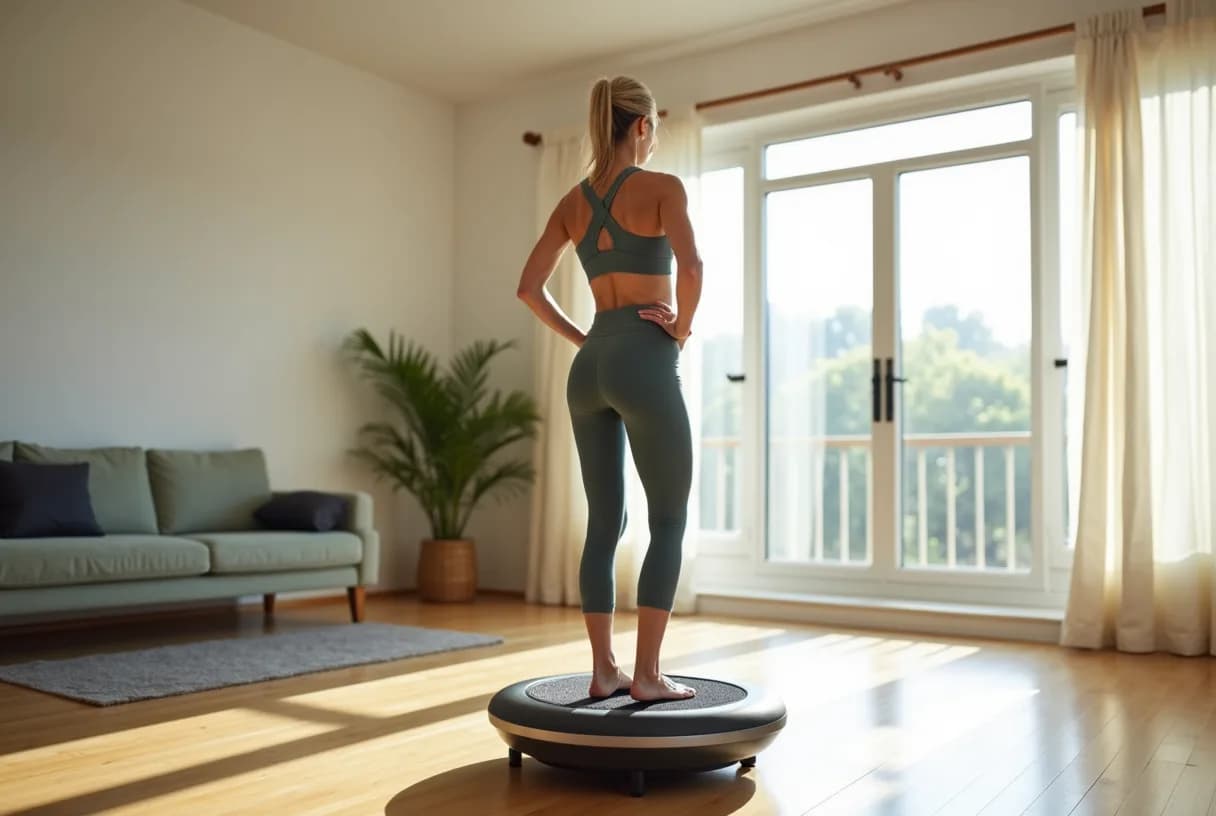
The honest verdict: Whole-body vibration is sold as a shortcut to stronger bones, but it is not a proven way to rebuild them. The single best-designed, year-long trial found no change in bone density at the spine or hip, and the wider research shows — at most — a very small lumbar-spine gain from low-quality evidence. Vibration is not a replacement for the one thing that reliably builds bone: progressive resistance and weight-bearing impact exercise. Where a plate may genuinely help is balance and fall prevention in frailer older adults, and it appears safe for most people. If you buy one, buy it for what it can plausibly do — not for the osteoporosis reversal the ads imply.
Quick verdict — by what you actually want
- Best for bone Not a plate. Progressive strength training plus impact and weight-bearing movement is the guideline-backed bone stimulus. Vibration is, at best, an add-on.
- The studied version Low-magnitude, low-intensity vibration (around 0.3 g) — the type used in most clinical trials. Many consumer "high-G" plates are not this and were never tested for bone.
- Only FDA-cleared bone device Osteoboost — a prescription vibration belt for postmenopausal osteopenia that slows spine bone loss. It is worn at the hips; it is not a stand-on plate.
- Reasonable to try You can't do weight-bearing exercise (frailty, severe joint disease) and want a gentle, low-impact option with a possible balance benefit — cleared with your doctor first.
- Skip it if You expect it to reverse osteoporosis, replace medication or strength training, "burn fat," or "detox." None of that holds up.
How is vibration supposed to build bone?
Bone is living tissue that remodels in response to mechanical strain — a principle behind why weight-bearing exercise strengthens the skeleton. Whole-body vibration (WBV) tries to borrow that mechanism without the load. You stand on a plate that oscillates rapidly, transmitting small, high-frequency signals through your legs. The idea, supported by animal studies from bone researcher Clinton Rubin and others, is that these tiny signals might nudge bone-forming cells the way muscle contractions and impact do. That's a plausible hypothesis. The problem for consumers is that a mechanism working in a sheep's leg or a mouse's spine has repeatedly failed to translate into meaningful bone gains in human trials.
Does whole-body vibration actually increase bone density?
Here the marketing and the evidence part ways. The strongest single study is a 12-month randomized trial of 202 postmenopausal women with low bone mass (T-scores between −1.0 and −2.5), published in Annals of Internal Medicine. Participants stood on a low-magnitude (0.3 g) platform at 90 Hz or 30 Hz for 20 minutes daily, all while taking calcium and vitamin D. The conclusion was blunt: WBV "did not alter BMD or bone structure" at the spine or hip compared with women who did not use the plate. A well-run trial designed to detect a benefit found none.
Pooled analyses are more mixed, but not more encouraging. A 2024 overview in BMC Women's Health examined 15 systematic reviews spanning 2009–2023. At the lumbar spine, only three of eight reviews found a statistically significant improvement — and the effect was tiny (a mean difference around 0.01 g/cm²) and rated low-certainty. At the femoral neck, just one of nine reviews showed benefit. At the total hip, none did. Roughly 87% of those reviews were rated "critically low" in methodological quality. The overview's authors landed on a rare, plainly stated position: they do not recommend WBV for improving bone density in postmenopausal women, while allowing it might help maintain bone in people who struggle to exercise.
A separate 2024 meta-analysis of 13 trials (783 women with postmenopausal osteoporosis) is the more optimistic read: it found a small but significant lumbar-spine gain and a borderline femoral-neck gain, plus a meaningful reduction in pain. Even so, the spine effect (a mean difference of about 0.018 g/cm²) is modest, and the same analysis found no change in fat mass or muscle mass. Put together, the honest summary is: at best a small, inconsistent, site-specific effect on the spine; little to nothing at the hip — the site where fractures are most dangerous.
| Marketed claim | What the research actually shows | Verdict |
|---|---|---|
| "Rebuilds bone / reverses osteoporosis" | The best 12-month RCT (202 women) found no change in spine or hip BMD. Meta-analyses show at most a tiny lumbar-spine gain (mean difference ~0.01–0.02 g/cm²) on low-certainty evidence; total-hip benefit is essentially absent. | Not supported |
| "As good as — or better than — exercise for bones" | No head-to-head evidence supports this. Progressive resistance plus impact exercise is the top-graded recommendation in osteoporosis exercise guidelines; vibration is not a proven replacement. | Not supported |
| "Improves balance and lowers fall risk" | Meta-analyses show better balance scores (Tinetti, Timed-Up-and-Go) and one pooled analysis found ~33% fewer falls in some trials. Results are mixed; frailer adults benefit most. | Modest / plausible |
| "Eases osteoporosis bone and back pain" | A 2024 meta-analysis of 13 trials found a statistically significant reduction in pain. | Modest |
| "Burns fat, tones, or detoxes" | The same meta-analysis found no significant change in fat mass or muscle mass. "Detox" has no physiological basis. | Not supported |
| "FDA-approved to treat bone loss" | No stand-on plate is FDA-approved or cleared to treat osteoporosis. One prescription vibration belt (Osteoboost) is FDA-cleared to slow spine bone loss in osteopenia — a different device worn at the hips. | Misleading |
Why do the studies disagree? Not all vibration is the same
Part of the confusion is that "whole-body vibration" describes wildly different machines and protocols. Trials differ by magnitude (how forceful the shake is), frequency (Hz), platform type (a vertical piston versus a side-alternating see-saw motion), session length, and how consistently people actually used them. The negative Annals trial used gentle, low-magnitude 0.3 g vibration — the same "low-intensity" signal studied in bone biology. Some smaller trials that reported hip gains used higher-magnitude, side-alternating platforms.
This matters for shoppers, because the machines that dominate the consumer market are often high-magnitude "lifestyle" plates capable of 5–15 g — quite different from the low-intensity signal that has the most biological rationale, and different again from the higher-magnitude research platforms. The evidence base is a patchwork, and it does not cleanly transfer to whatever plate happens to be on sale. When a product page cites "studies," ask which vibration, at what dose, in whom — because a positive result on one platform says little about another.
Is any vibration device FDA-approved for osteoporosis?
No stand-on vibration plate you can buy is FDA-approved or cleared to treat or prevent osteoporosis. That includes low-intensity therapeutic units: Marodyne LiV, for example, is marketed for bone health and is registered in Canada, Australia and Europe, but it is not FDA-approved for osteoporosis in the United States.
There is one exception, and it's an important one to understand precisely. Osteoboost is FDA-cleared — through the De Novo pathway, with a Breakthrough Device designation — for postmenopausal women with osteopenia (low bone density that hasn't reached osteoporosis). But Osteoboost is a prescription vibration belt worn at the hips that targets the spine and hips, not a plate you stand on. In its double-blind, placebo-controlled pivotal trial at the University of Nebraska Medical Center, women who used it at least three times a week had substantially less bone-density loss at the spine than the placebo group. Two honest caveats: "cleared" is not the same as "approved" — clearance reflects safety and similarity to existing devices, not proof of a large clinical benefit — and the device slowed loss rather than reversing it. It also isn't the machine most people picture when they hear "vibration plate."
Can it help with balance and preventing falls?
This is where vibration has its most defensible case. Because most osteoporotic fractures happen when someone falls, anything that steadies you on your feet has value. Meta-analyses in older adults show WBV can improve balance and mobility measures such as the Tinetti score and the Timed-Up-and-Go test, and one pooled analysis found roughly a third fewer falls in the studies that tracked them. The overall picture is genuinely mixed — several trials found vibration no better than standard exercise — and the people who seem to benefit most are frailer, older adults with existing deficits. So it's fair to say vibration may help balance, especially if you can't do much else. It is not uniquely good at it: balance training, tai chi and lower-body strength work do the same job with more consistent evidence.
What actually builds and protects bone
The proven bone stimulus isn't glamorous, but it's well documented. Osteoporosis exercise guidelines give their strongest recommendation to progressive resistance training (challenging the major muscle groups a few days a week) combined with weight-bearing impact — the kind of load that comes from your muscles pulling on bone and your feet striking the ground. The Bone Health & Osteoporosis Foundation echoes this: weight-bearing and muscle-strengthening exercise are the core prescription. Vibration, by contrast, is described in guidelines as difficult to justify as something that can replace exercise.
If bone health is your goal, the highest-yield moves are: build a strength habit (see exercises for bone density and strength training for women), make sure your calcium and vitamin D intake is adequate, know your numbers with a bone-density (DEXA) test, and — if you have osteopenia or osteoporosis — discuss whether medication is warranted. Because the sharpest phase of bone loss follows the estrogen drop of menopause, that window is where the biggest gains — and the biggest mistakes — happen. A vibration plate belongs at most at the edges of that plan, never at its center.
How much do vibration plates cost?
As of 2026, prices vary widely and change often — verify before buying. Budget consumer plates run roughly $60–$400; mid-range home units sit in the low hundreds; and premium studio-style machines (the kind gyms use) run from about $1,800 to $3,200 or more. Higher price generally buys more force and better build quality, but a bigger G-force is not the same as a bigger bone benefit — much of the low-end market is essentially a massage device with a fitness label. The prescription Osteoboost belt is a separate category with its own cost and requires a prescription; check current pricing directly. Before spending anything, it's worth asking whether the same money toward a set of adjustable dumbbells or a few sessions with a trainer would do more for your bones.
Safety: who should be cautious, and when to see a doctor
For most healthy adults, brief vibration sessions are well tolerated; trials report only minor side effects such as temporary leg discomfort, itching or mild nausea, with no serious harms. Still, vibration isn't for everyone. Talk to a clinician before using a plate if you have a recent or unhealed fracture, severe osteoporosis, acute back or joint problems, a blood clot (DVT), retinal disease, a pacemaker or other implanted device, or if you're pregnant. If you have advanced bone loss, don't assume a plate is a gentle "safe" option — get individualized clearance first.
See a doctor promptly if you have new back pain, a sudden loss of height, or a fall, and don't stop an osteoporosis medication or drop your strength routine to rely on a plate instead. A vibration device is, at most, a reference point and a possible add-on — not a diagnosis, a treatment, or a reason to skip the interventions that actually protect your skeleton.
Bottom line: Whole-body vibration is a modest, mostly overhyped tool. The honest "worth it" answer: not worth it if you're buying it to build bone or replace exercise, and possibly worth a look if you can't do weight-bearing activity and want a gentle add-on with a chance of steadier balance — with your doctor's sign-off and realistic expectations. Spend your first dollars on strength, impact, calcium and vitamin D, and a real bone-density assessment.