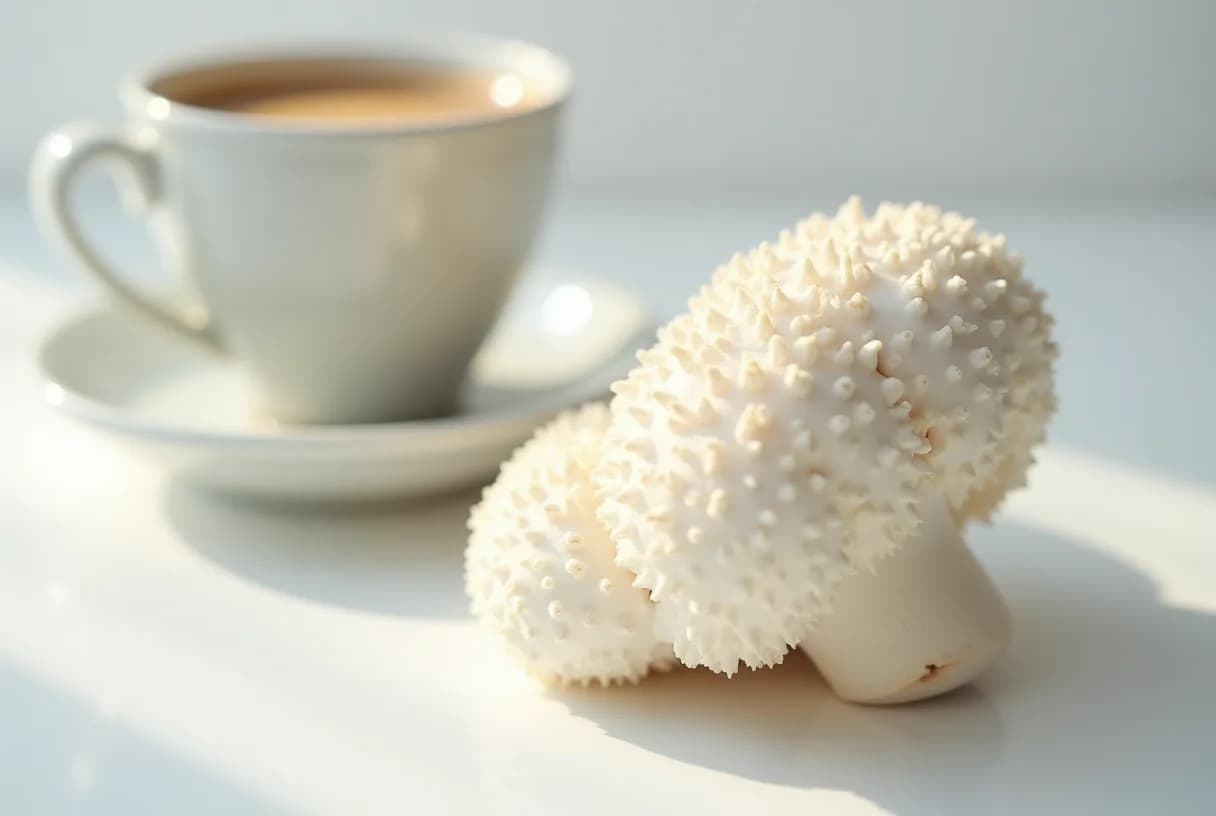
Lion's mane (Hericium erinaceus) is an edible medicinal mushroom sold as a "nootropic" for memory, focus, mood and nerve health. The theory is real but early: its compounds — hericenones and erinacines — can stimulate nerve growth factor (NGF) in cell cultures and rodents. In people, though, the evidence is a small handful of short trials. They hint at modest, temporary benefits for mild cognitive impairment and low mood, but lion's mane is not proven to prevent dementia or reliably sharpen a healthy brain. And if you are chasing midlife "brain fog," the more likely culprit is perimenopause, poor sleep, thyroid, low B12 or mood — worth ruling out before a mushroom.
What lion's mane is — and the claim behind the hype
Lion's mane is a shaggy white mushroom used for centuries in East Asian cooking and traditional medicine. Its appeal as a brain supplement rests on one interesting mechanism: laboratory studies show that hericenones (found mainly in the fruiting body, the part you'd recognize as a mushroom) and erinacines (concentrated in the mycelium, the root-like network) can trigger nerve cells to make more NGF, a protein that helps neurons grow, survive and form connections.
Here is the honest catch that supplement marketing skips: NGF itself does not cross the blood–brain barrier. The hypothesis is that lion's mane's small molecules do — and then raise NGF inside the brain. Erinacines have shown this in animals; in humans it remains unproven. Almost all the nerve-regeneration data lives in petri dishes and rodent studies, not in people. That does not make it worthless. It makes it preclinical — a promising lead, not a settled fact.
The claims vs. what the human evidence actually shows
There are only a few randomized human trials, most with 30–50 participants and lasting weeks, not years. Graded plainly:
| Claim | What the human trials actually found | Evidence grade |
|---|---|---|
| Improves memory in mild cognitive impairment | One 16-week trial in 30 older adults (50–80) with MCI: 3 g/day of fruiting-body powder improved a dementia-screening score vs. placebo — but the benefit faded about 4 weeks after stopping. | Preliminary (one small, short trial) |
| Sharpens a healthy brain / faster focus | One trial in 41 healthy young adults: a single 1.8 g dose sped reaction time on the Stroop task at 60 minutes — yet after 28 days the lion's mane group recalled fewer words on a delayed-memory test than placebo. | Weak / mixed |
| Lifts mood and eases anxiety | One 4-week trial in 30 women (average age 41): lion's mane cookies lowered depression, anxiety and palpitation scores vs. placebo. Small, short, and mood scales are subjective. | Preliminary |
| Prevents or treats Alzheimer's / dementia | One 49-week pilot in 49 people with mild Alzheimer's used erinacine-A-enriched mycelium: daily-living scores improved, but cognitive results were modest and inconsistent between groups. A pilot, not a treatment. | Not established |
| Regrows nerves by boosting brain NGF | Hericenones and erinacines raise NGF in cells and rodents; NGF itself can't cross the blood–brain barrier, and the effect is unproven in humans. | Preclinical only |
| Fixes menopausal brain fog | No trial has tested this. Midlife fog usually traces to perimenopause, sleep loss, thyroid, B12 or mood — not a mushroom deficiency. | No human evidence |
Notice the pattern. The signals that exist are real but fragile: single studies, tiny samples, short durations, and at least one result pointing the wrong way (worse word recall after four weeks in healthy adults). No large, long, replicated trial shows lion's mane protects a healthy brain or halts cognitive decline. Anyone selling it as a guaranteed memory upgrade is ahead of the science.
The midlife angle: "brain fog" is rarely a mushroom deficiency
If you're in your 40s or 50s and words go missing mid-sentence, you're not imagining it. The Study of Women's Health Across the Nation (SWAN) tracked thousands of women and found measurable dips in processing speed and verbal memory during perimenopause — but the dip was largely transient, recovering after the transition. That's the key insight lion's mane marketing exploits: the fog is real, but it usually has a treatable cause that a mushroom won't touch.
Before spending money on a supplement, it's worth ruling out the usual suspects — most of which have far better evidence and, often, a real fix.
| More likely cause | Telltale clue | Where to start |
|---|---|---|
| Perimenopause hormone swings | Fog arrives with hot flashes, irregular periods, mood shifts; comes and goes | Menopause brain fog |
| Poor or fragmented sleep | Night sweats or insomnia; fog is worst on bad-sleep days | Menopause insomnia |
| Thyroid problems | Fatigue, weight or hair changes, cold intolerance alongside the fog | Thyroid or menopause? |
| Low vitamin B12 | Tingling, fatigue, low mood; common with vegetarian diets, metformin or acid reducers | B12 deficiency |
| Low iron / ferritin | Fatigue, breathlessness, heavy periods in perimenopause | Low ferritin |
| Undiagnosed ADHD unmasked at menopause | Lifelong distractibility that got harder as estrogen fell | Menopause and ADHD |
Most of these are checked with a simple conversation and a blood test. A clinician can order thyroid, B12 and ferritin labs — a much higher-yield first move than a nootropic, because if one of these is off, treating it can lift the fog in a way no mushroom has been shown to. A menopause-literate provider can also weigh hormone therapy for the whole symptom cluster; finding the right care matters more than any single pill.
If you still want to try it: quality and dosing
Lion's mane isn't a drug, and — like all supplements — it isn't pre-approved or tested for accuracy by the FDA before it reaches the shelf. Under U.S. law, the maker is responsible for its own quality claims, so what's on the label may not be what's in the bottle. Two quality questions matter most:
- Fruiting body vs. mycelium. Quality fruiting-body extracts test at roughly 20–40% beta-glucans (the active polysaccharides). Cheap "mycelium-on-grain" powders often test at 5–10% and are padded with leftover starch from the growing substrate. Confusingly, the erinacines used in the Alzheimer's pilot come from specially cultivated mycelium — so "mycelium bad" is too simple. The honest rule: buy a product that proves its content, not one that just says "mushroom."
- Third-party testing. Look for a certificate of analysis (COA) from an independent, ISO-accredited lab reporting the actual beta-glucan percentage — not just "polysaccharides," a number that can be inflated by starch. Our supplement scorecard walks through what a trustworthy label looks like.
On amount: human trials used about 1–3 grams a day of fruiting-body powder for 4 to 16 weeks, and effects were modest and reversed after stopping. That's a description of the studies, not a prescription — dosing that suits you, alongside your other medications and conditions, is a conversation for your clinician or pharmacist, not a label. Give any supplement a fair, time-limited trial (say 8–12 weeks) and judge it honestly; if nothing changes, stop.
Safety, side effects and who should be cautious
Lion's mane is generally well tolerated. In the NIH LiverTox database it carries the lowest concern rating for liver injury, and mild gastrointestinal complaints — abdominal discomfort, nausea, loose stools — occur in under 10% of users. The Alzheimer's pilot lost four participants to abdominal discomfort, nausea or skin rash, a reminder that "natural" is not "side-effect-free."
The rare but serious risk is allergy. Because it's a fungus, lion's mane can trigger reactions in people sensitive to molds or other mushrooms, and there is a published case of anaphylaxis to it. Hives, facial or throat swelling, wheezing or trouble breathing after taking it is a medical emergency — stop and seek care immediately.
A few groups should talk to a clinician first, ideally with a medication interaction check:
- Anyone on blood thinners or antiplatelet drugs, given theoretical additive effects (human interaction data are thin, which is itself a reason for caution).
- People with diabetes on glucose-lowering medication, since some data suggest lion's mane may nudge blood sugar down.
- Anyone with a known mushroom or mold allergy.
- People who are pregnant or breastfeeding — there simply isn't safety data, so the default is to skip it.
- Anyone scheduled for surgery, which is a good time to pause non-essential supplements.
None of this means starting or stopping a prescription on your own. Never adjust a medication because of a supplement — bring the supplement to the prescriber instead.
When to see a doctor
Reach for a clinician, not a mushroom, if brain-related symptoms are more than the transient, comes-and-goes fog of the menopause transition. Get evaluated for:
- Memory loss that is steadily worsening, getting lost in familiar places, trouble handling money or medications, or personality changes — these are not typical perimenopause and need assessment.
- Fog paired with fatigue, hair or weight changes, or low mood that persists — worth checking thyroid, B12, ferritin and depression rather than self-treating.
- Any allergic reaction to lion's mane (hives, swelling, breathing trouble) — emergency care.
One unrelated red flag while we're on midlife health: any bleeding after menopause (12+ months with no period) always needs evaluation, regardless of supplements — it is never something to watch and wait on.
The honest verdict
Lion's mane is one of the more interesting supplements in the nootropic aisle — a genuine mechanism, a few encouraging small trials, and a reassuring safety profile. It is also nowhere near a proven cognition booster. The human studies are small, short and mixed; nothing shows it prevents dementia or reliably improves a healthy brain, and one trial found memory got slightly worse. If you're curious, it's a low-risk experiment when bought as a tested fruiting-body extract and run past your clinician. But if the real goal is clearing midlife brain fog, your money and attention are better spent on sleep, thyroid and B12 checks, and menopause care that treats the cause. Explore the evidence behind other options in our supplements guide.