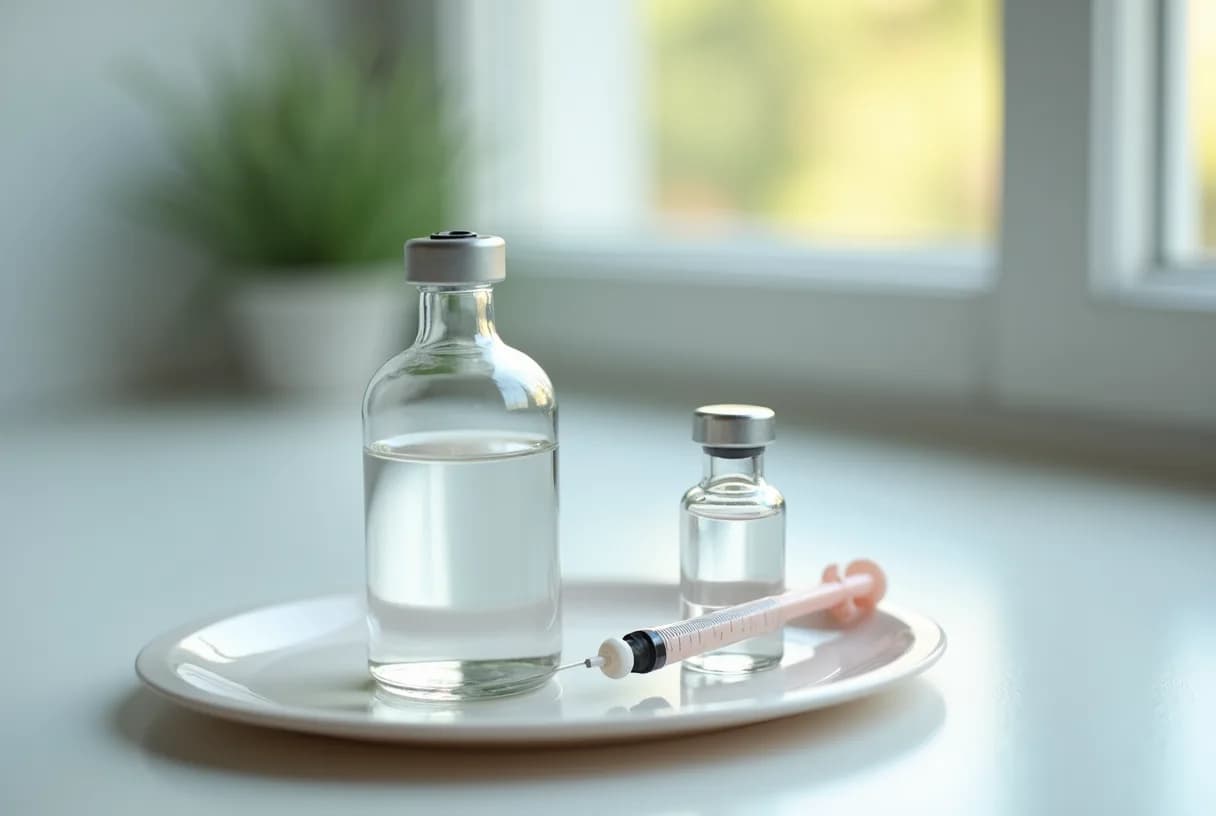
The honest verdict: The only "peptides" with strong evidence and FDA approval for weight loss are the GLP-1 and GLP-1/GIP receptor agonists — semaglutide (Wegovy) and tirzepatide (Zepbound) — obtained by prescription and dispensed by a licensed pharmacy. Everything else sold as a "weight-loss peptide," including research-chemical copies of those same drugs sold as powders you reconstitute, plus compounds like AOD-9604, fragment peptides, and "GLP-1 peptides," is unapproved for this use and moves through a grey market with no check on identity, purity, potency, or sterility. The single clearest red flag is a "research use only" or "not for human consumption" label — that product was sold to you specifically to sidestep the medical system.
Search "peptides for weight loss" and you land in two very different worlds that look deceptively similar. One is a regulated medicine you get from a clinician. The other is a marketplace of vials and powders sold on social media, wellness forums, and "research chemical" sites — often the exact same molecules, packaged to avoid the rules that make the first world safe. This guide is a map for telling them apart. It is not a how-to-buy or a dosing guide, and it never will be: the entire danger of the grey market is that it hands you a job — measuring and mixing an injectable drug — that no one trained you to do.
What people actually mean by "weight-loss peptide"
Peptides are short chains of amino acids — small protein fragments the body uses as signaling molecules. That is a huge, boring category that includes insulin. The reason "peptide" is suddenly a weight-loss buzzword is that the blockbuster obesity drugs happen to be peptides: semaglutide and tirzepatide are engineered GLP-1 (and, for tirzepatide, GIP) receptor agonists. These are genuine breakthroughs, and their success created a marketing halo that grey-market sellers now borrow. If a peptide drug can produce 15–20%+ weight loss in trials, the reasoning goes, then anything labeled "peptide" must be a shortcut. It is not. The evidence lives with specific approved molecules, taken at controlled doses under supervision — not with the word "peptide."
| Compound | Evidence for weight loss | FDA status | Bottom line |
|---|---|---|---|
| Semaglutide (Wegovy) | Strong — large randomized trials; ~15% average weight loss injectable, plus an approved oral 25 mg pill | FDA-approved for chronic weight management (oral pill approved Dec 2025) | Legitimate. By prescription only. |
| Tirzepatide (Zepbound) | Strong — GLP-1/GIP agonist; ~20% average weight loss in trials | FDA-approved for chronic weight management | Legitimate. By prescription only. |
| Retatrutide | Promising Phase 3 data (~25%+ in some trials), but still investigational | NOT approved; Phase 3 ongoing, application not yet filed | Not legally available. Any "retatrutide" for sale now is grey-market. |
| Tesamorelin (Egrifta) | Approved only to reduce excess belly fat in HIV-associated lipodystrophy — a specific medical condition, not general weight loss | FDA-approved for that narrow indication only | Not a general weight-loss drug. Off-label grey-market use is unsupported. |
| AOD-9604 ("HGH fragment") | Weak — an obesity trial failed its primary endpoint and development was stopped years ago | NOT approved for any use as a drug | Unproven. Sold almost entirely grey-market. |
| "Research" semaglutide/tirzepatide powders | Same molecule as the approved drug — but no guarantee it is actually that molecule, at the stated amount, uncontaminated | Unapproved; FDA has issued warning letters to sellers | Highest-risk. The drug may be real; the product is not. |
Why "research use only" is the whole problem
The most dangerous corner of this market isn't the exotic compounds — it's the copies of the real drugs sold as powders "for research purposes only" or "not for human consumption." That labeling is not a technicality. It is how a seller ships a prescription-strength injectable drug to your door without a prescription, a pharmacy, or a licensed manufacturer standing behind it. The FDA has treated these disclaimers as a fig leaf. In September 2025 it sent more than 50 warning letters to companies compounding or selling unapproved semaglutide and tirzepatide products, and it has repeatedly warned that "research use only" or "not for human consumption" labels don't change what a product is when it is sold to people to inject.
When you buy a powder to reconstitute, you personally take on four jobs a pharmacy normally does, with none of the safeguards:
- Identity: Is the powder even the drug on the label? There is no assay you can run at your kitchen table.
- Potency: How much active drug is in the vial? This is where people get hurt. The FDA has documented cases of self-injected overdoses of five to ten times the intended amount, causing severe nausea and vomiting, dehydration, fainting, and acute pancreatitis — some requiring hospitalization.
- Purity: Grey-market powders have been found contaminated or mislabeled. You cannot see endotoxins or the wrong molecule.
- Sterility: You are mixing and injecting a solution yourself. Every step is a chance to introduce infection.
Add the confusion between milligrams, milliliters, and "units" on an insulin syringe, and reconstitution becomes exactly the setup the FDA warned about — the point where a math error becomes a medical emergency. This is why we won't publish reconstitution or dosing steps: better instructions don't make an unverified drug safe, they just make people more confident while doing something inherently unverifiable.
The red flags — a checklist
| Red flag | Why it matters |
|---|---|
| Sold as a powder you mix yourself | Shifts dosing, sterility, and measurement onto you — the leading cause of documented overdoses. |
| "Research use only" / "not for human consumption" | Legal cover to sell a drug outside the medical system. The FDA has issued warning letters over unapproved GLP-1 products sold this way. |
| No prescribing clinician involved | No one screens you for contraindications, checks interactions, or monitors side effects. |
| Crypto-only or gift-card payment | Untraceable payment is how sellers avoid accountability and refunds. |
| Sold via Instagram, TikTok, Telegram, or forums | Legitimate prescription drugs are not marketed to you by DM. |
| Price far below the legitimate range | Real manufacturing, testing, and pharmacy dispensing cost money. A "too cheap" injectable signals none of it happened. |
| A named drug that isn't approved yet (e.g., retatrutide) | If it can't be prescribed, every source is by definition grey-market. |
The kernel of real science — and where it stops
It's worth being fair about why these compounds sound plausible, because the physiology is real. GLP-1 and GIP are genuine gut hormones that regulate appetite, insulin, and how full you feel; drugs that mimic them work because that biology is sound. Tesamorelin is a real growth-hormone-releasing hormone analog that genuinely reduces a specific type of abdominal fat — which is why it's approved for HIV-associated lipodystrophy, and only that. AOD-9604 was designed from a fragment of growth hormone on a reasonable hypothesis about fat metabolism. The problem isn't that the ideas are absurd. It's that a plausible mechanism is not evidence of benefit or safety in you. AOD-9604's obesity trial failed; retatrutide's data look strong but it hasn't finished the process that confirms a drug is safe enough to sell. "It should work" is where the grey market starts and where good medicine refuses to.
When to talk to a clinician
If you're carrying weight you want to lose and wondering about peptides, the honest move is to bring that question to a clinician rather than a vendor. Talk to a doctor, nurse practitioner, or pharmacist before starting, stopping, or changing any medication or supplement — and specifically seek care promptly if you have already used a grey-market product and develop severe or persistent vomiting, intense abdominal pain radiating to your back (a possible sign of pancreatitis), signs of infection at an injection site (redness, swelling, warmth, fever), fainting, or symptoms of severe dehydration. Bring the actual vial or packaging if you have it. A clinician can also tell you whether an approved GLP-1 drug is appropriate for you, screen for the conditions that make it unsafe, and check it against your other medicines. If you take medication for diabetes or blood pressure, or supplements like berberine or inositol that affect blood sugar, that interaction check matters — our interaction checker is a starting point, not a substitute for that conversation.
The legitimate path actually exists
The reason the grey market is so frustrating is that the real thing is more accessible than it used to be — not less. There are now FDA-approved GLP-1 options including a semaglutide pill, and legitimate telehealth routes that connect you to a real prescriber and a licensed pharmacy. That path has gatekeepers for a reason: they're the same people who catch the drug interaction, the contraindication, or the counterfeit. If cost is the barrier that pushed you toward powders, that's a solvable problem worth solving through coverage, appeals, and legitimately compounded options during shortages — not through an unverified vial.
Start here instead: how to get a GLP-1 online safely, how GLP-1 drugs actually work, and — if you've seen "compounded" versions advertised — compounded semaglutide vs. Wegovy and the current compounding and shortage status. For the bigger picture on midlife metabolism, see our weight & metabolism hub. The safest weight-loss peptide is the one a clinician chose, a pharmacy filled, and a label you can trust — full stop.