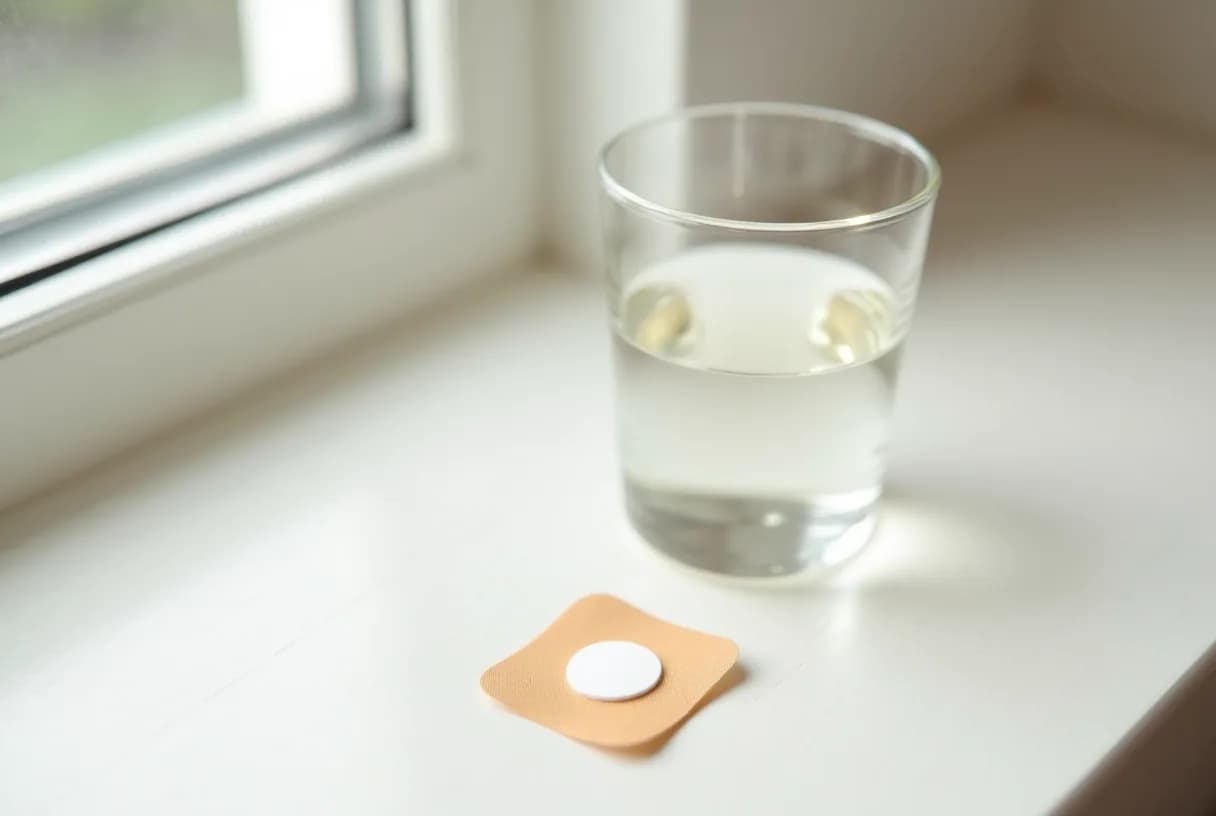
No — transdermal "GLP-1 patches" do not work, and you should not buy them. The same goes for "GLP-1" gummies, drops, and nasal sprays sold on Instagram, TikTok, and online marketplaces. There is no FDA-approved GLP-1 patch, gummy, or spray. This is not a matter of the right brand or a stronger formula: it is chemistry. Semaglutide (the drug in Ozempic and Wegovy) weighs about 4,114 daltons and tirzepatide (Mounjaro and Zepbound) about 4,814 daltons. Intact human skin blocks almost every molecule heavier than roughly 500 daltons — so these peptides are about ten times too large to cross your skin in any meaningful amount.
Why a patch physically can't deliver semaglutide or tirzepatide
The outer layer of your skin, the stratum corneum, is an evolved barrier designed to keep things out. Dermatologists summarize its limits with the "500 Dalton rule": with rare exceptions, only small, fairly fat-soluble molecules pass through intact skin by passive diffusion. That is why nicotine, estradiol, and fentanyl work as patches — they are all comfortably under 500 daltons. Semaglutide and tirzepatide are not small molecules at all; they are engineered peptides, chains of dozens of amino acids. A patch has no mechanism to smuggle a molecule that size across the barrier at a dose that would change your appetite or blood sugar.
The same size problem is why the real drugs are injected. Injection bypasses both the skin barrier and the digestive tract, delivering the intact peptide straight into tissue. The one non-injected version that works — oral semaglutide (Rybelsus, and the Wegovy pill approved by the FDA for weight management in the US, launched in early 2026) — only works because it is co-formulated with an absorption enhancer called SNAC and must be taken on an empty stomach with a sip of water, then nothing else for at least 30 minutes. Even with all that engineering, oral bioavailability is low, which is why the pill dose is far higher than the injected dose. A patch or gummy has none of this. Swallowed peptides without a protective system are simply chopped up by stomach acid and gut enzymes.
| Product or route | Delivers a working dose? | Why |
|---|---|---|
| Injectable semaglutide / tirzepatide (Wegovy, Ozempic, Zepbound, Mounjaro) | Yes | Bypasses skin and gut entirely; the peptide reaches the bloodstream intact. FDA-approved. |
| Oral semaglutide (Rybelsus; Wegovy pill) | Yes, only if taken correctly | Uses the SNAC absorption enhancer plus strict empty-stomach dosing. FDA-approved. |
| Transdermal "GLP-1 patch" | No | Peptide is roughly 10x heavier than the ~500-dalton skin-penetration limit. No FDA-approved product exists. |
| "GLP-1" gummies, drops, sublingual sprays | No | No absorption enhancer; peptide (if any is present) is destroyed in the gut. Usually just herbs. |
| "GLP-1" nasal spray | No | No approved GLP-1 nasal product; a molecule this large is not reliably absorbed through the nose. |
So what are these "GLP-1 patches" actually made of?
They are unregulated dietary supplements dressed up in pharmaceutical language. In a 2026 analysis published in the Annals of Pharmacotherapy, pharmacy researchers at the University of Connecticut catalogued 24 transdermal "natural GLP-1" patch products and one gel. On average each listed about seven plant-derived ingredients — most often berberine, glutamine, cinnamon, and pomegranate. None of the products they examined posted a certificate of analysis, many omitted the required FDA disclaimer, and many used deceptive marketing. The researchers also flagged a legal fact worth knowing: under US law (the Dietary Supplement Health and Education Act), a dietary supplement must be swallowed — so a supplement delivered through a skin patch is illegal on its face, regardless of what it claims to contain.
Put plainly: you are usually paying premium prices for a botanical sticker. Some of these herbs have a kernel of real physiology behind them — berberine, for instance, can modestly affect blood sugar — but "modestly nudges glucose in a study" is a universe away from "reproduces a GLP-1 receptor agonist." And that same activity is a reason for caution, not comfort: berberine can lower blood sugar and interacts with diabetes and GLP-1 medications, so it is not a casual add-on. If you want the honest evidence read on that trend, see our piece on berberine as "nature's Ozempic", and run anything you are considering through the interaction checker.
What are the red flags?
These products follow a recognizable playbook. If you see several of the signals below, treat the product as marketing, not medicine.
| Red flag | Why it matters |
|---|---|
| "As effective as Ozempic / Wegovy" | No supplement has shown this in a trial. Comparing to a prescription drug is a marketing tell, not evidence. |
| No prescribing clinician anywhere in the process | Real GLP-1 therapy requires a prescription and monitoring. A checkout button is not a clinician. |
| Sold only through Instagram, TikTok, or a marketplace listing | Legitimate medicines are not distributed through social-media DMs and disappearing storefronts. |
| Dramatic before-and-after photos and testimonials | Photos are unverifiable and easily faked or bought; they are not clinical outcomes. |
| "Natural GLP-1," "GLP-1 boosting," or vague "peptide" wording | These phrases imply drug-like effects while avoiding the drug's name — and the FDA scrutiny that comes with it. |
| No certificate of analysis; contents not verifiable | You cannot confirm what is actually in the product, at what dose, or whether it is contaminated. |
| A buried "not evaluated by the FDA" disclaimer | The fine print quietly concedes the loud claims on the label are not backed by FDA review. |
Do "peptides in skincare" prove patches can work?
This is the fairest version of the counter-argument, so it deserves a straight answer. Yes, cosmetic "peptides" appear in serums and some patches — but those are very short peptide fragments (often 2–5 amino acids, well under 500 daltons) chosen precisely because tiny fragments can interact with the upper skin. Semaglutide and tirzepatide are the opposite kind of molecule: long, folded, deliberately large peptides engineered to last a week in your bloodstream. Borrowing the word "peptide" does not transfer the ability to cross skin. Size still decides, and on size these drugs lose the transdermal contest badly.
What about retatrutide and other "next-gen" peptides sold online?
You will see grey-market sellers pushing research peptides — retatrutide is the most hyped — as DIY weight-loss shortcuts. Here is the honest status: retatrutide is not FDA-approved and is not available by prescription as of July 2026. It is an investigational drug still in Eli Lilly's Phase 3 TRIUMPH trials, with a new-drug application not yet submitted and a possible US launch, if trials succeed, no earlier than 2027–2028. That means there is no legitimate consumer route to it. Anything sold to the public as retatrutide right now comes from unregulated "research chemical" suppliers with no verified identity, purity, sterility, or dose — the FDA has documented fraudulent and mislabeled GLP-1 products, including vials whose contents and pharmacies simply do not exist.
We are not going to tell you where to find these products, how to dose them, or how to reconstitute them, because there is no safe way for a consumer to do that — injecting an unverified peptide of unknown sterility and concentration is exactly the scenario that leads to dosing errors, infections, and hospitalizations. The honest answer to "how do I get it" is that you can't get it safely, and that is the whole point. If and when a drug like retatrutide is approved, the safe route will be a prescription and a clinician.
What actually works instead
Debunking is only useful if it points you somewhere real. Two things genuinely move the needle:
- FDA-approved GLP-1 medicines through a legitimate clinician. If you are a candidate, injectable semaglutide or tirzepatide and now oral semaglutide are the evidence-backed options — prescribed, dosed, and monitored by a qualified provider. Start with how GLP-1 drugs work, understand the safe access routes in how to get GLP-1 medication online safely, and know the difference between a licensed prescription and a grey-market copy in compounded semaglutide vs. Wegovy. The drug monograph for semaglutide covers uses and cautions.
- The unglamorous levers that work with or without a drug: a protein-forward, fiber-rich eating pattern, resistance training to protect muscle, and sleep. These are not consolation prizes — they are the foundation any medication is added on top of. Our weight and metabolism hub and Ozempic alternatives lay out the honest options, and if a supplement is tempting, learn how to spot a supplement recall before you spend a cent.
When to talk to a clinician
Weight and metabolic health are medical questions, and self-treating with grey-market products is where people get hurt. Talk to a doctor, pharmacist, or qualified telehealth clinician — not a social-media seller — before you buy any "GLP-1" product, and especially if any of the following apply:
- You are considering a GLP-1 medication and want to know whether you are a candidate and which route fits you.
- You have type 2 diabetes or take any blood-sugar medication — supplements like berberine can add unpredictable glucose-lowering effects.
- You already bought a patch, gummy, drop, or "research peptide" and have any reaction — rash, injection-site infection, palpitations, severe nausea, or dizziness. Seek care promptly.
- You are pregnant, breastfeeding, or have heart, kidney, or thyroid conditions, where unknown ingredients carry extra risk.
A clinician can tell you, honestly, whether a real GLP-1 medicine makes sense for you — and can spare you from paying for a patch that was never going to work. To find one, use our find care directory. The reference ranges and product claims discussed here are general information, not a diagnosis or a treatment plan for your situation.