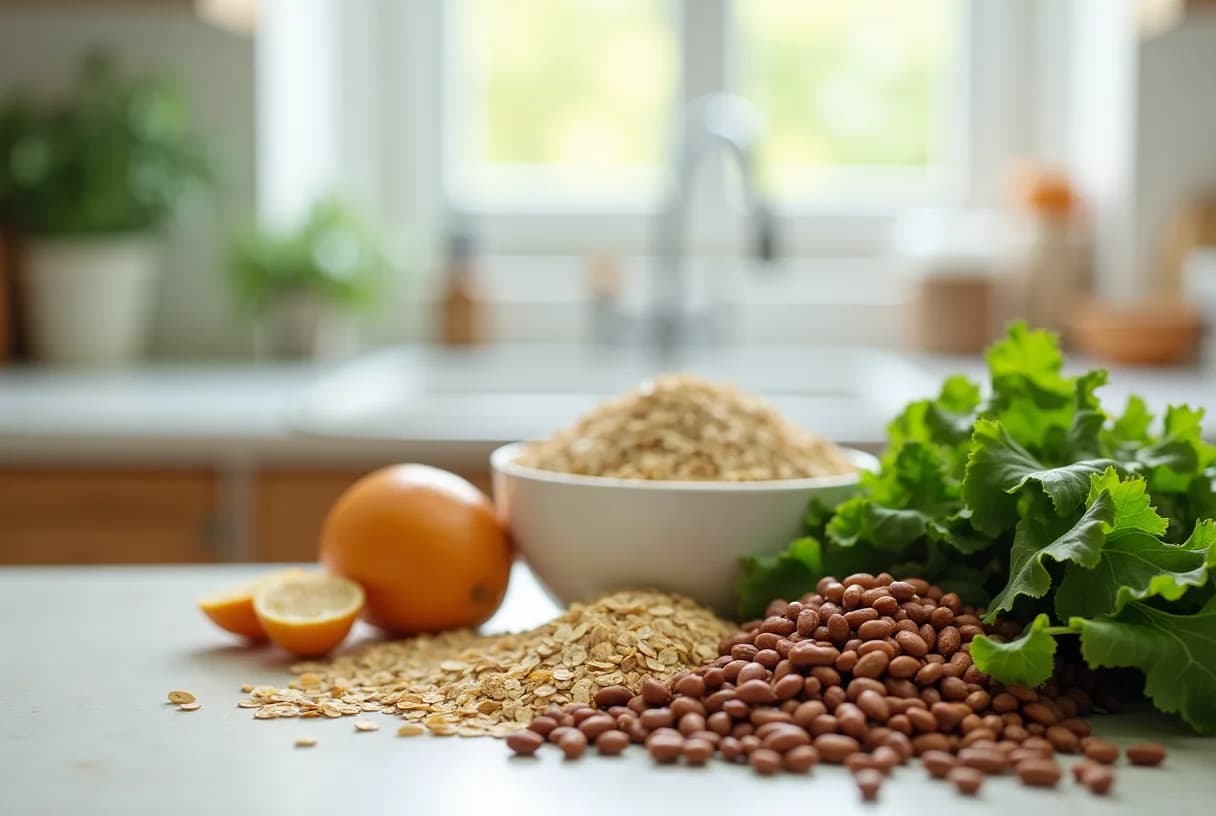
There is no "natural Ozempic." No food, drink, or supplement reproduces what semaglutide — the drug in Ozempic and Wegovy — does. Semaglutide is a manufactured GLP-1 receptor agonist that acts on appetite and blood-sugar pathways at a strength and duration nutrients from food simply cannot match. That said, a few of the popular candidates genuinely help, just modestly: soluble fibre slows how fast your stomach empties, protein increases fullness and protects muscle, and berberine produces small glucose improvements. The honest bottom line: some of these support appetite regulation a little; none is a substitute for a GLP-1 drug when one is medically indicated, and most products marketed as "natural Ozempic" are unproven and unregulated.
Why "natural Ozempic" is a marketing hook, not a mechanism
Semaglutide mimics glucagon-like peptide-1 (GLP-1), a gut hormone your body releases after eating. The drug is engineered so a single molecule keeps acting for roughly a week, driving down appetite, slowing gastric emptying, and improving insulin response continuously. Your own gut also releases GLP-1 after a meal — that part is real physiology — but natural GLP-1 is broken down within minutes, and the amount food triggers is a tiny fraction of a therapeutic dose. So the claim "this food boosts your GLP-1 like Ozempic" contains a kernel of truth wrapped in a wildly misleading comparison. Boosting a hormone for a few minutes after breakfast is not the same as saturating the receptor for seven days. For the full picture on the drug class, see our plain-English guide to how GLP-1 medications work.
The honest evidence grades
Below is where each popular "natural Ozempic" candidate actually stands. "Modest" means measurable in trials but small; it is not code for "as good as the drug."
| Candidate | Real mechanism? | Evidence grade | Honest verdict |
|---|---|---|---|
| Soluble fibre (psyllium) | Yes — forms a gel, slows gastric emptying, raises satiety | Moderate | The closest thing to a genuine shared mechanism; lowers post-meal glucose and hunger, but effect size is small |
| Protein | Yes — most satiating macronutrient; preserves muscle | Moderate | Genuinely useful at midlife; supports fullness and protects against muscle loss |
| Oats / beta-glucan | Yes — soluble fibre, same viscosity mechanism as psyllium | Low–Moderate | Helpful whole food for glucose and fullness; not a fat-loss agent on its own |
| Berberine | Partly — activates AMPK, modest glucose lowering | Low–Moderate | Real but small blood-sugar effect; NOT comparable to a GLP-1 drug; quality and interaction concerns |
| Apple cider vinegar | Weak — may slightly blunt glucose spikes | Very low | Tiny, inconsistent effects; heavily overhyped; some studies flagged for questionable data |
| "Oatzempic" / "lemon coffee" drinks | No specific mechanism | None | At best a low-calorie swap; no evidence they act like a GLP-1 |
The candidates with a real mechanism: fibre and protein
If anything on this list earns the "closest thing" label, it's soluble fibre — and specifically psyllium. In the gut it forms a viscous gel that slows how fast the stomach empties and how fast sugars are absorbed, which is loosely analogous to one of the ways GLP-1 drugs work. In people with type 2 diabetes, psyllium supplementation has lowered HbA1c by roughly 1 percentage point and fasting glucose meaningfully in pooled trial data; in people without diabetes it blunts post-meal glucose spikes. It also modestly reduces hunger between meals. Oat beta-glucan works through the same viscosity mechanism — see why oats earn their reputation for women. None of this is dramatic weight loss, but it is real, low-risk, and food-based.
Protein is the other genuine tool, and it matters more in midlife than most trends acknowledge. Protein is the most satiating macronutrient — it increases fullness hormones and reduces overall intake — and it preserves lean muscle at a stage of life when muscle is quietly declining. That combination supports both appetite and metabolic rate. Our high-protein guide for women covers realistic targets. If you want food-first strategies for glucose specifically, see foods that help steady blood sugar.
Berberine: "nature's Ozempic" is the wrong label
Berberine, a plant compound, is the supplement most aggressively marketed as "nature's Ozempic." The honest read: it does produce small, reproducible blood-sugar improvements. Meta-analyses of randomised trials show reductions in fasting glucose and HbA1c — but the mechanism (activating an enzyme called AMPK) is nothing like a GLP-1 drug, and the effect is far smaller. It is also a supplement, which in the U.S. means no guarantee that the capsule contains what the label claims. Berberine meaningfully affects blood sugar, so combining it with glucose-lowering medications, including GLP-1 drugs or metformin, can compound the effect and risk hypoglycaemia. We cover the nuance in detail in our dedicated berberine review, and you can screen combinations with our interaction checker.
Apple cider vinegar and the viral TikTok drinks
Apple cider vinegar (ACV) sits near the bottom of the evidence table. A few small studies suggest it may slightly reduce post-meal glucose or nudge body weight, but the effects are tiny and inconsistent, one prominent 2024 trial was later flagged for statistically improbable data, and the Mayo Clinic's position is that ACV isn't likely to cause meaningful weight loss. Undiluted vinegar can also erode tooth enamel and irritate the throat.
The TikTok drinks — "oatzempic" (blended oats, water, lime) and "lemon coffee" — have no specific fat-loss mechanism. If a glass of blended oats replaces a higher-calorie breakfast, you may eat slightly less that morning; that is a calorie swap, not a drug effect. There is no evidence these drinks act on GLP-1 in any therapeutic way. They're harmless as food, misleading as medicine.
What about "GLP-1-boosting foods"?
You'll see lists claiming eggs, avocado, or leafy greens "boost your GLP-1 like Ozempic." The physiology is fair: protein, fat, and fibre do stimulate your gut to release GLP-1 after a meal. But that release is transient — natural GLP-1 is degraded within a couple of minutes — and the peak is nowhere near the sustained receptor activation a weekly injection produces. Eating protein and fibre is a good idea for many reasons, including appetite. Framing it as a drug substitute is not.
Grey-market "retatrutide" and peptides: the honest, safety-first answer
Retatrutide is not FDA-approved. As of July 2026 it remains in Phase 3 trials (Eli Lilly's TRIUMPH program), with trial results showing large weight loss but a regulatory submission not expected until late 2026 at the earliest and possible approval no sooner than 2027. There is no legitimate consumer route to obtain it. Because it is not a component of any approved drug, U.S. law does not permit it to be legally compounded, and the FDA has sent warning letters to sellers marketing it — often mislabelled "for research use only."
The grey-market route is genuinely dangerous, and that is the real answer to "how do I get it." The FDA and independent testing have documented vials containing heavy metals, bacterial endotoxins, and incorrect peptide sequences; contaminated injectables have caused infections, hospitalisations, and in extreme cases deaths, and dosing errors from unregulated products have sent people to the emergency room. We will not provide sources, doses, or reconstitution instructions, because doing so would put readers at risk. The same caution applies to grey-market "compounded" semaglutide and tirzepatide sold outside a licensed pharmacy relationship. If a GLP-1 medication is right for you, the safe path runs through a licensed clinician and a legitimate pharmacy — see our overview of approved and evidence-based alternatives and the drug profile for semaglutide. Note that an oral semaglutide (Wegovy) tablet was FDA-approved in December 2025, expanding legitimate, non-injectable options.
When to talk to your clinician
Supplements and food strategies are not neutral when you have a medical condition or take medication. Talk to a doctor or pharmacist before starting any "natural Ozempic" product — and specifically if you:
- Take a glucose-lowering medication (a GLP-1 drug, metformin, insulin, or a sulfonylurea) — berberine and inositol can add to the blood-sugar-lowering effect and raise the risk of hypoglycaemia.
- Have type 2 diabetes, PCOS, or insulin resistance and want a treatment that actually moves the needle — a clinician can weigh medication against lifestyle honestly.
- Are considering, or already using, any GLP-1 medication — never start, stop, or change a dose on your own.
- Have been tempted by an online seller offering retatrutide, peptides, or "research" vials — bring it to a clinician rather than self-injecting.
Do not start, stop, or change any medication or supplement based on this article. It is educational, not medical advice, and it is not a substitute for a conversation with a qualified clinician who knows your history. Explore more evidence-graded coverage in our weight and metabolism hub and supplements section.