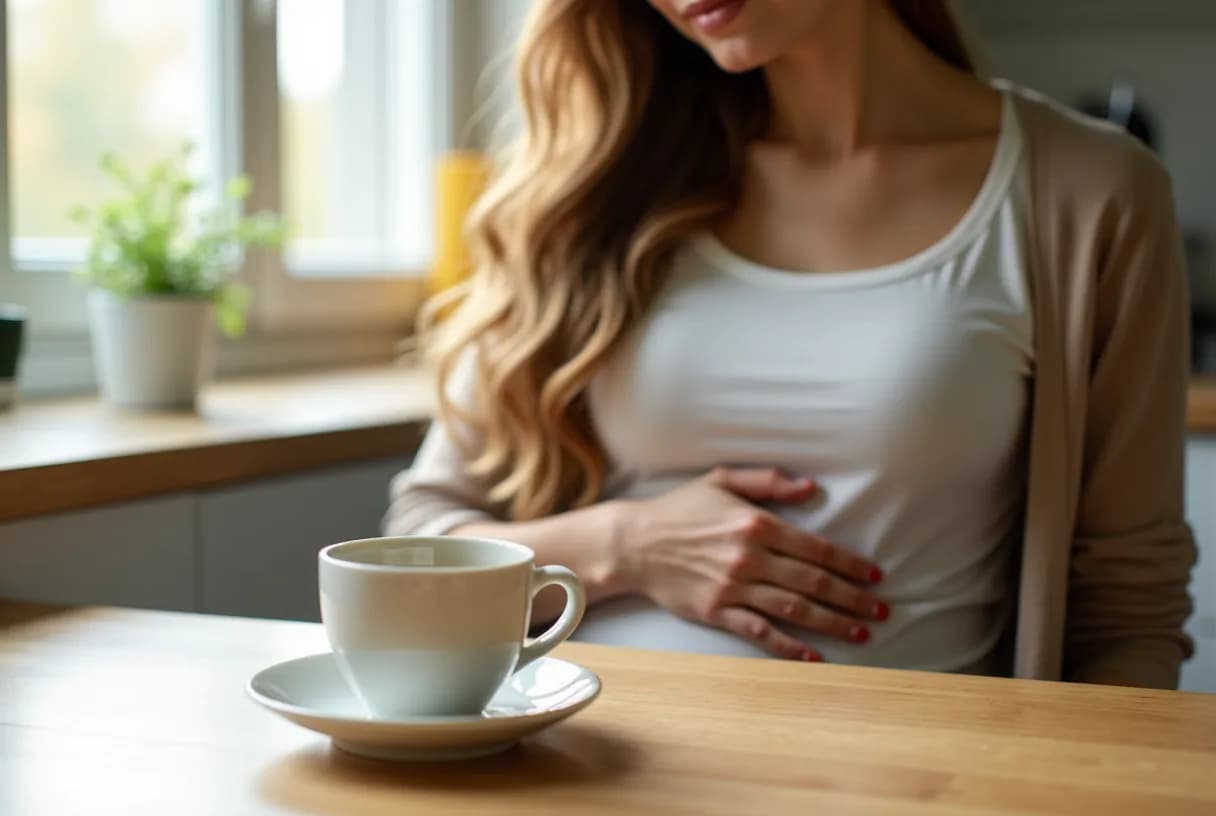
The mechanism: your cramps and your nausea have the same cause
When the uterine lining breaks down at the start of a period, the tissue releases prostaglandins — inflammatory signalling molecules that make the smooth muscle of the uterus contract. That contraction is the cramp. Prostaglandins are why cramps hurt, and why the standard medical explanation for painful periods (dysmenorrhoea) is a prostaglandin story, as ACOG and the NHS both describe it. Both also list nausea, vomiting and diarrhoea among the recognised accompaniments of period pain — not odd extras, but part of the same picture.
Here is the part almost nobody tells you: prostaglandins do not stay in the uterus. They diffuse into surrounding tissue and the circulation, and the gastrointestinal tract is also made of smooth muscle, studded with receptors for the same molecules. Prostaglandins acting on the gut disturb gastric emptying and change gut motility — the stomach empties more slowly or more chaotically, the bowel is driven harder. Slow, disordered gastric emptying is one of the most reliable physiological triggers of nausea there is.
Which means:
- The queasiness and the cramps are the same event, in two organs. Not a coincidence, not a "sensitive stomach", not anxiety about the cramps.
- They arrive together — typically in the 24 hours before bleeding and the first day or two of it, when prostaglandin release peaks.
- The worst nausea tracks the worst cramps. Nausea and vomiting are reported far more often by women with severe dysmenorrhoea than by women with mild cramps. If your pain got worse this year, expect the nausea to have followed it.
- The same chemistry explains why your bowels change on day one — same molecule, different segment of gut.
This is a symptom cluster with one upstream cause, not a collection of unrelated complaints to be triaged one page at a time.
What kind of period nausea is it? A differential
Prostaglandin nausea is the common one, but it is not the only one, and the distinctions change what you should do about it.
| Cause | What it feels like | Clues that point to it |
|---|---|---|
| Prostaglandin-driven nausea (the common one) | Queasy, off food, sometimes vomiting on the worst day. Rides alongside cramping. | Starts with the cramps, peaks with them, fades as bleeding settles. Worse in years when cramps are worse. Often with loose stools. |
| Menstrual migraine | Nausea is a core feature, not an add-on — it can dominate and outlast the headache. Light and sound feel unbearable. | Headache often one-sided and throbbing; you want a dark, quiet room. Attacks cluster around the couple of days before bleeding and the first days of it, tied to the oestrogen drop. Sometimes nausea with barely any headache at all. |
| Vasovagal reaction to severe cramp pain | A wave of nausea with cold sweat, grey clammy skin, ringing ears, tunnel vision, near-fainting — at the peak of a cramp. | Sudden, short-lived, eases when you lie flat with your legs raised. It is a reflex drop in heart rate and blood pressure triggered by intense pain — and it is a sign the pain is genuinely severe. |
| PMS / PMDD | Nausea as part of a broader premenstrual picture: bloating, breast tenderness, mood collapse, food aversion. | Symptoms build in the luteal phase (before bleeding) and typically settle once bleeding starts — close to the opposite timing to prostaglandin nausea, which peaks as the bleed begins. |
| Endometriosis | Nausea with pain that is disproportionate, escalating over years, and no longer confined to your period. | Pain with bowel movements or sex, pelvic pain between periods, bowel symptoms that flare cyclically. Endometriotic tissue on or near bowel and peritoneum can irritate the gut directly, on top of the prostaglandin load. |
| Adenomyosis | Nausea with heavy, dragging, deep cramping and heavy bleeding. | Often mid-to-late reproductive years; heavy periods, a bulky tender uterus, pain that has crept worse each year. |
| Other (do not force it into the period box) | Nausea that does not respect the calendar. | Pregnancy, gallbladder disease, gastritis, thyroid disease, medication side effects, migraine unrelated to the cycle. If it happens off-cycle too, it is not a period symptom. |
The two on that list that must not be assumed away are endometriosis and adenomyosis. "Cyclical nausea and pain that has got worse over the years, and painkillers no longer touch it" is a textbook history for both — and it is one of the most routinely dismissed sentences a woman can say in a consulting room. The World Health Organization notes that endometriosis is frequently diagnosed late, and that delay is not because the disease is silent. It is because this history gets waved through as normal periods. It is not normal for periods to get worse and worse.
What actually helps — and why
None of this is a prescription. It is an explanation of what each option is doing, so you can have a better conversation with a clinician instead of a worse one with the internet.
NSAIDs: the mechanism, not an instruction
Non-steroidal anti-inflammatory drugs (the class that includes ibuprofen, naproxen and mefenamic acid) work by inhibiting cyclo-oxygenase, the enzyme that manufactures prostaglandins. They do not simply mask pain downstream — they reduce the amount of the causative chemical being made. That is why they are the workhorse of period pain treatment: a Cochrane review of 80 randomised trials found NSAIDs substantially more effective than placebo for dysmenorrhoea, while being equally clear that adverse effects — gastrointestinal ones especially — are real and not rare.
And that is the interesting bit for nausea. If prostaglandins are driving both organs, blocking their synthesis should logically ease the gut symptoms alongside the cramps — but NSAIDs are themselves a gastric irritant, so for some women they add nausea rather than removing it. That tension is exactly why this is a conversation with a prescriber or pharmacist, especially if you have any history of stomach ulcers, reflux, kidney problems or asthma, or you take other medications. We are not telling you to take, start, stop or change anything.
Ginger
Ginger has modest but genuinely real trial evidence as an anti-nausea agent — most robustly in pregnancy-related nausea and in chemotherapy-related nausea, where its active compounds (gingerols and shogaols) appear to act on gut motility and on the receptors involved in the vomiting reflex. It is not a cure, the evidence in menstrual nausea specifically is thinner than the pregnancy evidence, and effect sizes are moderate rather than dramatic. But it is one of the few popular remedies for nausea with a plausible mechanism and actual randomised data behind it, rather than vibes.
Food, heat, and the boring things that work
- Small, frequent, bland meals. If the problem is impaired gastric emptying, a large or fatty meal is a lot of work for a stomach that is already struggling. Smaller volumes going in more often is a mechanical answer to a mechanical problem. (This is a general principle, not a diet — we are not prescribing what you eat or how much.)
- Heat for the cramps that drive the nausea. Treat the upstream problem. A heat pack or hot water bottle on the lower abdomen is one of the better-evidenced non-drug options for period pain — see how heat works on period pain and our wider guide to cramp relief.
- Lie flat with your legs raised if you feel faint. If it is a vasovagal wave, that position is the standard first response, and the wave usually passes within minutes.
- Track it. Two or three cycles of notes on when the nausea starts relative to bleeding, how bad the cramps were, and whether there was a headache is the single most useful thing you can take to an appointment. The period and ovulation tracker makes this less of a chore.
The midlife angle nobody writes about
Most articles on this topic are written for a 25-year-old. If you are in your forties, the picture changes in ways that matter.
In perimenopause, oestrogen does not glide gently downward — it swings, sometimes to levels higher than you had in your twenties, then crashes. Cycles shorten, then lengthen. Ovulation becomes hit-and-miss. The consequences for nausea:
- It becomes erratic. Three brutal months, then two easy ones, then a cycle where the nausea arrives a week early. That unpredictability is itself characteristic of perimenopause — but "it's perimenopause" is a description, not a diagnosis.
- Migraine often gets worse before it gets better. Steep oestrogen withdrawal is a potent migraine trigger, and perimenopause is a run of steep withdrawals. If nausea has become the dominant symptom, read menopause and migraine.
- Adenomyosis and fibroids are common in exactly this age band — often alongside heavier bleeding. Heavier bleeding means more endometrial tissue breaking down, which means a bigger prostaglandin load, which means more cramp and more nausea. There is a mechanism for why your forties can feel worse.
- Nausea can also show up outside the cycle entirely as a menopausal symptom in its own right — see nausea in menopause.
New cyclical nausea after 40 deserves a look, not a shrug. "You're at that age" is the most reliable way to miss adenomyosis, thyroid disease, gallbladder disease and endometrial pathology in the same appointment.
When to see a doctor
Call emergency services now if nausea comes with any of the following — in a woman over 40 especially, but at any age if the pattern fits:
- Chest pressure, tightness or discomfort
- Pain in the jaw, neck, back, shoulder or arm
- Breathlessness, cold sweat, or sudden lightheadedness
- Crushing, unfamiliar fatigue with any of the above
This is the most important sentence on this page: nausea plus any of those features is not a period symptom until a heart attack has been excluded. Do not drive yourself, and do not wait to see whether it passes. Chest discomfort is still the commonest heart attack symptom in women, as it is in men — but women more often have a heart attack without it, and nausea, regularly mistaken for indigestion, food poisoning or flu, is among the symptoms women most often report. It is listed as a warning sign by the American Heart Association. Women delay calling for help because the symptoms do not look like the film version, and that delay costs lives. Read heart disease symptoms in women, and use the heart risk check if you have never assessed your own risk.
Seek urgent medical care if you have:
- Vomiting you cannot stop, or cannot keep fluids down
- Nausea with a fever
- Severe one-sided pelvic pain, especially if it comes on suddenly (ovarian torsion and ectopic pregnancy both present this way)
- Fainting, or repeatedly nearly fainting
- Bleeding that soaks through a pad or tampon every hour for several hours
- Pain and nausea together when there is any chance you could be pregnant
Book a non-urgent appointment — and be specific — if:
- Nausea or pain is escalating year on year
- It is bad enough to make you miss work, school or plans
- You have pain during sex, with bowel movements, or between periods
- Nausea also happens off-cycle
- Painkillers that used to work no longer do
- Any of this is new after 40
Bring cycle data. "I feel sick on my period" gets a shrug; "for the last three cycles, nausea and vomiting start about 12 hours before bleeding, peak with cramps I rate 8 out of 10, and this has been getting worse for four years" gets taken seriously — and often gets you an ultrasound. That difference should not exist, but it does, so use it. Our guides to period pain, PMS and PMDD and the wider menstrual health hub cover what to expect from the workup.
Feeling sick every month is common. That does not make it acceptable, and it certainly does not make it inexplicable.
]]>