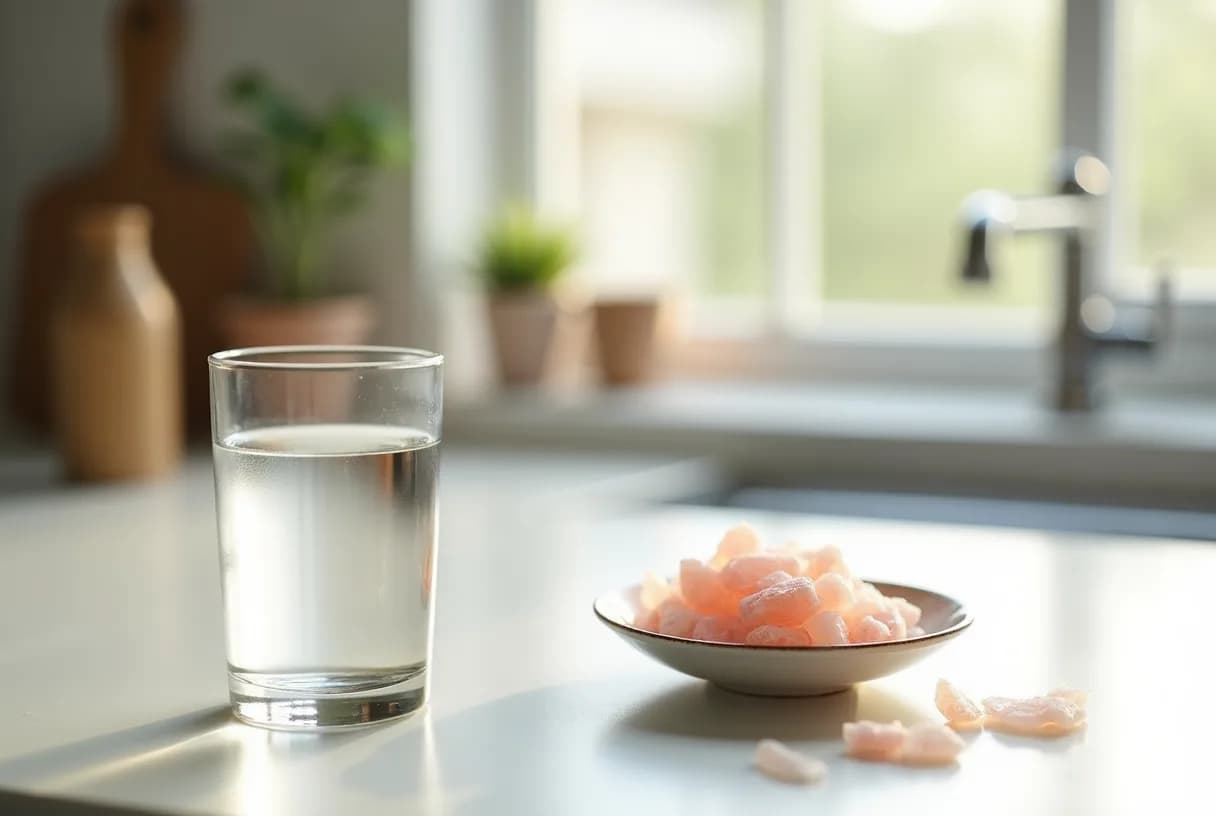
No. There is no good evidence that drinking Himalayan pink salt in water burns fat, speeds up your metabolism, or "detoxes" your body. Any quick change you see on the scale is shifting water, not lost fat — and adding extra salt can actually make you retain water and nudge your blood pressure up. The "pink salt trick" is a viral marketing story, not a weight-loss method. Here is what the claim gets wrong, what the real risks are, and what genuinely moves the needle.
What is the "pink salt trick"?
The "pink salt trick" (also sold as a "pink salt recipe," "Japanese pink salt trick," or "Mediterranean ritual") is a social-media routine that tells you to stir a pinch to half a teaspoon of Himalayan pink salt into a glass of water — often with a squeeze of lemon — and drink it first thing in the morning. The pitch is that this simple mix "melts fat," "resets your metabolism," "flushes toxins," and delivers "84 trace minerals" your body is supposedly missing.
Many versions are pushed through ads that use fake celebrity or doctor endorsements and AI-generated videos, usually to funnel you toward a paid supplement, "drops," or an ebook. The salt-water part is real. The fat-loss promise attached to it is not. No clinical trial shows that salt water causes weight loss.
What the pink salt trick claims vs. what really happens
| The claim | What really happens |
|---|---|
| "Boosts your metabolism so you burn more fat" | Salt has no calories and no known effect that raises metabolic rate. Nothing in salt water burns fat. |
| "Detoxes and flushes out toxins" | Your kidneys and liver already do this. Extra sodium makes the kidneys work harder, not less. |
| "Melts belly fat and resets fat-burning" | Fat loss requires a sustained calorie deficit. A morning drink cannot target belly fat. |
| "The scale drops, so it is working" | Early scale changes are water, not fat — and salt tends to make you hold water. |
| "Gives you 84 essential minerals" | The trace minerals in pink salt are in amounts too tiny to matter, and it has no added iodine. |
Does pink salt actually boost metabolism or "detox" your body?
Short answer: no on both counts. Here are the three biggest claims, one at a time.
"It speeds up your metabolism"
Salt is sodium chloride. It contains zero calories, and there is no mechanism by which a pinch in water raises the rate at which your body burns energy. Your metabolism is driven mostly by your body size, muscle mass, age, and activity — not by a mineral in your water glass. To understand what genuinely changes your burn rate, see how metabolism changes with age and foods that support your metabolism.
"It detoxes and flushes toxins"
Your body already runs a hard-working detox system: the liver, kidneys, gut, and skin. There is no everyday "toxin" that a glass of salt water removes. If anything, a big sodium load asks your kidneys to do extra work to excrete it and pull water along with it. In this kind of marketing, "detox" is a sales word, not a physiological one.
"It is packed with 84 trace minerals"
Pink Himalayan salt does contain trace minerals like magnesium, potassium, and calcium — but in amounts so small they are nutritionally meaningless. Cleveland Clinic notes that no matter where salt comes from, it is essentially the same sodium chloride, and its trace-mineral content is too tiny to provide real benefits. One catch runs the other way: unlike ordinary iodized table salt, most pink salt has no added iodine, a nutrient that matters for thyroid health. You would have to eat a genuinely harmful amount of pink salt to get a meaningful dose of any single "trace mineral."
Why does the scale drop the next morning if it is not fat?
People swear the trick "works" because the scale reads lower after a day or two. Here is the honest explanation:
- You are simply drinking more water. Any morning ritual that gets you to down a big glass of water often replaces higher-calorie drinks and can dull appetite a little. That is the water and the routine — not the salt.
- Scale weight swings by several pounds a day. Normal shifts in water, glycogen, sodium, hormones, and bowel contents move the number far more than daily fat change ever could.
- Losing one pound of body fat takes roughly a 3,500-calorie deficit. No zero-calorie drink can create that. What "melts" overnight is water, not fat.
Ironically, sodium pulls water into your body. A salty morning drink is more likely to make you retain water and feel puffy than to "flush" it out. If bloating is your real concern, start with what causes menopause bloating instead.
The real risk: you are adding sodium
The part these videos never mention: you are voluntarily adding a mineral most of us already get far too much of. On average, adults eat about 3,400 mg of sodium a day — above the federal limit of less than 2,300 mg, and well above the American Heart Association's ideal target of no more than 1,500 mg for most adults. Too much sodium raises blood pressure, and higher blood pressure raises the risk of heart disease and stroke.
A single "pink salt" drink can use up a big slice of your day's budget before breakfast:
| Pink salt in your glass | Approx. sodium | Share of AHA's 1,500 mg ideal daily limit |
|---|---|---|
| ¼ teaspoon | ~575 mg | ~38% |
| ½ teaspoon | ~1,150 mg | ~77% |
| 1 teaspoon | ~2,300 mg | Over 150% — a full day's upper limit |
This matters far more for some readers than others. Be especially cautious — and talk with your clinician before adding daily salt water — if you have:
- High blood pressure or a family history of it (see high blood pressure in women).
- Heart failure or heart disease, where extra fluid and sodium can worsen symptoms.
- Kidney disease, since damaged kidneys struggle to clear excess sodium.
- Pregnancy, or a blood-pressure or steroid medication that affects your fluid balance.
If lowering blood pressure is your actual goal, plain water and less sodium — not more — is the evidence-based move.
Is Himalayan pink salt healthier than table salt?
Not in any way that helps you lose weight. Gram for gram, pink salt delivers essentially the same sodium as table salt. Its rosy color comes from trace minerals present in negligible amounts. The one practical difference actually favors ordinary salt: standard iodized table salt is a reliable source of iodine, while most pink salt is not. Choosing pink salt "for your health" can quietly leave a nutritional gap rather than fill one.
What actually works for weight — and for hydration?
The unglamorous habits below are what decades of research and bodies like the NIDDK actually support. None of them fit in a 20-second clip, which is exactly why they work.
- Build meals around protein and fiber. They keep you full on fewer calories and steady your energy. See metabolism-supporting foods.
- Move most days, including walking. A brisk daily walk is one of the most sustainable tools there is — here is walking for weight loss.
- Protect muscle with strength training. Muscle is metabolically active, and holding onto it matters more with age.
- Prioritize sleep and manage stress. Poor sleep and chronic stress push appetite and belly-fat storage — a big driver of menopause belly fat.
- Track honestly, not obsessively. The NIDDK finds that people who record their habits and how they feel are more likely to make changes stick. A tool like our menopause symptom diary can help you connect weight with sleep, mood, and your cycle.
Menopause shifts the picture too: changing hormones can redistribute weight toward the middle even when your habits have not changed. Our guide to menopause weight gain and the wider weight and metabolism hub go deeper.
Hydration done right: if your real goal is to drink more water, just drink water. Mayo Clinic suggests roughly 11.5 cups of total fluids a day for women, adjusted for activity and heat, and notes that food covers about 20% of that. You generally do not need added salt — plain water is fine. If you are sweating heavily, exercising for a long stretch, or ill, a balanced electrolyte mix (not a spoonful of salt) can help; see our best electrolytes for women roundup.
When should you see a doctor?
The pink salt trick itself will not help you lose fat, but the sodium can cause real problems. Check in with a healthcare professional if you notice:
- Headaches, swelling in your hands, ankles, or face, or unusual puffiness after adding salt.
- Home blood-pressure readings that are creeping upward.
- Increased thirst, dizziness, or a racing heartbeat.
- Any weight-loss product promising fast results through "drops," "salt tricks," or celebrity-endorsed pills — run it past your clinician before you buy.
Also see your doctor if you are genuinely trying to lose weight and it will not budge despite real effort, or if weight changes come with fatigue, hair changes, or a racing or slow heartbeat — those can point to thyroid or hormonal causes worth checking, rather than anything a salt fix could solve.
The bottom line
The pink salt trick is a repackaged old idea — salt water — dressed up with big promises and fake endorsements. It does not boost metabolism, it does not detox anything, and the only "weight" it moves is water. In small amounts it is harmless for most people, but for anyone watching their blood pressure, heart, or kidneys, adding daily salt is a step in the wrong direction. Save your money, drink plain water, and put your energy into the ordinary habits that actually work.