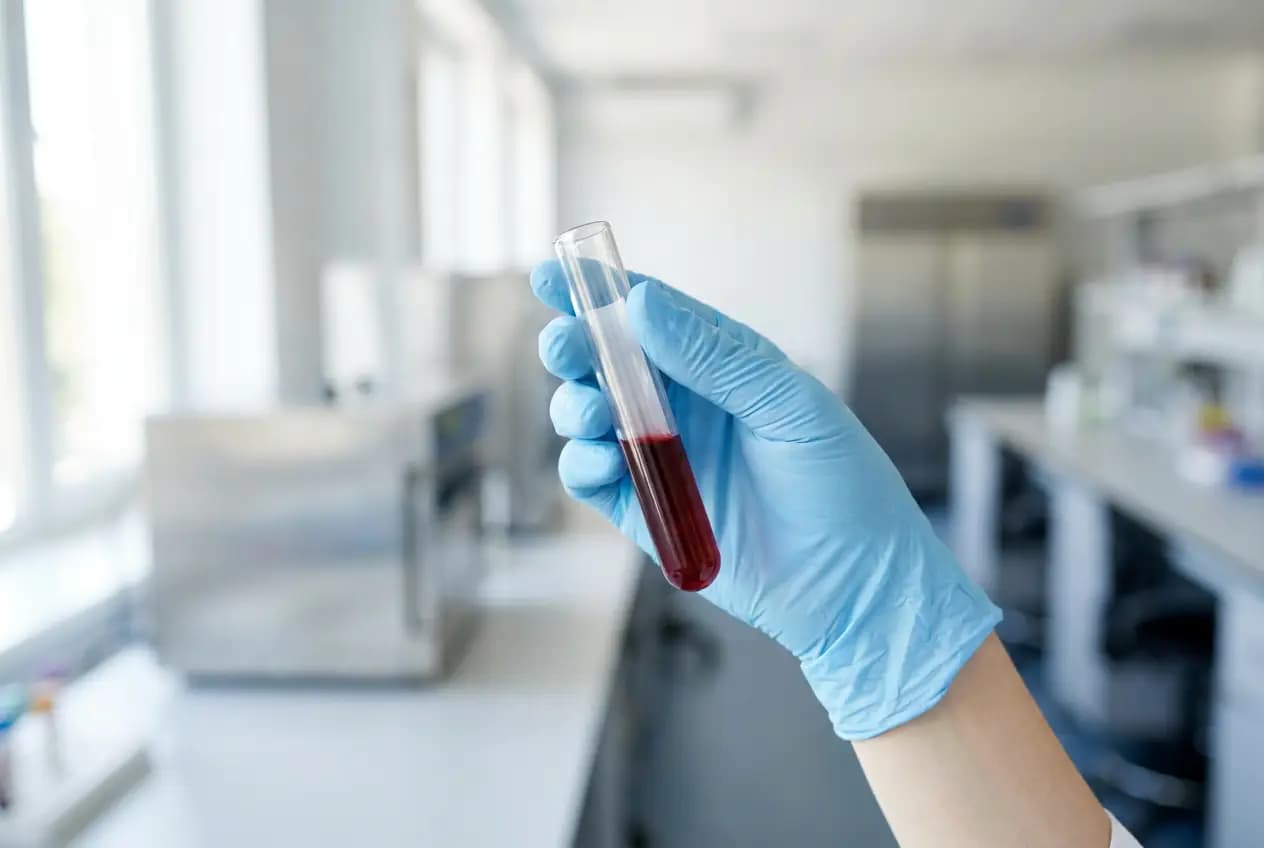
If you're in your late 40s or 50s with irregular periods and hot flashes, you probably don't need a menopause test at all. Menopause is usually a clinical diagnosis — based on your age, your symptoms, and your period pattern — and a blood test rarely adds anything. Here's when a test genuinely helps, and when it just adds cost and confusion.
How menopause is actually diagnosed
Menopause is defined as the point 12 months after your last period, with no other cause.[4] The years of change leading up to it — irregular cycles, hot flashes, night sweats, mood and sleep shifts — are called perimenopause. For most women in the typical age range, the diagnosis is made from the story alone: no test can beat "irregular periods plus hot flashes in your 40s, then a year with no period."
Major bodies including ACOG and the Mayo Clinic agree that in women over 45 with classic symptoms, hormone testing is not routinely recommended.[1] It rarely changes the diagnosis and even more rarely changes what helps you feel better. If you want the bigger picture of how the transition unfolds, see the stages of menopause and perimenopause vs menopause.
What FSH is and why it rises
FSH — follicle-stimulating hormone — is made by the pituitary gland to prompt the ovaries to ripen an egg each cycle. As the ovaries run low on eggs and produce less estrogen, the feedback loop that normally keeps FSH in check weakens, so the pituitary pushes harder and FSH climbs.[3] A consistently high FSH (often above 30 mIU/mL) together with no periods points toward menopause. But there is no single magic number that flips the switch, and the timing of the blood draw matters enormously.
It helps to think of FSH as an indirect signal rather than a direct readout of "how much menopause" you've reached. A high value suggests the ovaries are being pushed hard and are probably winding down — but on its own it can't pinpoint where you are or predict how much longer the transition will last. That's why it's read alongside your age, your period pattern, and how you feel, not as a stand-alone verdict.
Why a single FSH test is unreliable in perimenopause
During perimenopause, hormones don't glide smoothly downward — they swing. FSH can be menopausal-range one month and near-normal the next, sometimes within the same cycle. A single snapshot can read "high" on a day you feel fine, or "normal" on a week of relentless night sweats. That's why one test in a still-menstruating woman can be genuinely misleading, and why chasing it often causes more anxiety than clarity.
A few things can further distort the reading:
- Hormonal birth control and some menopause therapies suppress FSH, masking the real trend.
- Where you are in the cycle — FSH is normally checked early in the cycle (around day 3) for the most consistent read.
- Day-to-day variation in late perimenopause, when levels bounce around most.
When a menopause test is worth it
Testing earns its place when the picture is unusual or the answer changes what you'd do next:
- Suspected early or premature menopause. If periods stop or symptoms hit before age 45 (early) or 40 (premature, also called primary ovarian insufficiency), FSH and estradiol help confirm it — and that confirmation matters for bone and heart protection and for fertility decisions.[3]
- After a hysterectomy (uterus removed, ovaries kept). With no periods to track, hormone levels are one of the few clues to where you are in the transition.
- To rule out mimics. Thyroid problems, and sometimes high prolactin or pregnancy, cause overlapping symptoms — so a thyroid panel and other tests may be checked instead of, or alongside, FSH.
- Unclear symptoms in your early 40s, where the pattern doesn't neatly fit perimenopause and a clinician wants more information.
Menopause tests compared
| Test | What it measures | When it's useful | Main limitation |
|---|---|---|---|
| FSH (blood) | Pituitary drive to the ovaries; rises as ovaries wind down | Suspected early/premature menopause; after hysterectomy | Swings widely in perimenopause; one value can mislead |
| Estradiol (blood) | Main estrogen the ovaries make | Alongside FSH to confirm low ovarian activity | Also fluctuates; not a standalone answer |
| TSH / thyroid | Thyroid function | To rule out thyroid as the cause of symptoms | Doesn't diagnose menopause itself |
| AMH (blood) | Ovarian reserve (egg supply) | Mainly fertility assessment | Doesn't confirm you've reached menopause |
| At-home urine FSH kit | FSH in urine (high/low) | Curiosity or a rough flag | One snapshot; can't diagnose; false reassurance or alarm |
What about at-home menopause tests?
Drugstore and mail-order kits usually measure FSH in urine and report "high" or "low." They have the same core weakness as a single blood test — a snapshot of a moving target — plus less precision. A kit can't tell you whether you've reached menopause, and it can't decide whether your symptoms warrant treatment. A "low" result during a calm week can feel falsely reassuring, and a "high" one on a rough day can spark needless worry. If your symptoms are disrupting life, a conversation about options — including lifestyle changes, hormone therapy, and other treatment options — is far more useful than a test result.
When testing usually isn't needed
You can generally skip hormone testing if you are in your late 40s or 50s with typical symptoms, or if you've already gone 12 months without a period. At that point the diagnosis is made and a number won't change it. The more useful questions are practical ones: managing sleep, low-estrogen symptoms, vaginal dryness, and protecting bone and heart health for the years ahead. Curious how long that takes? See how long menopause lasts. And note: until you've reached menopause, pregnancy is still possible — a single FSH result doesn't mean you can stop contraception, so ask your clinician how long to keep using it (a common guide is about a year after periods stop if you're over 50, and about two years if you're under 50).
When to see your doctor
Some situations deserve prompt medical attention rather than a home test:
- Any bleeding after menopause (12+ months since your last period) — this always needs evaluation, even if it's light.
- Very heavy, prolonged, or frequent bleeding during perimenopause — see heavy periods.
- Symptoms before age 45, or periods stopping early, which warrant testing to confirm early menopause.
- A new breast lump or nipple or skin change, which should always be checked.
- Symptoms that could be thyroid or another condition — fatigue, weight change, palpitations — where a proper work-up helps.
A clinician can weigh your age, symptoms, and history, decide whether any test is worthwhile, and — importantly — talk through what actually helps you feel better. The test is rarely the point; the plan is.
Related: Thinking about a drugstore kit? At-Home Menopause (FSH) Tests: Do They Actually Work? explains why a single reading rarely settles the question.
Related: Wondering whether you can skip the lab and check your hormones from home? See At-Home Hormone Tests for Women: What They Can and Can't Tell You before you buy a kit.