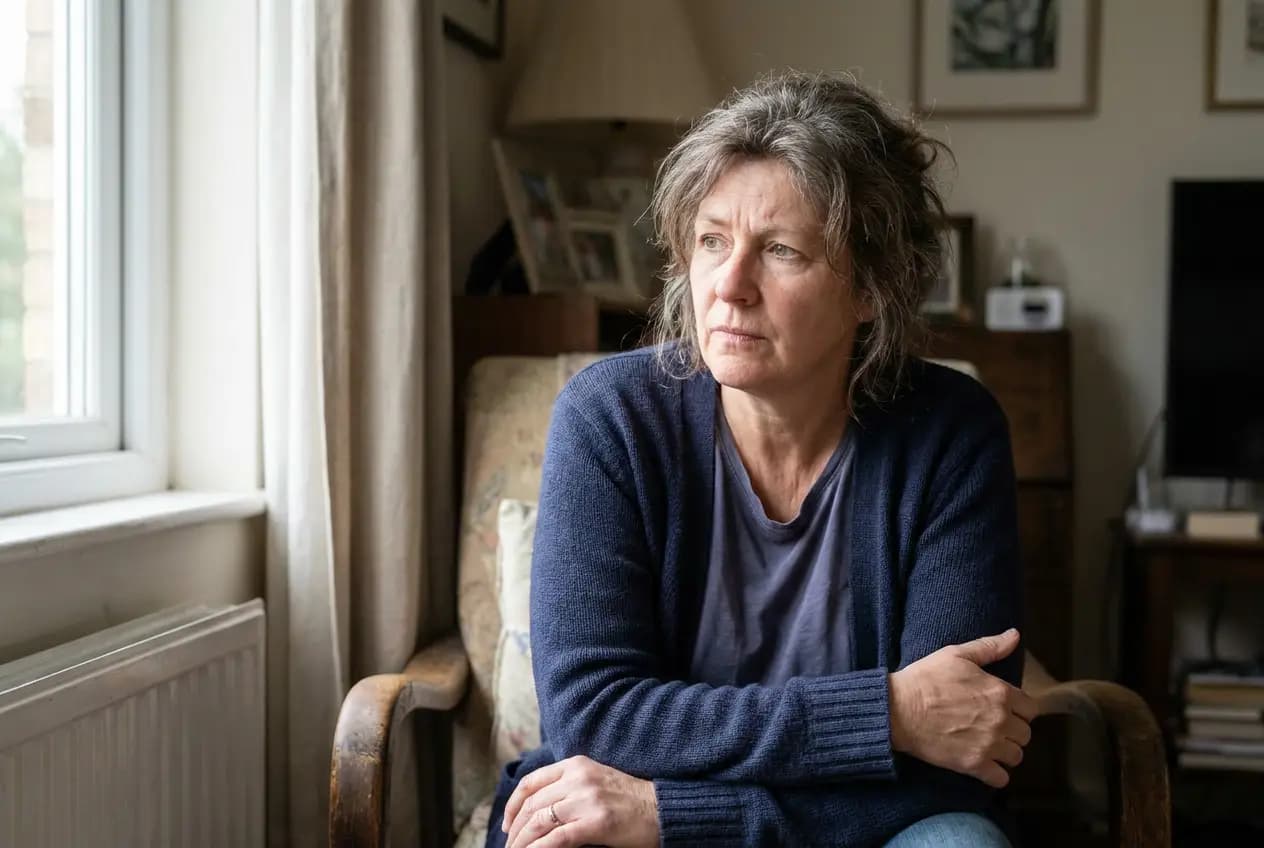
Tender, achy, or swollen breasts can feel alarming in your forties and fifties, but they are one of the most common and least talked-about signs of the menopause transition. Here is why fluctuating hormones cause the pain, how to tell ordinary tenderness from a warning sign, and what actually helps.
Can menopause cause sore breasts?
Yes. Breast pain and tenderness — doctors call it mastalgia — are very common in perimenopause, driven by fluctuating estrogen and progesterone acting on breast tissue.[2] Most sore breasts in menopause are "cyclical," meaning the tenderness tracks loosely with your hormones, and it usually eases after menopause once those hormones settle at a low level. One reassuring point up front: breast pain on its own is rarely a sign of breast cancer, which more often shows up as a painless lump.[6] But a few specific signs do need a doctor, and we cover them below.
Why your breasts hurt in perimenopause
Estrogen and progesterone both act on breast tissue, and during perimenopause they swing erratically rather than declining smoothly.[4] Those swings make breast tissue retain fluid and feel swollen, heavy, and tender — usually in both breasts, often across the upper and outer areas that reach toward the armpit. Many women find this tenderness more intense than the premenstrual breast soreness of earlier years, precisely because the hormone fluctuations of perimenopause are bigger and less predictable. It can come and go, loosely following your increasingly irregular cycles, and it often arrives alongside other signs of shifting hormones such as heavier or erratic periods. This is a normal part of the transition through the stages of menopause, not a sign that something is wrong.
Why it can feel worse than premenstrual soreness
In your reproductive years, breast tenderness followed the tidy rise and fall of the menstrual cycle. In perimenopause, ovulation becomes erratic and estrogen can spike higher than usual before dropping, so the fluid-retention effect on breast tissue is exaggerated. That is why the ache can feel deeper, last longer, and turn up at unexpected times — even when your periods are becoming further apart.
What about sore breasts after menopause?
Once you are postmenopausal and estrogen stays low, cyclical breast pain usually settles down. That means new or persistent breast pain after menopause is less likely to be hormonal — and more worth getting checked, especially if it stays in one spot. Non-hormonal causes become relatively more common with age, including muscle or chest-wall strain, costochondritis (inflammation where the ribs meet the breastbone), a large or unsupportive bra, and occasionally certain medications.[1] None of these is usually serious, but they are worth sorting out rather than assuming the pain is "just hormones."
Can hormone therapy cause breast tenderness?
Yes — this is a common exception. Starting hormone therapy (HRT), whether estrogen alone or estrogen with progesterone, frequently causes breast tenderness in the first few months, which usually eases as your body adjusts.[3] If it does not settle, a clinician can adjust the type, dose, delivery route, or schedule. Understanding the roles of estrogen versus progesterone can help you have that conversation, since the progesterone component is a common driver of tenderness.
Cyclical vs. non-cyclical breast pain
Telling these two patterns apart helps you know what is routine and what is worth a closer look:
| Cyclical (usually hormonal) | Non-cyclical (worth a closer look) | |
|---|---|---|
| Where | Both breasts, often upper and outer | One breast, often one specific spot |
| Feel | Dull, heavy, achy, swollen | Sharp, burning, tight, or pulling |
| Timing | Comes and goes, loosely with your cycle | Constant, or unrelated to your cycle |
| Typical age | Common in perimenopause | More common after menopause |
| What to do | Self-care; reassurance | Get it evaluated if it persists or is one-sided |
What helps sore breasts
Most cyclical breast pain responds well to simple, low-risk self-care. Give any single change a few weeks before judging it:
- A well-fitted, supportive bra — including a soft, supportive bra at night — is one of the simplest and most effective steps. Getting professionally measured is worthwhile, since bra size often changes in midlife.
- Over-the-counter pain relief — acetaminophen or NSAIDs such as ibuprofen; topical anti-inflammatory gels help some people with less whole-body effect.
- Warm or cold compresses, whichever feels better on the day.
- Trial cutting back caffeine. The evidence is genuinely mixed, but some women notice less tenderness, so a few weeks' trial is a reasonable, low-cost experiment.
- Weight management and a lower-fat, plant-forward diet. A menopause-friendly eating pattern may reduce tenderness for some, and helps with other symptoms too.
- Enough magnesium. Some women use magnesium for premenstrual-type symptoms; evidence for breast pain specifically is limited, so keep expectations modest and treat it as an experiment rather than a proven fix.
- Evening primrose oil is widely tried, but controlled trials show little benefit over placebo — so keep expectations modest and don't spend heavily on it.
When it comes as part of a bigger picture
Sore breasts rarely arrive alone. They often show up alongside hot flashes, night sweats, disrupted sleep, and mood shifts. Treating the whole transition — rather than each symptom in isolation — is usually more effective. If you are unsure which stage you are in, perimenopause vs. menopause explains the difference, and hormone testing covers what blood tests can and can't tell you (in short: a single hormone level rarely confirms perimenopause on its own).
How long does breast tenderness last?
There is no fixed timeline, because it tracks your hormones rather than the calendar. For most women, cyclical breast pain is most noticeable during perimenopause — the years when hormones swing most — and eases within a year or two of the final period, once estrogen stays reliably low. Because the whole transition is variable, our guide on how long menopause lasts puts the timing in context. If tenderness lingers well past menopause, or appears for the first time afterward, that is the pattern most worth getting checked.
When to see your doctor
Breast pain by itself is usually not cancer, but see a clinician promptly if you notice any of the following:
- A new lump or thickening in the breast or armpit.
- Pain in one specific spot that does not go away.
- Skin changes — dimpling, puckering, redness, or an orange-peel texture.
- Nipple changes — a nipple turning inward, discharge (especially bloody or from one duct), or a new rash or scaling.
- Breast pain that is new and persistent after menopause.
- Pain severe enough to interfere with sleep, work, or daily life despite self-care.
Keep up with recommended mammogram screening regardless of whether you have pain — screening finds cancers that cause no symptoms at all.[5] And remember that pregnancy is still possible in perimenopause, which is another (much happier) reason breasts can suddenly feel sore. If you would like tailored help, online menopause treatment options explains how to get menopause care, including whether hormone therapy is a fit for you.
Related: what causes breast pain and when to get it checked — a broader look at the everyday reasons breasts can hurt at any age, and the signs worth raising with a doctor.