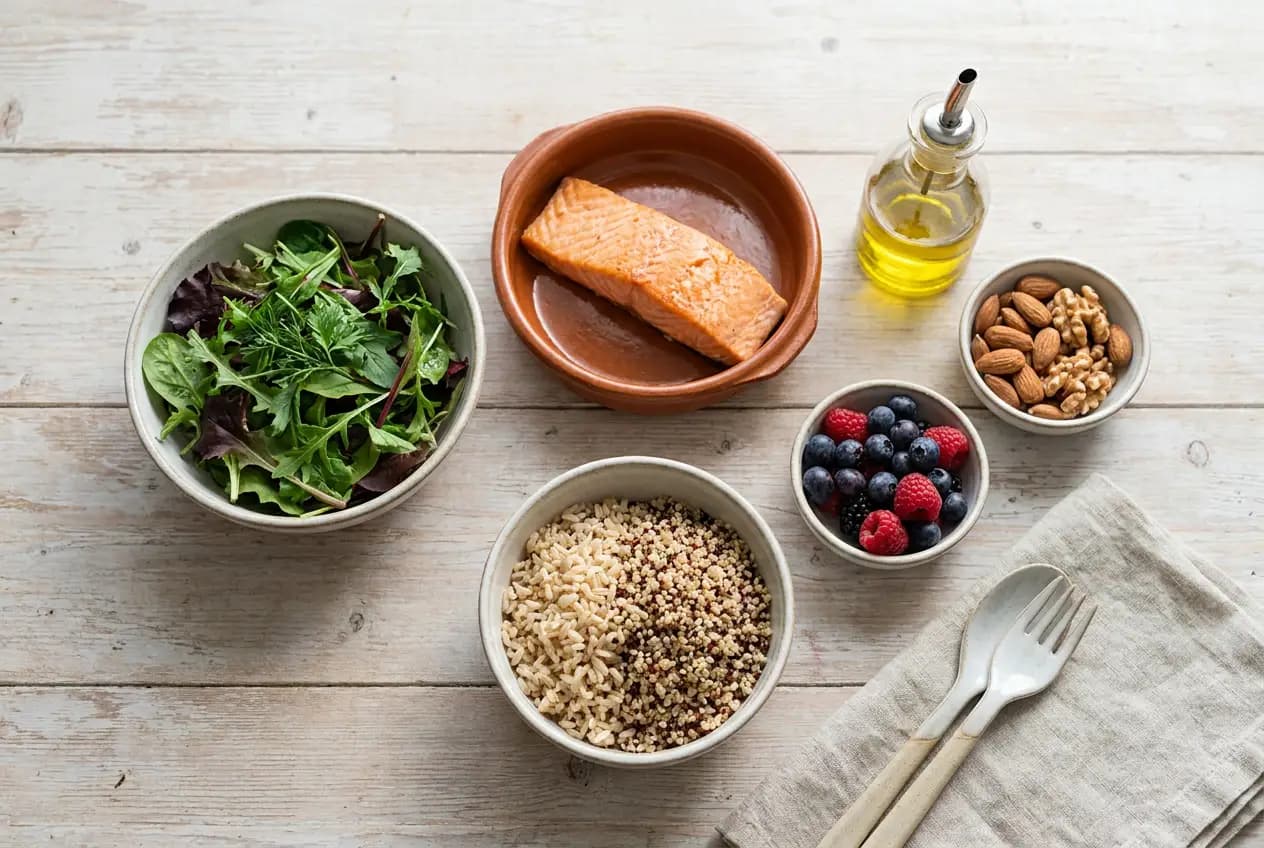
There's no magic menopause diet, but the way you eat during this stage genuinely matters — for your symptoms today and for your heart, bones, and weight over the decades ahead. Here's what the evidence actually supports, and what to shift toward.
Is there a single "best" diet for menopause?
The strongest evidence points clearly to one pattern: a Mediterranean-style diet — rich in vegetables, fruit, whole grains, legumes, fish, nuts, and olive oil, with less red and processed meat. It's repeatedly linked to better heart health (important because cardiovascular risk rises after menopause), a healthier weight, and in some studies fewer or milder hot flashes.[3] Think of the best diet for menopause as a flexible pattern to move toward, not a rigid plan to follow perfectly. Wherever you are in the menopause stages, the same eating pattern applies throughout.
Why menopause changes what your body needs
As estrogen falls, several things shift at once. Muscle mass tends to decline with age, which can slow metabolism and weaken the support around your joints and bones. Bone loss speeds up in the years around your final period, raising fracture risk.[2] Cardiovascular risk climbs as the protective effects of estrogen fade.[5] And body fat often redistributes toward the abdomen. None of this is inevitable, and none is fixed by a single food — but a thoughtful eating pattern, paired with movement, addresses all of it at once. Diet is one lever among several, and it's one of the most powerful you control day to day.
What to prioritize in a menopause diet
| Focus on | Why it matters in menopause | Good sources |
|---|---|---|
| Protein | Preserves muscle, which declines with age and protects metabolism and bone | Fish, poultry, eggs, beans, lentils, dairy, tofu |
| Calcium + vitamin D | Bone loss speeds up after menopause and fracture risk rises | Dairy, fortified foods, leafy greens; sunlight or a supplement for vitamin D |
| Fiber & whole grains | Help weight, cholesterol, blood sugar, and gut health | Vegetables, fruit, beans, oats, whole grains |
| Healthy fats (incl. omega-3) | Support heart health as cardiovascular risk rises | Olive oil, nuts, seeds, oily fish like salmon |
| Phytoestrogens (soy) | Modest evidence for easing hot flashes | Soy, edamame, tofu, flaxseed |
Protein: the muscle-protecting priority
Getting enough protein — and spreading it across meals rather than loading it all at dinner — helps preserve the muscle that naturally erodes with age.[1] Muscle underpins metabolism, balance, and bone strength, so this is one of the highest-value changes many women can make. Aim to include a protein source at each meal: eggs or Greek yogurt at breakfast, beans or fish at lunch, poultry or tofu at dinner.
Calcium and vitamin D: defending your bones
Because bone loss accelerates around menopause, calcium and vitamin D become central. Food-first is ideal — dairy, fortified plant milks, leafy greens, tinned fish with soft bones — with a vitamin D supplement often needed since sunlight alone is unreliable. More on this in calcium and vitamin D for bones. Don't megadose calcium supplements without advice; more is not better, and very high doses may carry risks.[2]
Fiber, whole grains, and healthy fats
Fiber steadies blood sugar, lowers cholesterol, feeds a healthy gut, and helps with fullness — all useful for managing weight and heart risk. Swap refined grains for whole ones, and lean on olive oil, nuts, seeds, and oily fish for heart-supportive fats. This overlaps heavily with protecting menopause and heart health.
Phytoestrogens and soy
Soy foods contain plant compounds (isoflavones) that behave weakly like estrogen.[4] The evidence for easing hot flashes is modest and mixed, but whole soy foods like edamame, tofu, and tempeh are nutritious regardless. See phytoestrogen foods for a fuller look — and note that concentrated isoflavone supplements are a different question from food.
What to limit in a menopause diet
- Alcohol — a common trigger for hot flashes and night sweats, it also disrupts sleep, adds calories, and raises breast-cancer risk.
- Added sugar and refined carbs — drive energy crashes and can make menopause weight gain easier to accumulate.
- Ultra-processed foods and excess salt — linked to weight gain and higher blood pressure.
- Caffeine — for some women it worsens hot flashes and sleep; notice whether it affects you, especially if you struggle with insomnia.
How the Mediterranean diet compares to other patterns
You'll see plenty of eating plans marketed for menopause. Most that work do so because they overlap with Mediterranean principles.
- DASH diet — designed to lower blood pressure; very compatible with Mediterranean eating and helpful for post-menopausal heart risk.
- Plant-forward and flexitarian — emphasizing legumes, vegetables, and whole grains works well, as long as protein and calcium needs are met.
- Very low-carb or keto — may help short-term weight loss for some, but isn't clearly better long-term and can be hard to sustain; discuss with a clinician if you have other conditions.
- Restrictive "detox" or single-food diets — no good evidence, and they risk shorting protein, calcium, and fiber exactly when you need them most.
New to this way of eating? Start with our Mediterranean diet beginner's guide.
Pulling it together: weight, heart, and bones
The same plate does several jobs at once. A Mediterranean pattern plus enough protein, calcium, and vitamin D — paired with strength training and weight-bearing exercise — supports a healthier weight, protects your heart, and defends your bones, all of which become priorities after menopause. Consistency matters far more than perfection; small, sustainable swaps beat a strict plan you abandon in a month. For symptom-specific eating, supplements are a separate question — see what the supplement evidence actually shows before adding pills.
When to see a clinician or dietitian
Food is powerful, but it isn't a substitute for medical care. Consider professional guidance if you want a bone-health check (such as a DEXA scan) and a tailored plan, if you're managing a condition like diabetes, high cholesterol, or high blood pressure, or if you'd like help reaching a healthy weight sustainably. See a doctor promptly for any bleeding after menopause — bleeding a full year or more after your last period is never normal and needs evaluation — a new breast lump or nipple or skin change, unexplained weight loss, or difficulty swallowing. And always check with a clinician or pharmacist before starting supplements, since some interact with medications.
Related: Protein deserves special attention in midlife — High-Protein Diet for Women explains how much you really need to protect muscle and bone.
Related: If you're still in the transition years, dietary needs shift even earlier — see our guide to the Perimenopause Diet: What to Eat and What to Limit for foods that ease the run-up to menopause.
Related: Soy and Menopause: What the Research Actually Shows.