Greens powders are one of the most heavily marketed supplements on the internet, promising to "flood your body with nutrients," boost energy, and stand in for the vegetables you didn't eat. The honest verdict: a decent greens powder can top up small gaps in a limited diet, but it is a supplement — not a substitute for real produce — and the bulk of the health claims are advertising, not evidence. Worse, the ingredient that should worry you most (lead and other heavy metals) is the one no brand puts on the front of the pouch. This guide grades the category honestly and shows you how to choose by criteria rather than hype.
Quick verdict: how to shop greens powders
- Best approach A single- or short-blend powder with a fully transparent label that is third-party tested for heavy metals — or skip it and eat the vegetables, which works better and usually costs less.
- Purity safety Look for NSF Certified for Sport or Informed Sport. These are rare in this category; AG1 is one that carries NSF Certified for Sport — confirm the exact product on NSF's public registry before you rely on it.
- Best value A basic powder with full per-ingredient doses listed, no hero "detox" claims, often under ~$1 per serving — a fraction of premium subscription brands.
- Skip it Anything built on a "proprietary blend," mega-doses above safe upper limits, or "detox / immune-boosting" hero claims. That is the marketing playbook, not a quality signal.
- Not worth it If you already eat vegetables most days, a greens powder is largely redundant — your money goes further on produce, a fiber supplement, or a plain multivitamin if you have a specific gap.
What a greens powder actually is — and isn't
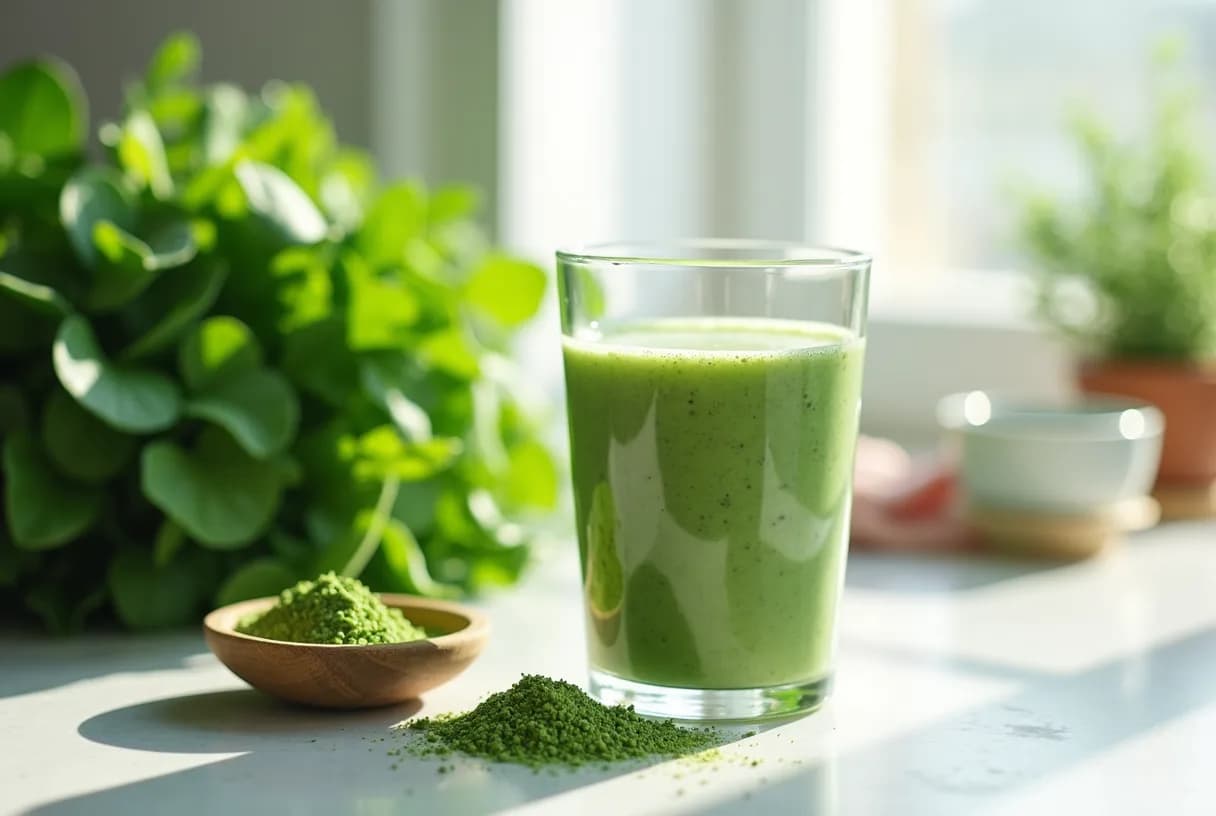
A "greens powder" is a dehydrated, concentrated blend usually built from leafy greens, algae (spirulina, chlorella), grasses (wheatgrass, barley grass), fruit and vegetable extracts, and a rotating cast of "functional" add-ins: probiotics, digestive enzymes, adaptogens, and mushroom extracts. You mix a scoop into water. It is regulated by the FDA as a dietary supplement, which means — unlike a drug — it is not reviewed or approved for safety or effectiveness before it goes on sale.6 The manufacturer, not the FDA, is responsible for making sure the claims are truthful and the product is safe.
That matters because the marketing leans on a reasonable-sounding idea — most people don't eat enough vegetables — and then quietly implies a scoop fixes it. It doesn't. The concentration that lets a powder pack "the equivalent of several servings" into one scoop strips out the thing whole produce is most valuable for: fiber and food volume. For context on why real leafy vegetables earn their reputation, see our guide to leafy greens for women.
Do greens powders actually work?
Some do a narrow job well — they deliver vitamins and minerals, and a few small studies have reported modest short-term changes in lab markers such as antioxidant status or blood pressure. But the evidence base is thin and conflicted: much of it is funded by the brands themselves, few studies are randomized and placebo-controlled, and a striking number never test the actual finished product being sold. Independent clinical reviewers describe long-term health benefits as unproven.34 Here is how the common claims hold up against the evidence.
| Marketing claim | What the evidence shows | Honest grade |
|---|---|---|
| "Replaces your daily vegetables" | No. A scoop typically supplies ~2 g of fiber against a ~25–30 g/day target, and lacks the volume, water, and full phytonutrient mix of whole produce. | Marketing |
| "Detoxes your body" | No. Your liver and kidneys handle that. No powder is shown to remove "toxins." | Debunked |
| "Boosts energy" | No reliable trials. Any lift usually traces to added caffeine, B-vitamins, or placebo, not the greens. | Overstated |
| "Supports immunity" | Vague. Correcting a genuine deficiency helps; powders are not shown to prevent illness in well-nourished people. | Overstated |
| "Fills small micronutrient gaps" | Plausible for restricted diets — it does deliver vitamins and minerals, though often more than you need. | Modest / plausible |
| "Improves antioxidant / BP markers" | A few small, short, often industry-funded studies suggest lab-marker changes; durable health outcomes unproven. | Preliminary |
The pattern is consistent across independent sources: greens powders are a plausible gap-filler and an unproven health upgrade. As Stanford nutrition researcher Christopher Gardner has put it, most adults eating a varied diet don't have the clinically significant deficiencies a greens powder would correct — which makes the powder redundant for the very nutrients it advertises.
The heavy-metals problem no one markets
This is the part that should shape your decision more than any flavor or "75 ingredients" boast. Because greens powders are ultra-concentrated — a single scoop can represent pounds of raw plant material — trace contaminants in the source plants get concentrated too. Independent testing has repeatedly found lead in this category.
In testing of best-selling U.S. products (2024–25), the Clean Label Project reported that 10 of 13 mixed greens powders exceeded California's Prop 65 warning level for lead — including more than half of the organic greens powders tested — and that spirulina products were often worse. Findings were re-confirmed by a second ISO-accredited lab across multiple lots.2 Independent testing by ConsumerLab has likewise flagged several greens and spirulina products for lead unsuitable for regular use by children or pregnant people, along with tablets that failed to disintegrate.1
Two honest caveats so you can weigh this correctly. First, California's Prop 65 warning threshold for lead (0.5 micrograms per day) is deliberately conservative — far lower than the FDA's interim reference level for adults (roughly 12.5 mcg/day). Exceeding the Prop 65 level triggers a warning label, not proof of acute harm. Second, that conservatism exists for a reason: there is no known "safe" level of lead for children or during pregnancy, and this is a daily supplement you might take for years. The practical takeaway isn't panic — it's that third-party heavy-metal testing is the single most important thing to verify, and that pregnant people and children have the least room for error.
The proprietary-blend and "fairy dusting" trap
The second quality tell is the label itself. Under FDA rules, a company that lists ingredients inside a "proprietary blend" must name what's in the blend but not how much of each — only the total weight.6 That loophole enables "fairy dusting": a 3,000 mg blend can be almost entirely cheap filler (rice flour, wheatgrass) with trace, sub-therapeutic amounts of the trendy adaptogens and mushrooms the brand markets hardest. Because botanical ingredients only work at the doses actually studied, a proprietary blend makes it impossible to know whether you're getting a meaningful amount of anything — or a pinch for the label.
So the rule is simple: a transparent panel that lists every ingredient's amount beats a long "proprietary blend" every time. A shorter formula with honest doses is more useful than a 75-ingredient blend you can't evaluate. You can run any label past our supplement scorecard to pressure-test it.
How much do greens powders cost — and is it worth it?
Prices vary widely and change often, so verify current pricing before you buy. As of 2026, premium subscription brands sit at the top: AG1, the category's most-advertised product, runs about $99 for a 30-day supply on subscription — roughly $3+ per serving — up from around $77 when it launched years ago. Basic single-ingredient or short-blend powders can cost under $1 per serving. Over a year, that difference is the gap between roughly $100 and well over $1,000.
Is the premium worth it? For most people, no. AG1, to its credit, does carry NSF Certified for Sport (you can confirm the specific product on NSF's registry5), which certifies purity and screens for banned substances — a genuine plus if you're a tested athlete. But that certification says nothing about whether its adaptogen-and-mushroom blend delivers the benefits the ads imply, and independent experts consistently judge the price high relative to any likely benefit. If your goal is more vegetables, the money almost always goes further on food. If you want to see how supplement spend fits a broader health budget, our cost and coverage estimator can help you frame it.
How to choose a greens powder (by criteria, not hype)
If you've decided a powder fits your situation, here's the honest checklist — the same criteria we'd apply to any supplement:
- Third-party tested for heavy metals. This is non-negotiable in this category. Look for NSF Certified for Sport, Informed Sport, or a published, batch-level Certificate of Analysis for lead, arsenic, cadmium, and mercury. "Third-party tested" with no certifier named or no report available is a claim, not proof.
- Fully transparent label — no proprietary blend. Every active ingredient should show its amount.
- No mega-doses. Avoid formulas stacking vitamins or minerals well above safe upper limits; more is not better and some (like fat-soluble vitamins) can accumulate.
- Modest, believable ingredient list. A focused formula with real doses beats a 75-ingredient "everything" blend that fairy-dusts the interesting parts.
- No "detox," "cleanse," or disease-prevention claims. Those are red flags for marketing over substance.
Because contamination and recalls do happen in this category, it's also worth knowing how to spot a supplement recall before it reaches your cabinet.
How we chose — and what we don't do
VidaBeacon does not run a testing lab, and we don't crown a single "best greens powder." Nobody honestly can, because purity varies lot to lot and no independent body ranks these products head-to-head for effectiveness. Instead we recommend by criteria and certification: what to verify, which third-party marks to trust, and when the honest answer is "eat vegetables instead." We only name a brand when we can confirm a specific claim (for example, AG1's NSF Certified for Sport status, verified on NSF's public registry). Everything here is sourced to independent testing bodies (ConsumerLab, Clean Label Project), the FDA, and academic medical centers — not to manufacturer marketing.
Who benefits — and who's wasting money
A greens powder is most defensible when it's genuinely filling a gap: a restricted or low-variety diet (some vegan, elimination, or limited-appetite situations), stretches with little access to fresh produce, or a period of poor intake. Even then, it's a convenience tool, not a treatment — and if you suspect a real deficiency (iron, B12, vitamin D), that's a conversation for testing and a clinician, not a scoop of powder. See our overview of supplements and the wider nutrition hub for context.
Who's likely wasting money: anyone already eating vegetables most days. For that reader, a greens powder is largely redundant, delivers little you're missing, and costs more than the produce it's imitating. The most useful thing it does — reminding you to think about vegetables — you can get for free.
What the pooled evidence actually found
Almost every greens-powder marketing page cites a single small trial — often one connected to the company selling the product. Pooled evidence works differently: it gathers every trial on a question, including the unflattering ones, and reports what survives when you look at all of them together. That is the standard worth applying before committing to a recurring monthly cost, indefinitely.
Here is the honest headline: there is no systematic review of "greens powders" as sold today. The closest published evidence covers mixed fruit and vegetable concentrates — a related but not identical product category — and even that literature is thin, short, and entangled with industry funding.
The largest synthesis is Esfahani and colleagues in the Journal of the American College of Nutrition (2011), which searched MEDLINE and EMBASE and identified 22 reports on commercially available mixed fruit-and-vegetable concentrate supplements[s1]. Its clearest finding is a blood-chemistry one: daily supplementation significantly increased serum concentrations of the major antioxidant provitamins and vitamins, including beta-carotene, vitamins C and E, and folate. Beyond that, the review documents reductions in homocysteine and in markers of oxidative stress, and calls the effects on inflammation, immunity and endothelial function "promising" — the authors' own word, not a claim of proven benefit. Their conclusion is modest: these products may help people who struggle to meet daily fruit and vegetable intake recommendations, and what the field needs is "larger, randomized, placebo-controlled double-blind trials." The abstract reports no effect sizes.
The more recent synthesis, Lorenzoni and colleagues in the Journal of Clinical Medicine (2019), searched four databases and included just 13 articles covering 8 different products — encapsulated fruit and vegetable concentrate plus various juices[s2]. Two things about it matter more than its positive-sounding conclusion. First, it did not perform a meta-analysis. Where multiple studies assessed the same product in the same population, only the study reporting the most effective action was carried forward — and those figures were then fed into a Markov chain simulation model. That is not an averaged effect and cannot be read as one; the authors themselves phrase the public-health payoff as something that "might be hypothesized." Second, the limitations they list are substantial: small sample sizes, no large-scale long-term controlled trials, heterogeneous designs with most interventions running under two months, an inability to separate the concentrate's effect from concurrent dietary changes, and mixed concentrate types with different mechanisms. One listed author is affiliated with the Juice Plus+ Science Institute — the science arm of a company selling this exact product category — while the paper declares no conflict of interest.
On contamination, the relevant large dataset is Luo and colleagues in Frontiers in Pharmacology, which analysed 1,773 crude plant extract samples across 86 herbal medicine types collected between 2014 and 2019 from four major Chinese herbal markets[s3]. Detection was near-universal — lead in 98.98% of samples, cadmium in 97.74%, arsenic in 94.70%, mercury in 84.43% — but detection is not the same as exceeding a limit. Measured against Chinese Pharmacopoeia thresholds, 30.51% of samples (541) exceeded a permissible limit for at least one metal: lead 5.75%, cadmium 4.96%, arsenic 4.17%, mercury 3.78%, copper 1.75%. This is botanical raw material from one supply region, not greens powders on a US shelf — so it indicates that contamination in plant-derived supplement inputs is real and measurable, not that any specific product you might buy is contaminated.
| Question a buyer is actually asking | What the reviews found | Strength of that answer |
|---|---|---|
| Do blood levels of vitamins actually change? | Yes — significant increases in beta-carotene, vitamins C and E, and folate across 22 reports[s1] | The most consistent finding in this literature |
| Does homocysteine or oxidative stress improve? | Reductions in homocysteine and in markers of oxidative stress were documented; inflammation, immunity and endothelial function are called only "promising"[s1] | Reported without effect sizes in the abstract |
| Does cholesterol, blood pressure or BMI move? | The 2019 review examined total cholesterol, LDL, homocysteine, systolic BP and BMI across 13 articles / 8 products — but ran no meta-analysis, carrying forward the most effective study per product-population pair into a simulation, so no averaged effect size exists[s2] | Weak — small samples, heterogeneous designs, industry-affiliated author |
| Do these products prevent disease long term? | Unanswered. The authors cite the absence of large-scale, long-term controlled trials; most interventions ran under two months[s2] | No evidence either way |
| What about safety over years of use? | Neither review's abstract reports on adverse events, and neither covers interventions longer than a few months[s1][s2] | Not established either way |
| Is heavy-metal contamination a real risk? | In 1,773 botanical samples, 30.51% exceeded a pharmacopoeial limit for at least one metal (lead 5.75%, cadmium 4.96%, arsenic 4.17%, mercury 3.78%)[s3] | Real and measurable in raw botanicals — but this sample was Chinese herbal medicine, not US greens powders |
| Is there a review of "greens powders" specifically? | None found. The evidence base covers fruit-and-vegetable concentrates, a related but different product class | The category is largely unstudied as sold |
The honest bottom line. If the outcome you care about is "will my blood levels of certain vitamins and carotenoids go up," the reviewed evidence supports that, consistently[s1]. If the outcome you care about is anything a person can feel or that changes long-term health — energy, cholesterol, blood pressure, weight, disease risk — the published syntheses do not support a confident answer, and the more recent of the two carries an industry affiliation and declined to pool its own data[s2]. Three specific weaknesses are worth naming: trials are small, they are short (mostly under two months), and none of the reviewed evidence tests the multi-ingredient greens powders currently on the market. On contamination, plant-derived supplement inputs demonstrably carry lead, cadmium and arsenic, with a meaningful minority of samples over limit in the largest dataset available[s3] — a practical argument for favouring products that publish independent third-party heavy-metal testing with actual numbers, rather than a badge. This is reference information about the state of the evidence, not medical advice; questions about your own supplements belong with a clinician who knows your history.
When to talk to a doctor
Greens powders interact with more than most people expect. The vitamin K in leafy-green concentrates can affect blood-thinner (warfarin) dosing; high mineral loads can interfere with thyroid medication like levothyroxine and with iron absorption; and mega-dosed vitamins can push you past safe upper limits if you're also taking a multivitamin. Talk to your clinician or pharmacist before starting one if you're pregnant, breastfeeding, giving it to a child, take prescription medication, or have kidney disease. And treat any powder as a supplement to a diet and care plan — not a substitute for evaluating symptoms, which deserve a real diagnosis, not a self-prescribed scoop.