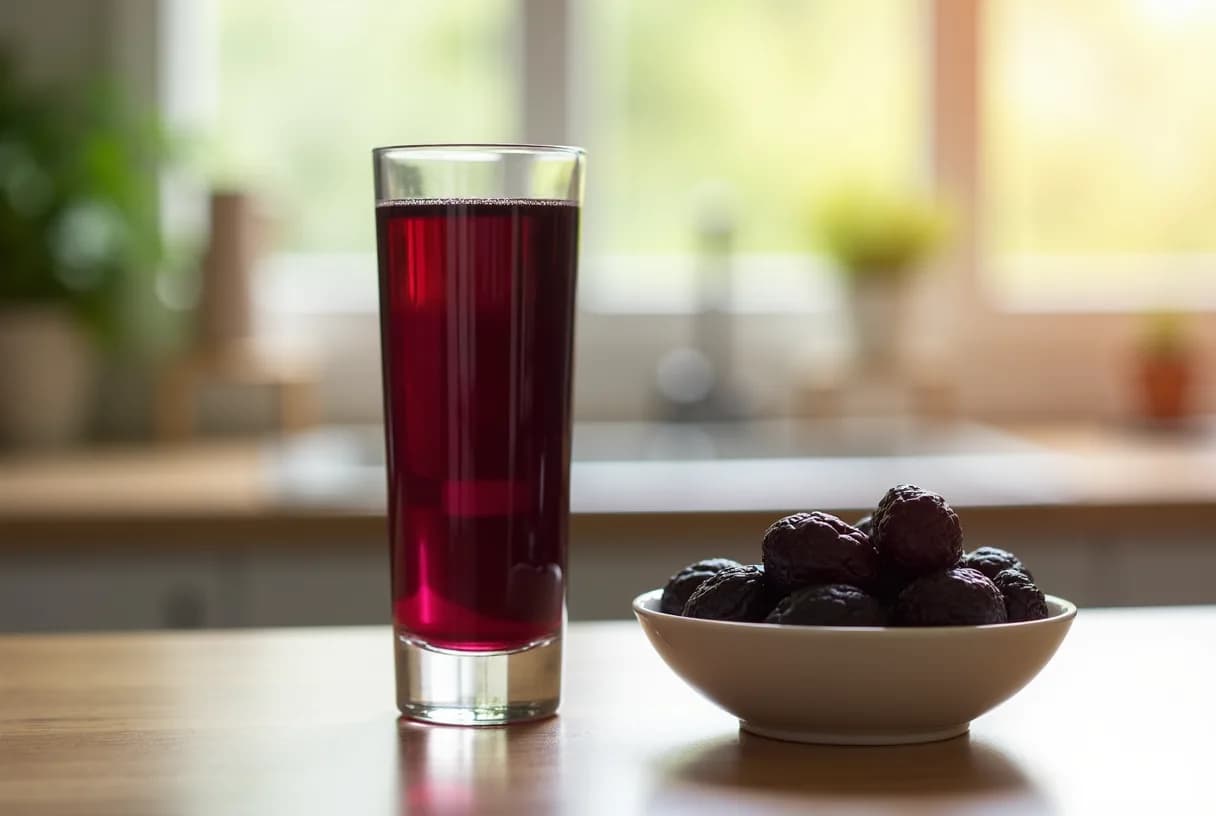
Yes — prune juice is one of the better-studied home remedies for occasional constipation, and for many people it works. It contains sorbitol, a natural sugar alcohol that draws water into the bowel to soften stool, along with a modest amount of fiber. A reasonable starting amount is half a cup (about 120 ml) in the morning, working up to a full cup if needed, with relief usually arriving within a few hours to a day.
Does prune juice actually work for constipation?
This is not just folk wisdom. Prunes (dried plums) are one of the few foods with actual clinical trial data behind them. In a randomised crossover trial, adults with chronic constipation ate about 100 grams of dried plums a day (roughly 11 prunes) or took psyllium fiber for three weeks each. On prunes, they had more spontaneous bowel movements and softer, easier-to-pass stools — and prunes came out ahead of the fiber supplement. Digestive-health authorities, including the U.S. National Institute of Diabetes and Digestive and Kidney Diseases (NIDDK) and the UK's NHS, list prunes and prune juice among the practical first steps for constipation. Prune juice is also a common, gentle option for older adults, who get constipated more often as gut transit naturally slows.
That said, prune juice is a remedy for occasional or mild constipation, not a cure for everything. If your constipation is frequent, painful, or new and unexplained, food fixes are a starting point, not the whole answer — see our full guide to constipation relief.
Why prune juice works: sorbitol and fiber
Prune juice helps through two main mechanisms, plus a few minor ones.
Sorbitol pulls water into your gut
Sorbitol is a sugar alcohol that your small intestine absorbs poorly. Because so much of it passes through, it acts as an osmotic laxative — it holds water in the bowel, which softens the stool and adds volume that stimulates movement. An 8-ounce (240 ml) cup of prune juice provides roughly 6 to 7 grams of sorbitol, which is enough to have a real, gentle laxative effect in most people. This same osmotic action is why too much can backfire into gas and loose stools.
Fiber adds bulk (whole prunes more than juice)
Fiber holds water and adds bulk that keeps things moving. Whole prunes are a good source — about 3 to 4 grams of fiber in five to six prunes, and roughly 6 to 7 grams in the ~100 grams (about 11 prunes) used in the clinical trial. Prune juice has much less, roughly 2.5 grams per cup, because straining removes most of the insoluble fiber. So juice leans more on sorbitol, while whole prunes give you sorbitol and more fiber.
The minor players
Prunes also contain natural compounds (phenolics) and a bit of fructose that may add small osmotic and gut-stimulating effects. These are secondary — sorbitol and fiber do the heavy lifting.
How much prune juice should you drink, and when?
Start low and go slow. The sorbitol that helps you can also cause cramping and gas if you overdo it on day one, so it is smarter to begin with a smaller amount and increase only if needed.
| Step | Amount | Timing |
|---|---|---|
| Start here | ½ cup (about 120 ml / 4 oz) | Morning, on an empty stomach |
| If no relief in a day | Up to 1 cup (about 240 ml / 8 oz) | Split: some in the morning, some in the evening |
| Typical daily ceiling | Around 1 cup total | More rarely adds benefit and often adds gas |
Timing: Morning is a sensible choice because eating and drinking after an overnight fast triggers the natural urge to go (the gastrocolic reflex). Pairing prune juice with breakfast and a glass of water can nudge that reflex along.
Warm or cold — does it matter?
You will read that prune juice "works better warm." Honestly, there is no strong evidence that heating it changes how the sorbitol or fiber act. Any warm drink in the morning may mildly stimulate the bowel, so warm prune juice is a reasonable comfort preference — but the temperature is not doing the real work. Drink it however you will actually drink it.
Prunes vs. prune juice: which is better?
Both work. Whole prunes give you more fiber for the same laxative effect; juice is easier to swallow quickly and gentler on the jaw if chewing is hard. Here is the quick comparison.
| Feature | Whole prunes (~5–6) | Prune juice (~1 cup) |
|---|---|---|
| Fiber | Higher (~3–4 g) | Lower (~2.5 g) |
| Sorbitol | Comparable, per serving | Comparable (~6–7 g) |
| Calories / sugar | Similar, but you chew, so more filling | Concentrated and easy to over-drink |
| Best if… | You want fiber and fullness too | You want a fast, easy dose or dislike chewing |
| Clinical evidence | Strongest (studied directly) | Good, by extension |
If your bigger goal is regularity over time rather than a one-off fix, whole prunes — or other high-fiber foods like chia seeds — are the better everyday choice.
How fast does prune juice work?
For most people, prune juice works within a few hours to about a day. The osmotic pull of sorbitol is not instant — it takes time for water to shift into the bowel — so do not double up because "nothing happened" after 30 minutes. Give a serving up to 24 hours before adding more. Curious how this compares with fiber supplements or magnesium? Our how-long-until-it-works tool lays out typical timelines.
If a cup of prune juice plus water, fiber, and a walk does nothing over a day or two, that is useful information — it usually means the cause needs a closer look rather than a bigger dose. Constipation that repeatedly ignores food and fluid changes is worth raising with a clinician.
Cautions: gas, cramping, sugar, and who should go slow
Prune juice is food, not a drug, but the same sorbitol that softens stool can cause trouble in the wrong amounts or the wrong person.
- Gas, bloating, and cramping. Sorbitol ferments in the gut. Too much, too fast is the usual reason people feel worse — the fix is a smaller amount, not quitting. If bloating is a recurring theme for you, see why midlife bloating happens.
- Blood sugar and calories. An 8-ounce cup has roughly 180 calories and 40-plus grams of carbohydrate, mostly natural sugar. If you have diabetes or watch blood sugar, count it as a sugary drink, keep the portion small, and consider whole prunes or a fiber supplement instead.
- IBS and sensitive guts. Prunes are high in FODMAPs (including sorbitol), which can trigger gas, cramping, and diarrhea in people with irritable bowel syndrome. If you have IBS, introduce prune juice cautiously in small amounts — or skip it.
- It is not a daily crutch. Relying on any laxative — even a food-based one — every day for weeks can mask a problem that needs attention.
Worth saying plainly: prune juice actually has evidence behind it, unlike many viral "cleanse" fixes. If you have been tempted by the pink salt trick or similar hacks, prune juice is the far more sensible bet.
When to see a doctor
Occasional constipation is common and usually harmless. Contact a clinician if you have:
- Constipation lasting more than three weeks, or a new, persistent change in your normal bowel pattern
- Blood in your stool, black or tarry stools, or unexplained weight loss
- Severe or ongoing abdominal pain, vomiting, or an inability to pass gas
- Constipation alternating with diarrhea, or symptoms that do not improve after a couple of weeks of fiber, fluids, and movement
These can point to something that needs evaluation, so they are a reason to be seen rather than to keep self-treating.
Where prune juice fits in a bigger plan
Prune juice is a helpful tool, not a whole strategy. The foundations of staying regular are steady fiber (aim to build up gradually toward the recommended 25 or so grams a day for women, to avoid a sudden gas spike), fluids throughout the day, and daily movement — even a brisk walk helps stimulate the bowel. Layer prune juice on top of those for an occasional nudge. Building fiber slowly with foods like beans, whole grains, fruit, and gut-friendly fermented foods tends to work better long-term than leaning on any single fix, and a fiber supplement can fill the gap on days your diet falls short.
Midlife adds its own wrinkle: shifting hormones, slower gut transit, and pelvic-floor changes can all make constipation more common around menopause. If that is you, our guide to menopause and gut health covers why it happens and what actually helps.