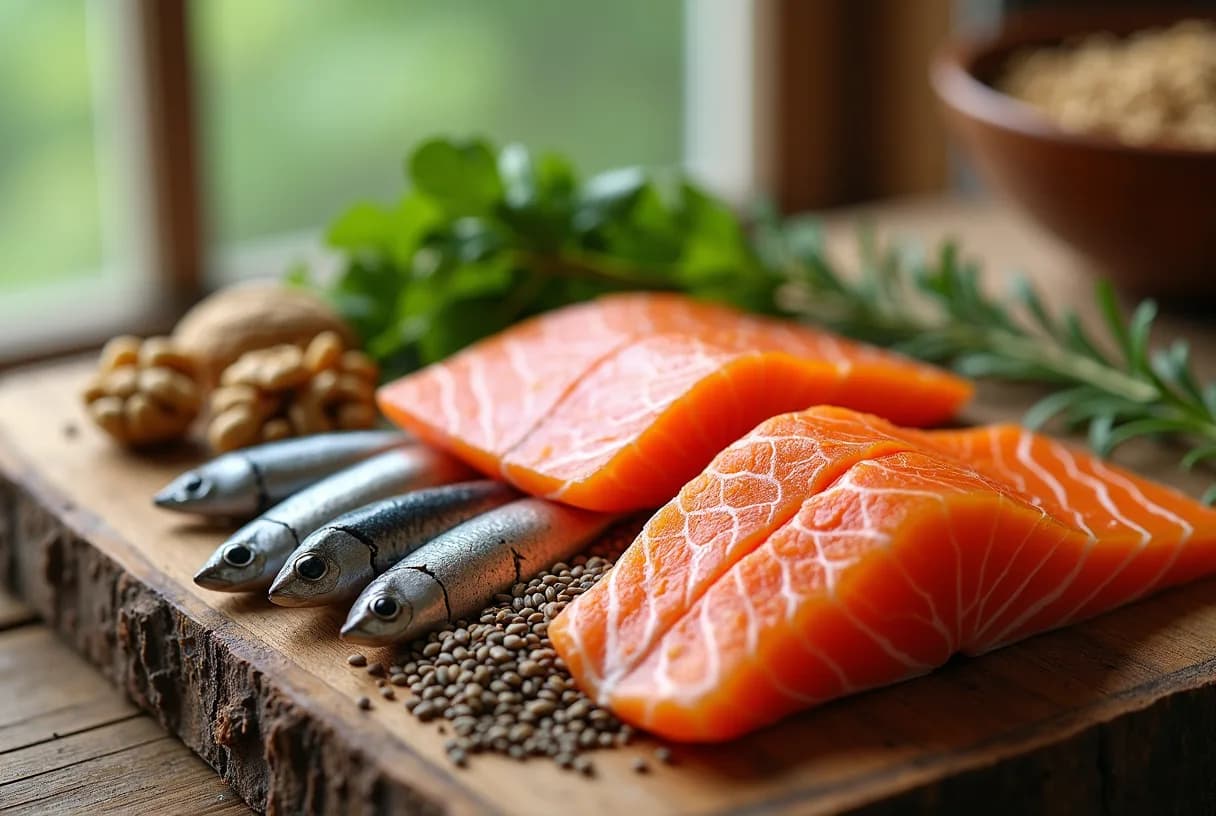
The richest food sources of omega-3s are oily fish — salmon, sardines, mackerel, herring and anchovies — which deliver the two forms your body uses most, EPA and DHA. Plant foods like flaxseed, chia, walnuts, hemp and soy are high in a third omega-3 called ALA, but your body converts ALA into EPA and DHA only in small amounts. If you don't eat fish, algae oil is the one plant-based source that supplies EPA and DHA directly. Below are the best sources in each camp, with rough amounts per serving.
Which foods have the most omega-3?
Omega-3 isn't one nutrient. Marine foods carry EPA and DHA — the long-chain forms tied most closely to heart, brain and eye research. Plant foods carry ALA (alpha-linolenic acid), the short-chain "parent" form. Both count as omega-3s, but they behave very differently in the body, so it helps to see the two lists side by side.
| Food | Serving | Approx. EPA + DHA |
|---|---|---|
| Salmon (Atlantic) | 3 oz cooked | 1.5–2.0 g |
| Herring (Atlantic) | 3 oz cooked | ~1.7 g |
| Sardines (canned) | 3 oz | ~1.2 g |
| Mackerel (Atlantic) | 3 oz cooked | ~1.0 g |
| Anchovies (canned) | 2 oz | ~1.0 g |
| Rainbow trout | 3 oz cooked | ~0.8 g |
| Albacore (white) tuna | 3 oz | ~0.7 g |
| Oysters | 3 oz | ~0.4 g |
| Light canned tuna | 3 oz | 0.2–0.3 g |
| Food | Serving | Approx. ALA |
|---|---|---|
| Flaxseed oil | 1 tbsp | ~7.3 g |
| Chia seeds | 1 oz (~2 tbsp) | ~5.1 g |
| Hemp seeds (hearts) | 3 tbsp | ~2.6 g |
| Walnuts (English) | 1 oz (~14 halves) | ~2.5 g |
| Ground flaxseed | 1 tbsp | ~2.4 g |
| Canola oil | 1 tbsp | ~1.3 g |
| Soybean oil | 1 tbsp | ~0.9 g |
| Firm tofu | ½ cup | ~0.7 g |
| Edamame | ½ cup | ~0.3 g |
Amounts are approximate and vary with species, farming, fat content and cooking method. Marine values are EPA + DHA combined; plant values are ALA. See our deeper dive on chia seeds and on salmon for women.
ALA vs EPA/DHA — why the source matters
This is the honest part most "top omega-3 foods" lists skip. A tablespoon of chia looks like it out-punches a fillet of salmon on paper — 5 grams of omega-3 versus under 2. But they are not the same molecule, and your body treats them differently.
EPA and DHA (from fish and algae) are ready to use. Your cells can put them straight to work. ALA (from seeds and nuts) is a raw material: to get the benefits linked to EPA and DHA, your body has to convert it — and it does that job poorly. Estimates vary, but conversion of ALA to EPA is commonly under about 10%, and conversion to DHA is often under 1%. Much of the ALA you eat is simply burned for energy instead.
What that means in plain terms: plant omega-3s are genuinely good for you, and ALA has its own value, but a big number on a seed's label does not translate one-to-one into the EPA and DHA your heart and brain draw on. If EPA/DHA is the goal, fish (or algae) does the job far more efficiently than flax or chia alone. One nuance worth knowing: women of reproductive age appear to convert ALA somewhat better than men, likely an estrogen effect that supports DHA supply in pregnancy — but it's a modest edge, not a workaround.
How much omega-3 do you actually need?
There is no official recommended daily amount for EPA and DHA specifically. The only formal target is for ALA: an Adequate Intake of about 1.1 grams a day for women and 1.6 grams for men. Most people hit that easily from everyday oils, nuts and seeds.
For EPA and DHA, the widely used benchmark comes from heart guidance: aim for two servings of oily fish per week (roughly 8 ounces total), which averages out to a few hundred milligrams of EPA + DHA a day. Higher intakes are sometimes used under medical supervision — for example, to help manage high triglycerides — but those are prescription-level doses, not something to self-prescribe from the supplement aisle. More is not automatically better.
- General wellbeing: two servings of oily fish weekly, or algae oil if you don't eat fish.
- ALA target: ~1.1 g/day for women — a tablespoon of ground flax or an ounce of walnuts covers it.
- Pregnancy/breastfeeding: DHA matters for fetal brain and eye development; ask your clinician about intake and safe fish choices.
How can vegetarians and vegans get enough omega-3?
You can absolutely cover ALA without fish — that's the easy part. Closing the EPA/DHA gap takes a little strategy, because plants (other than algae) don't contain those forms at all.
- Eat ALA-rich foods daily. Rotate ground flaxseed, chia, hemp hearts and walnuts through oats, yogurt, salads and smoothies. Grind flaxseeds — whole ones often pass through undigested, so you miss most of the oil.
- Consider an algae-oil supplement. Marine algae are where fish get their omega-3s in the first place. Algal oil delivers EPA and DHA directly, typically a few hundred milligrams per softgel, making it the go-to EPA/DHA source for vegans and anyone who won't eat fish.
- Watch your omega-6 balance. Diets heavy in refined seed and vegetable oils flood the body with omega-6 fats, which compete with ALA for the same conversion enzymes. Leaning on olive, canola and flax oils over corn or soybean oil can help the little conversion you do get.
Because conversion is so limited, relying on flax and chia alone to supply DHA is the single most common vegan omega-3 mistake. If that describes you, algae oil is the honest fix.
When food falls short: do you need a supplement?
For most people who eat fish twice a week, food wins — whole oily fish also brings protein, selenium, iodine, vitamin D and B12 that a capsule doesn't. But supplements have a real place: if you dislike fish, eat plant-based, are pregnant and need reliable DHA, or simply can't get two fish servings in on a busy week.
If you go that route, shop by the numbers, not the front of the bottle:
- Read the EPA + DHA figure, not the "fish oil" figure. A "1,000 mg fish oil" softgel may contain only 300 mg of actual EPA + DHA — the rest is other fats.
- Choose third-party-tested products for purity and freshness; omega-3 oils oxidize, and rancid oil is worth avoiding.
- Vegan? Look specifically for algal oil, which lists EPA and/or DHA.
- On blood thinners, or heading into surgery? High-dose omega-3 can affect bleeding — clear it with your clinician first.
Our best omega-3 supplements for women guide compares real products by EPA/DHA content and testing, and our supplement scorecard helps you grade any label yourself. For the bigger picture on why these fats matter across midlife, see omega-3 for women.
Omega-3s, your heart and midlife
Omega-3s are one of the more consistent players in a heart-healthy diet — associated with lower triglycerides and a role in overall cardiovascular eating patterns. That matters more after menopause, when the drop in estrogen shifts cholesterol and raises women's heart-disease risk. Swapping a couple of weekly meals to salmon, sardines or a lentil-and-walnut bowl is a small, evidence-aligned move. Read more on menopause and heart health, and browse our full nutrition library.
When to see a doctor
Omega-3 is a food question, not usually a medical one — but talk to a clinician if:
- You've been told you have high triglycerides or heart disease and want to know whether prescription-strength omega-3 fits your plan.
- You take anticoagulant or antiplatelet medication, or have a bleeding disorder, and are considering high-dose supplements.
- You're pregnant, breastfeeding or trying to conceive — for DHA guidance and which fish are lowest in mercury.
- You have a fish or shellfish allergy and want a safe EPA/DHA source (algal oil is typically fine, but confirm).
There's no simple, routine blood test for "omega-3 status," and symptoms of low intake are vague — so don't self-diagnose a deficiency. Focus on the pattern on your plate first, and use a supplement to fill a genuine gap rather than to chase a number.