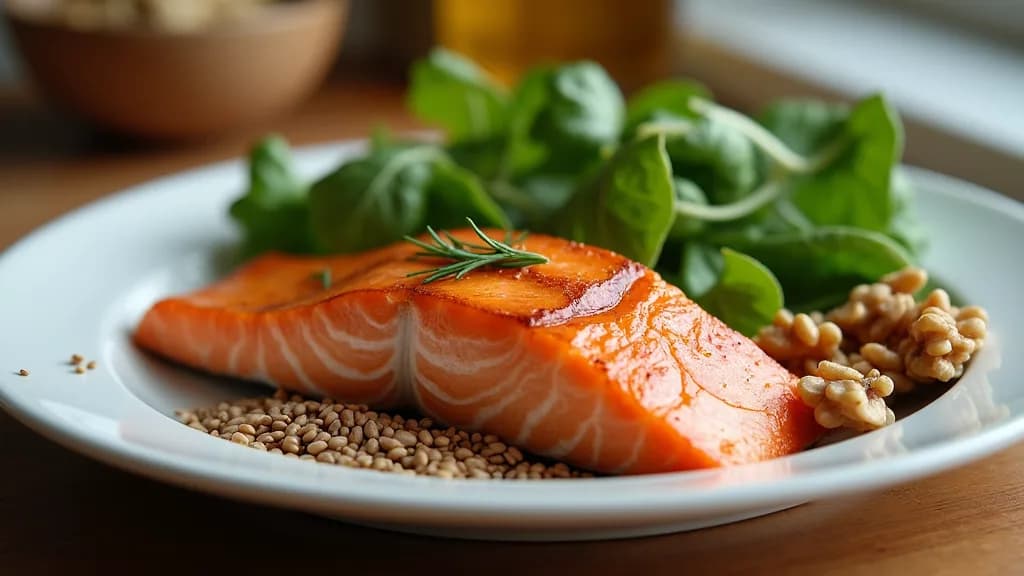
Omega-3 fats are among the few supplements with genuinely good science behind them — but the marketing has raced far ahead of the evidence. For most women, the sensible goal is simple: eat fish about twice a week, choosing an oily fish like salmon or sardines at least once. That habit supplies the two omega-3s that matter most, EPA and DHA. Whether a fish-oil capsule adds anything on top depends entirely on why you're taking it.
What omega-3s actually are
"Omega-3" is an umbrella term for a family of fats your body can't make in useful amounts, so you have to get them from food. Three matter for health:
- EPA (eicosapentaenoic acid) and DHA (docosahexaenoic acid) — the long-chain "marine" omega-3s found in oily fish, fish oil, and algae. These are the forms with the most research behind them.
- ALA (alpha-linolenic acid) — the plant form in flaxseed, chia, walnuts, and canola oil. Your body converts a small fraction of ALA into EPA and DHA, but the conversion is inefficient, so ALA is not a full substitute for fish or algae.
DHA is a structural building block of the brain and the retina, which is why it draws special attention during pregnancy and breastfeeding.
Where the evidence is genuinely strong
Lowering high triglycerides
This is the clearest, least controversial benefit. Prescription-strength omega-3s reliably lower elevated blood triglycerides (a type of fat linked to heart and metabolic risk). This is a well-established medical use, and it's why doctors sometimes prescribe omega-3 products for people with very high triglycerides. The doses used are considerably higher than a typical drugstore capsule provides, which is exactly why this is a conversation to have with your clinician rather than a DIY project.
One honest caveat: lowering triglycerides is not the same as preventing heart attacks. Some high-dose trials have shown cardiovascular benefit, while others using DHA-containing formulations have not — so a drop in your triglyceride number doesn't automatically translate into fewer heart events. Treat triglyceride-lowering as its own goal, guided by your clinician, rather than a guaranteed shortcut to a healthier heart.
Eating fish as part of a heart-healthy pattern
Major heart and nutrition bodies consistently recommend eating fish — especially oily fish — as part of an overall dietary pattern, and this food-based advice is on firm ground. The American Heart Association advises two servings of fish per week for general cardiovascular health. Notice the distinction: the strong recommendation is for food, not necessarily for a supplement.
Where the evidence is mixed or weak
Preventing heart attacks and strokes with supplements
Here the honest answer is: it's complicated. Large randomized trials of omega-3 supplements in generally healthy people have mostly not shown that fish-oil capsules prevent heart attacks, strokes, or cardiovascular death. A Cochrane systematic review of omega-3 fats for cardiovascular disease found little to no meaningful effect on overall cardiovascular events. Some higher-dose prescription trials in specific higher-risk groups have shown benefit, but the results across studies don't point in one clean direction. The takeaway: a supplement is not a substitute for the basics — not smoking, moving regularly, managing blood pressure and cholesterol, and eating well.
Mood and depression
Omega-3s (particularly EPA-heavy formulas) have been studied as an add-on for depression, with some encouraging but inconsistent findings. The NIH's complementary-health center describes the evidence as promising in places but not conclusive. Omega-3s are not a treatment for clinical depression on their own — if you're struggling with your mood, that's a reason to see a clinician, not to self-prescribe capsules.
Joints, dry eye, and menopause symptoms
For rheumatoid arthritis, omega-3s may modestly ease joint tenderness and morning stiffness for some people, though they don't stop the underlying disease. For dry eye and for menopausal symptoms such as hot flashes, results are mixed and generally underwhelming — some women notice a difference, trials often don't. It's reasonable to try, with realistic expectations, but this is "may help some people," not "proven to work."
Omega-3s across a woman's life
DHA matters especially in pregnancy and breastfeeding, where it supports fetal brain and eye development. Guidance from ACOG on nutrition during pregnancy supports fish intake while choosing lower-mercury options — salmon, sardines, and light canned tuna rather than high-mercury fish like shark, swordfish, or king mackerel. The NHS similarly advises pregnant women to eat fish but to limit oily fish to a couple of portions a week and avoid certain high-mercury species. If you're pregnant, trying to conceive, or nursing, ask your clinician whether an algae- or fish-derived DHA supplement makes sense for you.
Around midlife and menopause, heart-disease risk rises for women, which makes the dietary pattern — fish, plants, less ultra-processed food — more valuable than ever. Just don't expect fish oil alone to carry that load.
Food first: the best sources
| Source | Main omega-3 | Notes |
|---|---|---|
| Salmon, mackerel, sardines, herring, trout | EPA + DHA | Richest dietary source; aim for oily fish weekly |
| Light canned tuna | EPA + DHA | Lower mercury than many large fish; convenient |
| Algae / algal oil | DHA (some with EPA) | Best plant-based marine omega-3; vegan-friendly |
| Flaxseed, chia, walnuts, canola oil | ALA | Healthy foods, but limited conversion to EPA/DHA |
The NIH Office of Dietary Supplements omega-3 fact sheet is a reliable, plain-English reference for typical amounts and food sources.
If you can't or don't eat fish
Vegetarians and vegans have a genuinely good option in algae-based (algal) oil — the same source fish get their omega-3s from in the first place. Algal supplements provide DHA (and increasingly EPA too) without the fish, the fishy aftertaste, or the sustainability and mercury concerns. If you rely only on flax, chia, and walnuts, you're getting ALA, which is worthwhile but won't fully replace the marine forms because so little converts.
How much omega-3 do you need?
There's no single official "omega-3 requirement" the way there is for, say, vitamin C, but useful anchors exist:
- Food target: two servings of fish a week, one of them oily, is the most widely endorsed goal.
- ALA adequate intake: the NIH Office of Dietary Supplements lists an adequate intake for adult women of roughly 1.1 grams of ALA per day, generally easy to meet through diet.
- Supplements: over-the-counter fish-oil capsules vary widely in how much actual EPA + DHA they contain — check the label for those two numbers, not just the total "fish oil" figure. More is not automatically better.
For high triglycerides or any medical use, the effective doses are higher and belong under a clinician's supervision.
Safety: what to know before you supplement
Omega-3s are well tolerated for most people, but there are real considerations:
- Bleeding risk at higher doses. Omega-3s can have a mild blood-thinning effect. At high doses, or if you take anticoagulant or antiplatelet medicines (such as warfarin or similar blood thinners), or you're heading into surgery, this matters — talk to your doctor before starting or continuing high-dose fish oil.
- Irregular heartbeat at very high doses. High-dose marine omega-3 (in the range of about 4 grams a day, the territory of prescription products) has been linked in several trials to a somewhat higher risk of atrial fibrillation, a common irregular heart rhythm. This is another reason high-dose use belongs under a clinician's supervision rather than self-dosing.
- Mild side effects. Fishy burps, a fishy aftertaste, and minor stomach upset are common; taking capsules with food or trying an enteric-coated or algal product can help.
- Mercury and contaminants. This is about the fish, not the capsule — choose lower-mercury species, especially in pregnancy.
- Supplements aren't tightly regulated. Quality varies. Look for reputable third-party testing, and remember the fact-sheet guidance from MedlinePlus and the Mayo Clinic that supplements complement — never replace — a good diet and prescribed treatment.
The honest bottom line
Omega-3s earn their reputation mainly through food. Eating fish a couple of times a week, as part of an overall healthy pattern, is a well-supported habit for women's hearts and, in pregnancy, for a baby's developing brain. Supplements have a clear role for lowering high triglycerides and a reasonable place for people who don't eat fish — but the idea that a daily fish-oil capsule prevents heart attacks in otherwise healthy women is not well supported by the trials. If you're considering a supplement for a specific health reason, or you take blood thinners, make it a conversation with your clinician rather than a guess in the vitamin aisle.
Related: Pair it with Vitamin D for Women — bone, muscle, and immune support in one everyday essential.
Related: If you're building a daily supplement stack around whole-body health, gut and vaginal balance deserve a place too — see Probiotics for Women: What They Do and When They Help.
Related: Curious about other anti-inflammatory options that pair well with fish oil? Weigh the evidence and safety caveats in Turmeric and Curcumin: Benefits, Evidence, and Cautions.
Related: If you're building a midlife supplement routine alongside omega-3s, don't overlook this energy-critical vitamin — see Vitamin B12 for Women: Deficiency Signs, Sources, and Supplements.
Related: Vitamin D and omega-3s often go hand in hand for midlife health, so if you're curious about checking your own status, see At-Home Vitamin D Tests: Are They Worth It?
Related: Salmon and Omega-3s for Women.