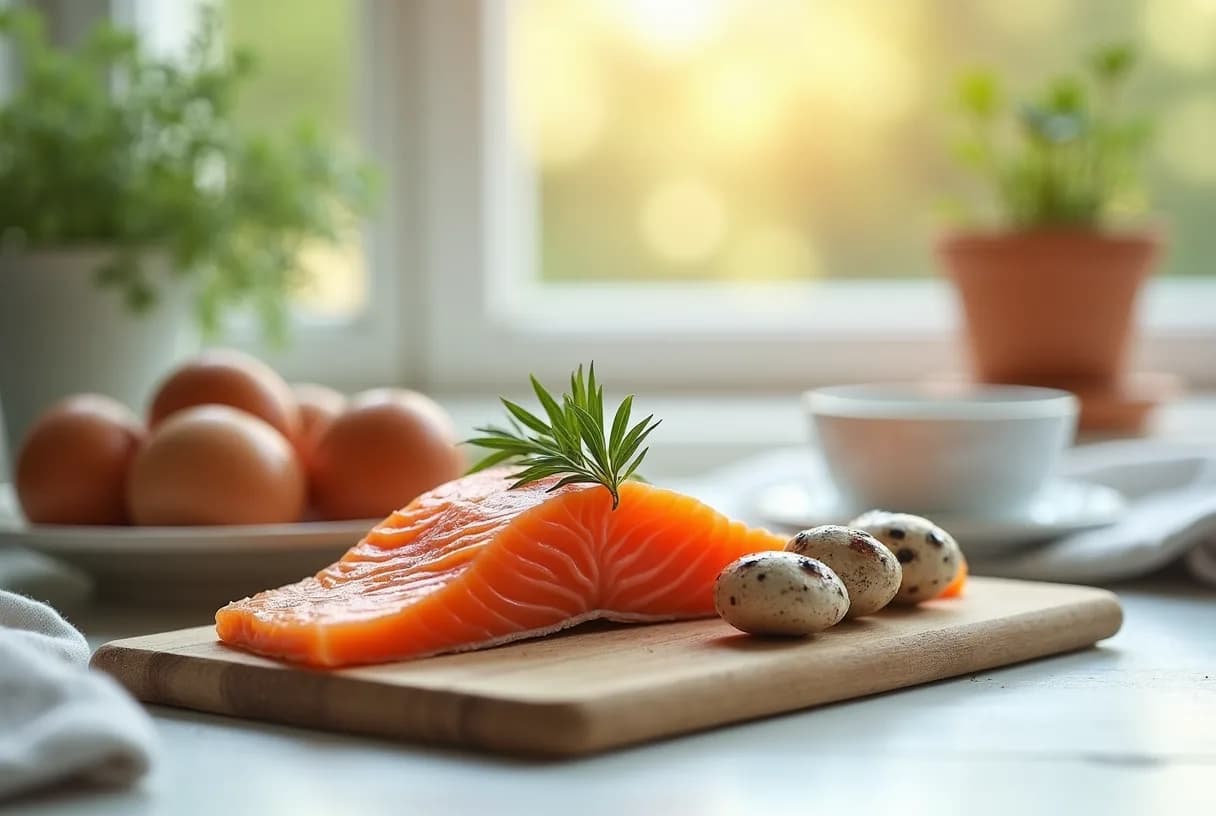
The best food sources of vitamin D are fatty fish — salmon, rainbow trout, mackerel and sardines — along with cod liver oil, egg yolks, UV-exposed mushrooms, and fortified foods like cow's milk, plant milks and breakfast cereal. A 3-ounce serving of cooked salmon or trout can deliver a full day's worth of vitamin D on its own. But almost everything else on the list provides only modest amounts — which is exactly why food alone often falls short, especially in winter, at northern latitudes, or when you spend most of the day indoors.
Which foods are highest in vitamin D?
Very few foods contain much vitamin D naturally, and the ones that do are dominated by oily fish. The table below shows approximate amounts per typical serving. The adult daily target (RDA) is 600 IU (15 mcg) up to age 70 and 800 IU (20 mcg) from 71 on, so you can see at a glance which foods make a real dent and which are just bonus.
| Food | Typical serving | Vitamin D (approx.) | Type |
|---|---|---|---|
| Cod liver oil | 1 tablespoon | ~1,360 IU (34 mcg) | D3 |
| Rainbow trout, farmed, cooked | 3 oz | ~645 IU (16 mcg) | D3 |
| Salmon (sockeye), cooked | 3 oz | ~570 IU (14 mcg); wild can be higher | D3 |
| Mackerel, cooked | 3 oz | ~300–400 IU (varies by species) | D3 |
| Mushrooms exposed to UV light | ½ cup | ~366 IU (9 mcg) | D2 |
| Sardines, canned, drained | ~1 small can (3.75 oz) | ~180 IU (4.5 mcg) | D3 |
| Fortified milk or plant milk | 1 cup | ~100–150 IU (2.5–3.6 mcg) | D2 or D3 |
| Fortified breakfast cereal | 1 serving | ~80 IU (2 mcg) | D2 or D3 |
| Egg, whole (vitamin D is in the yolk) | 1 large | ~44 IU (1.1 mcg) | D3 |
| Beef liver, cooked | 3 oz | ~42 IU (1 mcg) | D3 |
| Canned light tuna, in water | 3 oz | ~40 IU (1 mcg) | D3 |
| Cheddar cheese | 1.5 oz | ~17 IU (0.4 mcg) | D3 |
Two honest caveats. First, fish numbers swing widely — wild salmon can hold several times more vitamin D than farmed, and figures for the same species vary between databases. Treat these as ballpark, not gospel. Second, look at the bottom half of the table: eggs, tuna, liver and cheese each contribute only a trickle. You'd have to eat a lot of them to reach 600 IU, which is the whole problem with relying on food. The bonus with oily fish is that it also delivers omega-3s, so a salmon dinner does double duty — more on that in our guide to salmon and omega-3 for women.
Why isn't food enough to meet your vitamin D needs?
Vitamin D is unusual: it's the one nutrient your body is designed to make rather than eat. For most of human history, sunlight — not diet — was the main source, and food was only ever a supporting player. Two things make relying on food alone difficult.
Sunlight does most of the work, and it's unreliable
When UVB rays hit bare skin, they trigger vitamin D production. But that supply is easy to lose:
- Season and latitude. Above roughly 35–37° latitude (much of the US, all of the UK and Northern Europe), the winter sun sits too low to make meaningful vitamin D from about October to March.
- Skin tone. More melanin is protective against sun damage but slows vitamin D synthesis, so people with darker skin generally need more sun exposure to make the same amount.
- Age. Skin becomes less efficient at producing vitamin D as you get older — relevant for women navigating menopause and beyond, when bone loss also speeds up.
- Sunscreen and indoor life. Sunscreen, clothing, working indoors and time behind glass (window glass blocks the UVB you need) all cut production. You cannot make vitamin D through a car or office window.
Even good food sources can be poorly absorbed
Vitamin D is fat-soluble, so it's absorbed best alongside a meal containing some fat — one reason a fatty-fish dinner works so well. But absorption drops in people with conditions like celiac disease, Crohn's disease, or after bariatric (weight-loss) surgery. Carrying more body fat can also sequester vitamin D in fat tissue, lowering the amount circulating in your blood. In short: even a "good" diet doesn't guarantee a good blood level, which is why testing beats guessing.
Are fortified foods and mushrooms good sources?
Fortified foods quietly do a lot of heavy lifting because natural sources are so limited. In the US, most cow's milk is fortified with about 100 IU per cup, and many plant milks, orange juices, yogurts and breakfast cereals are fortified too. None of these is a jackpot on its own, but they add up across a day — check the Nutrition Facts label, because fortification is not universal.
Mushrooms are the only notable plant source, with one big asterisk: they make vitamin D only when exposed to ultraviolet light. Ordinary supermarket mushrooms grown in the dark contain almost none, while mushrooms labeled "UV-treated" or "high in vitamin D" can rival a serving of fish. You can even boost your own — set fresh mushrooms gills-up in direct sunlight for a while before cooking.
The catch is the form. Mushrooms and many fortified products supply vitamin D2 (ergocalciferol), while fish, eggs and sunlight give you D3 (cholecalciferol). Both raise your levels, but research generally finds D3 more effective at raising and holding blood vitamin D. We break the difference down in vitamin D vs D3. For most people the practical takeaway is simple: if you rely on mushrooms or D2-fortified products, you may need a bit more to reach the same blood level.
How much vitamin D do you actually need?
General guidance for adults is 600 IU (15 mcg) per day up to age 70 and 800 IU (20 mcg) per day from 71 onward. The tolerable upper limit for adults is 4,000 IU (100 mcg) per day from supplements — more is not better, and very high intakes over time can cause harm by raising blood calcium. What matters most is your blood level, measured as 25-hydroxyvitamin D [25(OH)D]. Most guidelines consider levels at or above 20 ng/mL (50 nmol/L) adequate for bone and general health, and below 12 ng/mL (30 nmol/L) as deficient. Vitamin D also works hand in hand with calcium to protect bone, which is why the two are so often discussed together — see calcium and vitamin D for bones.
Should you get tested and take a supplement?
Food, sun and supplements aren't competitors — they're a team, and a simple blood test tells you how big a gap you need to fill. A 25(OH)D test is inexpensive and can be ordered by your clinician or done through a reputable at-home kit; our guide to the best at-home vitamin D test explains what to look for, and you can decode your own result with our vitamin D lab-results tool.
If you eat oily fish a couple of times a week and get regular summer sun, you may not need a supplement at all in warmer months. If you don't — or it's winter, or your test comes back low — a daily D3 supplement is a reliable, cheap backstop. Because vitamin D is fat-soluble, it's best taken with a meal that contains some fat; see the best time to take vitamin D. For product specifics, our best vitamin D for women roundup compares forms and doses, and there's more midlife-specific context in vitamin D for women. Whatever you choose, stay under the 4,000 IU upper limit unless a clinician is supervising a short correction course.
When should you see a doctor?
Vitamin D deficiency is common and often silent, but it's worth checking in with a clinician if you notice possible signs — persistent fatigue, bone or muscle aches, muscle weakness, frequent infections, or low mood — especially if you have risk factors like limited sun exposure, darker skin, older age, a malabsorption condition, higher body weight, or you're pregnant or breastfeeding. Our guide to the signs of vitamin D deficiency covers what to watch for. Rather than self-prescribing high doses, ask for a 25(OH)D test: it turns guesswork into a number, and lets your clinician tailor food, sun and supplement advice to you. Very high supplemental doses should only be taken under medical supervision.