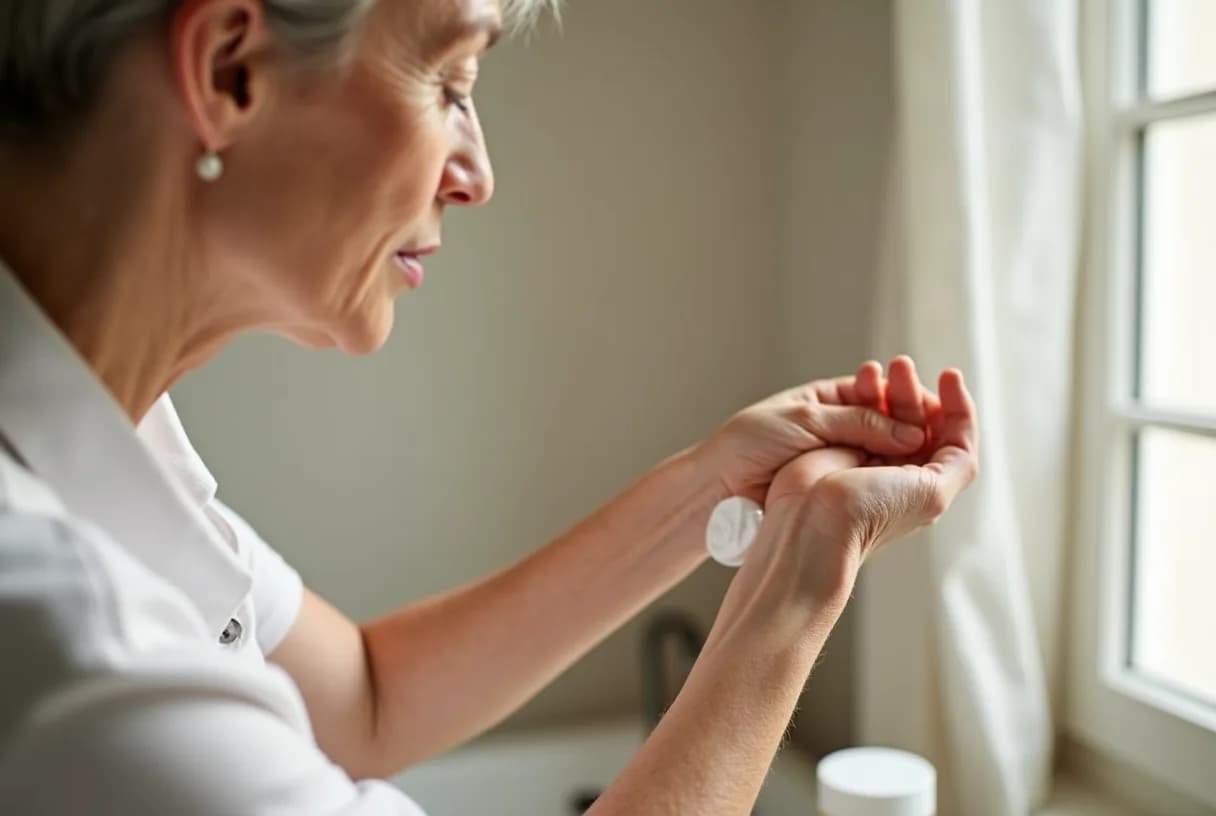
Dandruff on its own almost never causes permanent hair loss. The flakes are shed skin, not shed follicles, so treating the scalp does not "regrow" hair that dandruff destroyed — because it was never destroying it. What can nudge you toward more shedding is the fallout of an irritated scalp: hard scratching that snaps hairs and stresses follicles, plus the low-grade inflammation of seborrheic dermatitis, dandruff's more severe cousin. That shedding is usually temporary and reverses once the scalp calms down.
Does dandruff actually cause hair loss?
Dandruff is a mild, non-inflammatory flaking of the scalp. Seborrheic dermatitis is the same process turned up — red, greasy, itchy, scaly patches — often driven by an overgrowth of a normal skin yeast called Malassezia that feeds on scalp oil. Neither condition attacks the hair follicle directly, which is why dermatologists say flaking by itself doesn't make you bald.
The connection is indirect but real. Two things actually move hair:
- Scratching. Chronic, forceful scratching mechanically damages the hair shaft and irritates the follicle. You may notice short broken hairs, or more strands coming out when you scratch or comb.
- Inflammation. When seborrheic dermatitis is moderate to severe, the surrounding inflammation can push more follicles into their resting-and-shedding phase (called telogen) earlier than they should, so you shed more than usual for a while.
Neither of these is the same as the follicle-destroying, scarring hair loss seen in some other scalp diseases. Once the flaking, itching, and inflammation are controlled, the growth cycle typically returns to normal and the hair fills back in.
Does dandruff cause permanent hair loss?
For the vast majority of people, no. Because dandruff and seborrheic dermatitis don't scar the follicle, any shedding they trigger is reversible — hair regrows once the scalp is treated and the scratching stops. Permanent loss from a flaky scalp is uncommon, and generally happens only when severe, untreated inflammation persists for a very long time, or when a different, scarring condition was actually behind the symptoms all along.
The practical takeaway: if you're worried about thinning, the flakes are usually a red herring. Treat the scalp so you can stop scratching, then look honestly at whether something else — genetics, hormones, thyroid, or iron — is the real driver. More on that below.
Is it dandruff or dry scalp?
People often mix these up, and the fix is different. Dry scalp produces small, dry flakes and tight, itchy skin, and it tends to improve with gentler washing and moisture. Dandruff and seborrheic dermatitis produce larger, sometimes oily or yellowish flakes, usually with redness, and they respond to medicated shampoos rather than moisturizing ones. If a rich conditioner makes the flaking worse instead of better, you're probably dealing with dandruff, not dryness.
How do you treat a flaky, itchy scalp?
Medicated anti-dandruff shampoos are first-line, and most people improve without ever seeing a doctor. The step almost everyone gets wrong: these are scalp treatments, not hair washes. Massage the shampoo into the scalp and leave it on for 5 to 10 minutes before rinsing, so the active ingredient actually has time to work.
| Active ingredient | What it does | Good to know |
|---|---|---|
| Zinc pyrithione | Antifungal and antibacterial; curbs Malassezia yeast | Gentle and widely available; a common everyday option |
| Ketoconazole | Antifungal that targets the yeast overgrowth directly | 1% is over the counter; 2% is prescription strength |
| Selenium sulfide | Slows skin-cell turnover and reduces yeast | Can discolor light, gray, or color-treated hair — rinse thoroughly |
| Salicylic acid | Lifts and loosens built-up scale (keratolytic) | Can be drying; often paired with another active ingredient |
| Coal tar | Slows how fast scalp skin cells multiply | May stain light hair and increases sun sensitivity — cover up outdoors |
| Ciclopirox | Prescription antifungal for stubborn cases | From a clinician when over-the-counter options fall short |
How to use it — and how long it takes
- Match the frequency to your hair. If your hair is fine, straight, or oily, you can shampoo daily and use the medicated one about twice a week. If your hair is coarse, curly, or coily, use a medicated shampoo roughly once a week and apply it mainly to the scalp so the lengths don't dry out.
- Rotate ingredients. If one active stops working after a few weeks, switching to a shampoo with a different ingredient often helps, because the yeast can adapt.
- Handle hair gently. Ease off tight styles, aggressive brushing, and — hardest of all — scratching, since that's the part most likely to cost you strands. Stress and cold, dry weather can flare symptoms too.
- Be patient. Give a routine about a month before you judge it. Curious how long a new product should realistically take? Our how-long-until-it-works tool sets expectations.
If four weeks of a consistent over-the-counter routine doesn't help — or the scalp is very red, swollen, or sore — that's the signal to ask a clinician about prescription-strength options such as 2% ketoconazole, ciclopirox, or a short course of a topical anti-inflammatory. Don't start or stop any medication on your own; let the person examining your scalp guide it.
What else could be causing your hair loss?
Here's the part most articles gloss over: dandruff loves company. It very commonly coexists with an unrelated cause of thinning, and because the flaking is visible and annoying, people blame it for shedding that actually has a different source. If you clear the flakes but keep shedding, one of the causes below is usually why.
| Cause | Clues that point to it | How it relates to dandruff |
|---|---|---|
| Female-pattern hair loss | Gradually widening part, thinning over the crown, more scalp showing | Can coexist; dandruff doesn't cause it, and clearing flakes won't fix it |
| Telogen effluvium | Diffuse shedding 2–3 months after stress, illness, surgery, or childbirth | Scalp inflammation can trigger a similar burst of shedding |
| Menopause / hormonal shifts | Overall thinning around the 40s–50s, often with other menopause symptoms | Timing overlaps with when seborrheic dermatitis also flares |
| Thyroid disease | Thinning plus fatigue, weight or temperature changes, dry skin | Unrelated to flaking, but easy to blame on the visible dandruff |
| Iron deficiency (low ferritin) | Shedding with fatigue, pallor, or heavy periods | A common, checkable cause that dandruff can distract from |
| Tinea capitis (scalp ringworm) | Scaly patches with broken hairs and bald spots; more common in children | Looks like flaking but needs oral antifungal medication, not just shampoo |
| Scalp psoriasis | Thick, sharply bordered silvery plaques rather than loose flakes | Frequently confused with dandruff but treated differently |
| Alopecia areata | Sudden, round, smooth bald patches with no scaling | Autoimmune; unrelated to dandruff and needs specialist care |
Notice how many of these are checkable. Diffuse shedding with fatigue and heavy periods points toward low iron, which you can screen for with a ferritin level and address through diet or an iron supplement chosen for women. A gradually widening part is the signature of female-pattern hair loss, whose most-studied treatment is topical minoxidil. Shedding that lines up with your 40s or 50s often tracks with menopause-related hair changes. And thinning paired with fatigue, weight changes, or feeling cold deserves a look at your thyroid.
On supplements, be skeptical of pills marketed as one-shot dandruff or hair cures. Biotin only helps the rare person who is genuinely deficient, and most hair-growth supplements have thin evidence unless they correct a real shortfall. Fixing the scalp and the underlying cause beats any capsule.
When should you see a dermatologist?
Flaking that responds to shampoo doesn't need a doctor. Book a dermatologist if you notice any of the following, which suggest something beyond ordinary dandruff:
- Distinct bald patches, round smooth spots, or broken-off stubs of hair
- A scalp that is painful, oozing, crusting, or bleeding, or areas that feel boggy or swollen
- Thick, sharply bordered silvery plaques (possible psoriasis) rather than loose flakes
- Flaking with hair loss in a child — scalp ringworm needs oral antifungal medication, not just shampoo
- Shedding that keeps increasing, or continues after about a month of proper scalp care
- Thinning alongside fatigue, weight changes, missed periods, or heavy bleeding — clues to a hormonal or nutritional cause worth testing
A dermatologist can examine the scalp under magnification, confirm whether it's seborrheic dermatitis versus psoriasis, ringworm, or a scarring alopecia, order simple blood tests, and prescribe stronger treatment if you need it. The earlier a follicle-scarring condition is caught, the more hair you keep.
The bottom line
Dandruff is a scalp problem, not a follicle problem, so it rarely causes lasting hair loss — but the scratching and inflammation it brings can bump up temporary shedding, and it frequently sits on top of a separate cause you can't see in the mirror. Treat the scalp with a medicated shampoo used correctly, give it about a month, and if hair loss continues, get it evaluated rather than blaming the flakes. Want the bigger picture on thinning? Start with our guide to hair loss in women.