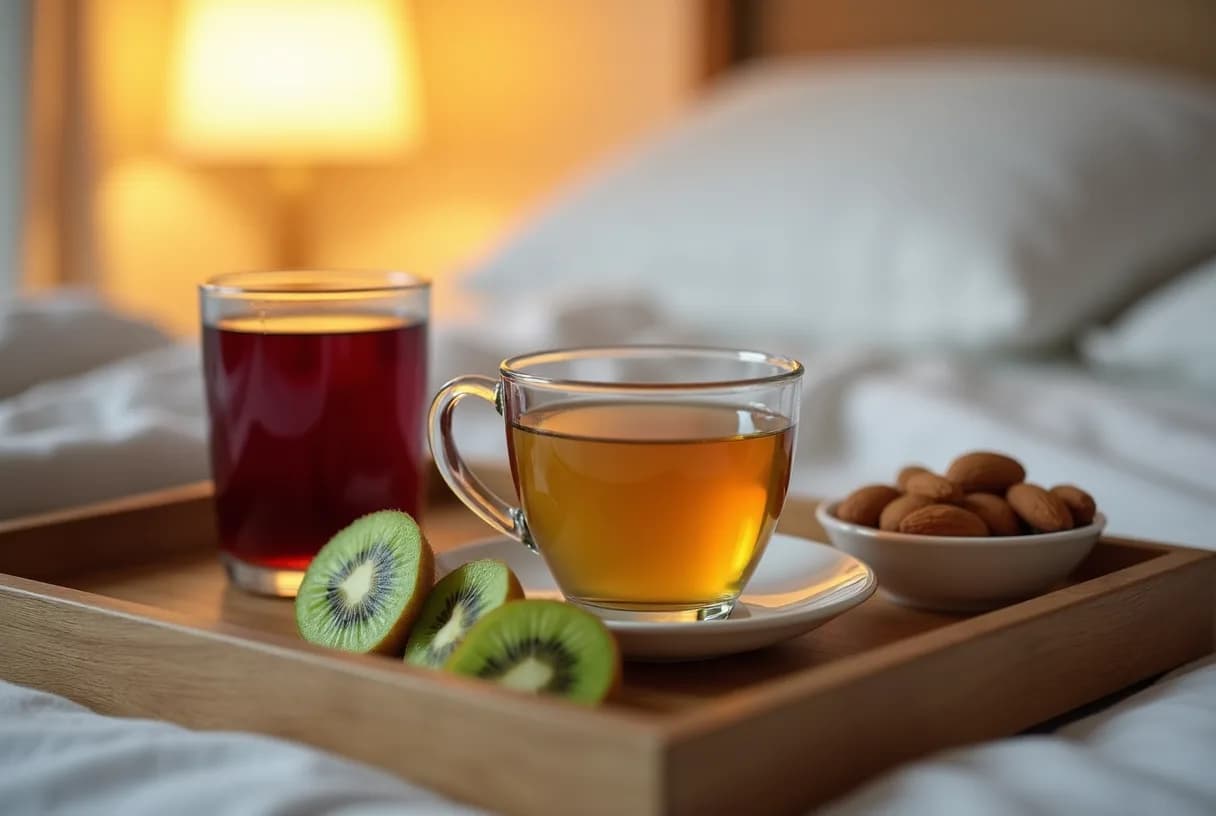
The honest answer: no drink or food is a proven sleep aid. Tart cherry juice and kiwifruit have the most human data of the popular options, and even that amounts to a handful of trials on 8 to 24 people reporting roughly 25 to 40 extra minutes of sleep — promising, not proven. What is well established is the damage at the other end: alcohol, late caffeine and a large meal close to bedtime measurably fragment sleep. Subtracting those beats adding anything, and it's free.
That's an unsatisfying answer if you came here for a magic mug. But it's the one that actually changes your night — and it's why the second half of this guide is a countdown you can run tonight rather than a shopping list.
What does the evidence actually say about each popular sleep drink?
Here is every item you've seen in a "drinks for sleep" listicle, with an honest label. "Limited" means real human studies exist but they are small, short, often unblinded, and not yet replicated at a scale that would change clinical practice.
| Drink or food | Evidence | What the research actually shows | Sensible use |
|---|---|---|---|
| Chamomile tea | Limited — and what exists is unimpressive | The US National Center for Complementary and Integrative Health puts it bluntly: there is very little information on chamomile's effect on insomnia, and a 2019 review found a single insomnia study, which showed no benefit. The anxiety data are somewhat more encouraging than the sleep data. | Fine as a warm, caffeine-free wind-down cue. Skip if you react to ragweed, chrysanthemums, marigolds or daisies — same plant family, and NCCIH flags the cross-reactivity. |
| Tart (Montmorency) cherry juice | Limited — the best of a weak field | Three small trials carry the whole claim. Twenty healthy adults drinking cherry concentrate for a week gained about 25 minutes of sleep (European Journal of Nutrition, 2012). A pilot in eight adults over 50 with insomnia reported 84 extra minutes — on eight people. An earlier trial in 15 older adults found only a modest change. Samples of 8 to 24, and you can taste which arm you're in, so blinding is imperfect. Proposed mechanisms: naturally occurring melatonin plus effects on tryptophan availability. | A modest glass (roughly 240 ml, or concentrate diluted) in the evening. It's real fruit juice — plenty of sugar, so treat it as a swap rather than an extra if that matters for you. |
| Warm milk | No direct evidence in adults | There is essentially no modern trial showing warm milk improves objective sleep in adults. The tryptophan story is mechanistically weak: the amount in a glass is small, and it competes with other amino acids to cross into the brain. Any benefit is most plausibly the ritual, the warmth and the association. | Keep it if you love it — a repeated, calm pre-bed cue has value. Just don't expect pharmacology. |
| Kiwifruit | Limited — one much-cited small study | The famous finding (two kiwis an hour before bed for four weeks) came from 24 people, with no control group and no blinding — participants were compared only against themselves. Reported total sleep time rose about 13%, and time to fall asleep dropped about 35%. Real numbers, weak design. Kiwi is genuinely rich in vitamin C, folate and fibre, so the downside is nil. | If you want an evening snack anyway, two kiwis is a reasonable one. Treat the sleep claim as untested. |
| Magnesium-rich foods (pumpkin seeds, almonds, spinach, black beans, oats) | Limited, and often misread | Low magnesium status is associated with poorer sleep in observational data, but food-level intake is not a sedative. The NIH Office of Dietary Supplements sets the RDA for adult women at 310–320 mg/day and notes that dietary surveys consistently show many people in the US fall below recommended amounts. Correcting a genuine shortfall is worthwhile for muscle, bone and blood pressure regardless of what it does to sleep. | Aim for magnesium across the day, not as a bedtime rescue. See magnesium and sleep, magnesium vs zinc, and our magnesium roundup if you're considering a supplement. |
| Herbal "sleepy" blends (valerian, passionflower, lemon balm, hops) | Limited and inconsistent | Valerian trials contradict each other. The American Academy of Sleep Medicine's 2017 clinical practice guideline recommends against valerian for chronic insomnia, because the evidence doesn't support benefit over no treatment. Passionflower and lemon balm have only small, preliminary studies. Herbal content in tea bags is unregulated and varies widely. | Low risk as a ritual. If you take sedatives, anticoagulants or antidepressants, run the herb through our interaction checker and ask a pharmacist. |
| Melatonin drinks, gummies and "sleepy" mocktails | Mixed — and misused | Melatonin is a circadian time-signal, not a sedative. It helps most for jet lag and shift work, and can shorten time to sleep modestly in some people. The same 2017 AASM guideline recommends against it for chronic insomnia. Label accuracy is poor: an analysis of retail products found actual melatonin content ranging from 83% below to nearly five times above the label claim. | Timing matters more than dose. See melatonin for women before you buy. |
| Ashwagandha lattes / "moon milk" | Very limited | A few small trials suggest ashwagandha may modestly improve sleep-quality scores, mostly in people with stress or insomnia symptoms. Study quality is low, funding is often industry-linked, and rare cases of liver injury have been reported. | Not a food, functionally — it's a supplement in a mug. Read ashwagandha and cortisol first. |
| Kava; high-dose L-tryptophan | Avoid — safety, not efficacy | Kava supplements have been implicated in cases of severe liver damage, which is why NCCIH warns about them explicitly. L-tryptophan carries historic contamination-related toxicity concerns, and the 2017 AASM guideline recommends against it for insomnia anyway. These are not "just teas." | Don't self-experiment. Talk to a clinician. |
Why does almost everything score "limited"?
It's worth understanding the pattern, because it repeats across every sleep-food headline you'll read next year:
- The studies are tiny. Many have 8 to 30 participants. One good sleeper's week can move the average.
- They're hard to blind. You know you drank cherry juice. Expectation alone shifts self-reported sleep.
- Several have no control group at all — people are compared against their own baseline, which flatters any intervention.
- Producers frequently fund them. Cherry growers, kiwi boards, supplement brands.
- The effect, when found, is small — and it's never measured against the actual first-line treatment.
None of that makes these foods bad. A warm, caffeine-free drink at a consistent time is a legitimate behavioural cue, and cueing does real work — it's the backbone of our 7-day better-sleep reset. Just don't let a mug of tea become the reason you never address the thing that's actually waking you at 3 a.m.
What actually hurts your sleep — and by how much
Alcohol: the trade you don't feel yourself making
Alcohol is the most effective sleep-wrecker most women use as a sleep aid. It genuinely shortens the time it takes to fall asleep — and then, as it clears, it fragments the second half of the night. Sleep-lab work summarised by the National Institute on Alcohol Abuse and Alcoholism describes this as a rebound effect: the body compensates for alcohol during the first half of the night, and once the alcohol is metabolised, that compensation shows up as wakefulness and light, broken sleep in the second half. Alcohol also relaxes the upper airway, worsening snoring and sleep apnea, and it's one of the most commonly reported triggers for night sweats and hot flashes.
The 3 a.m. wake-up after two glasses of wine isn't bad luck. It's the pharmacology arriving on schedule.
Practical: if you drink, finish at least 3 hours before bed and pay attention to what one drink versus two does to your 3–4 a.m. window. Most people who track this find the second drink is where the night breaks.
Caffeine: do the math, not the vibes
This is the one place where the evidence is genuinely strong, and it's stronger than most people expect. In a controlled trial published in the Journal of Clinical Sleep Medicine, 400 mg of caffeine — roughly four cups of coffee — taken six hours before bedtime reduced objectively measured total sleep time by more than an hour. Not self-reported sleep. Measured sleep. And the participants largely didn't notice it happening.
The mechanism is unremarkable: caffeine's half-life averages about 5 hours, so half of a 4 p.m. double espresso (~130 mg) is still circulating at 9 p.m. The FDA's guidance for healthy adults is up to about 400 mg a day — but that's a daily-total ceiling, not a timing rule, and the FDA itself notes wide person-to-person variation in how fast people clear it. Timing is the part that ruins sleep.
Two facts almost nobody is told:
- Oestrogen-containing oral contraceptives slow caffeine clearance substantially. A pharmacokinetic study found a caffeine half-life of about 7.9 hours in pill users versus 5.4 hours in non-users — the pill inhibits CYP1A2, the liver enzyme that does most of the work. If you're on it, a 2 p.m. coffee can behave like a 4 p.m. one.
- Clearance varies genetically and slows with age. "It's never bothered me" can quietly stop being true in your forties.
Practical: make your cut-off at least 6 hours before bed — 8 to 10 if you're on the pill or caffeine-sensitive — and hold it for two weeks before you judge it. Decaf isn't zero (roughly 2–15 mg a cup) but is almost always fine. Watch green tea and matcha in the afternoon; matcha is more caffeinated than most people assume.
Big, late, or reflux-triggering meals
A large meal within about three hours of lying down raises the odds of reflux, which wakes you without necessarily feeling like heartburn — sometimes it's just a cough, a sour taste, or a 2 a.m. stir you can't explain. High-fat and spicy meals slow gastric emptying, and in perimenopause, spicy food and heat are frequent flush triggers.
The flip side matters just as much, and diet culture gets it exactly backwards: going to bed genuinely under-fed disrupts sleep too. Skipping dinner to "save" calories is a reliable way to buy yourself a 4 a.m. wake-up. If you're hungry at bedtime, eat. A small snack combining carbohydrate and protein — yogurt with fruit, toast with peanut butter, oats — is a reasonable choice 30–60 minutes before bed. Our recipes have workable versions if you want something less depressing than dry toast.
The 10 p.m. mug of tea problem
Here's the irony nobody puts in the listicles: a big mug of herbal tea right before bed is a nocturia machine. Waking at 2 a.m. to use the bathroom — and then lying awake for 40 minutes — costs you far more sleep than chamomile could plausibly return. Bladder urgency also rises for many women after menopause.
Practical: if you want the ritual, have a small mug (about 150 ml) 60–90 minutes before bed, not a pint at lights-out, and empty your bladder immediately before getting in.
Does what you eat all day matter more than what you drink at night?
Probably, though the evidence here is observational and can't prove cause. Diets higher in fibre, vegetables, legumes, fish and olive oil are consistently associated with better sleep quality; diets higher in added sugar and saturated fat are associated with lighter, more fragmented sleep. Adequate protein and adequate total energy matter for the same reason: your body doesn't wind down well when it's short of fuel. If you're mid-way through a weight-loss phase or on a GLP-1, under-eating in the evening is a common and fixable cause of broken nights — see nutrition and protein needs at midlife.
The wind-down countdown: what to stop, and when
| Time before bed | Do this | Why it works |
|---|---|---|
| 6+ hours (8–10 if sensitive or on the pill) | Last caffeine of the day | 400 mg at the 6-hour mark cut measured sleep by over an hour in a controlled trial — and people didn't feel it happening |
| 3–4 hours | Finish your main meal. Include protein and fibre; don't skimp | Reduces reflux risk; prevents the hunger wake-up |
| 3+ hours | Last alcoholic drink, if you're having one. One, not two | Lets the rebound-arousal phase land before, not during, your sleep |
| 1–2 hours | 10–15 minute warm bath or shower | Passive warming, then a body-temperature drop — better supported for faster sleep onset than any drink on this page |
| 60–90 min | Small warm drink (150 ml), caffeine-free. Then stop large fluids | Keeps the ritual, avoids the 2 a.m. bathroom trip |
| 30–60 min | Small carb + protein snack if hungry; lights down; screens out of the bedroom | Removes the two most common physiological wake-up triggers |
| 0 | Empty bladder, cool dark room, same wake time tomorrow regardless of how tonight goes | A fixed wake time is the single strongest behavioural lever you have |
Run it for 14 nights before judging. One good night proves nothing; one bad night disproves nothing. If you want it structured for you, the 7-day better-sleep reset walks the same ground night by night — and if you're waking at 3 a.m. wired rather than restless, cortisol and sleep explains the other half of the picture.
Should I just take a supplement instead?
Understandable question, and the honest answer is: the supplement evidence isn't much stronger than the food evidence. Magnesium supplements have a small, mostly low-quality trial base in older adults. Melatonin is a circadian signal that the AASM guideline explicitly does not recommend for chronic insomnia — and neither does it recommend valerian or L-tryptophan. Nothing in the aisle outperforms fixing alcohol, caffeine timing and a fixed wake time. If you're going to try something anyway, run it through the supplement scorecard and read what the sleep supplement evidence actually shows so you know what you're buying.
When to see a clinician
Food and drink tweaks are for ordinary, occasional poor sleep. They are not treatment for a sleep disorder. Book an appointment if any of these apply:
- Trouble falling or staying asleep 3+ nights a week for 3+ months, with daytime consequences. That's the definition of chronic insomnia — and the first-line treatment is cognitive behavioural therapy for insomnia (CBT-I), not a pill and not a tea. The American College of Physicians recommends CBT-I as the initial treatment for all adults with chronic insomnia, ahead of medication, and it works through digital programmes as well as in person.
- Snoring, gasping, witnessed pauses in breathing, morning headaches, or unrefreshing sleep despite enough hours. Sleep apnea is under-recognised in women and rises sharply after menopause.
- Crawling, urge-to-move sensations in the legs at night — worth checking iron and ferritin.
- Reflux most nights, or night sweats soaking your sheets.
- Low mood, loss of interest, or anxiety that isn't lifting. Insomnia and depression travel together, and treating one usually needs the other addressed too — start with finding a therapist. If you are having thoughts of harming yourself, call or text 988 (US Suicide & Crisis Lifeline) or your local emergency number now.
Never start or stop a prescribed medication on the strength of an article. Bring the question to your clinician instead.
The bottom line
Buy the tart cherry juice if you enjoy it. Keep the warm milk if it's your signal that the day is over. Just be clear-eyed that you're buying a ritual, not a remedy — and that the three levers with real evidence behind them (alcohol out, caffeine early, dinner not-too-late and not-too-small) cost nothing and work regardless of what's in the mug. If those don't fix it in a few weeks, that's useful information: it means something else is waking you, and it's worth finding out what. More at our sleep hub, why sleep matters and menopause and insomnia.