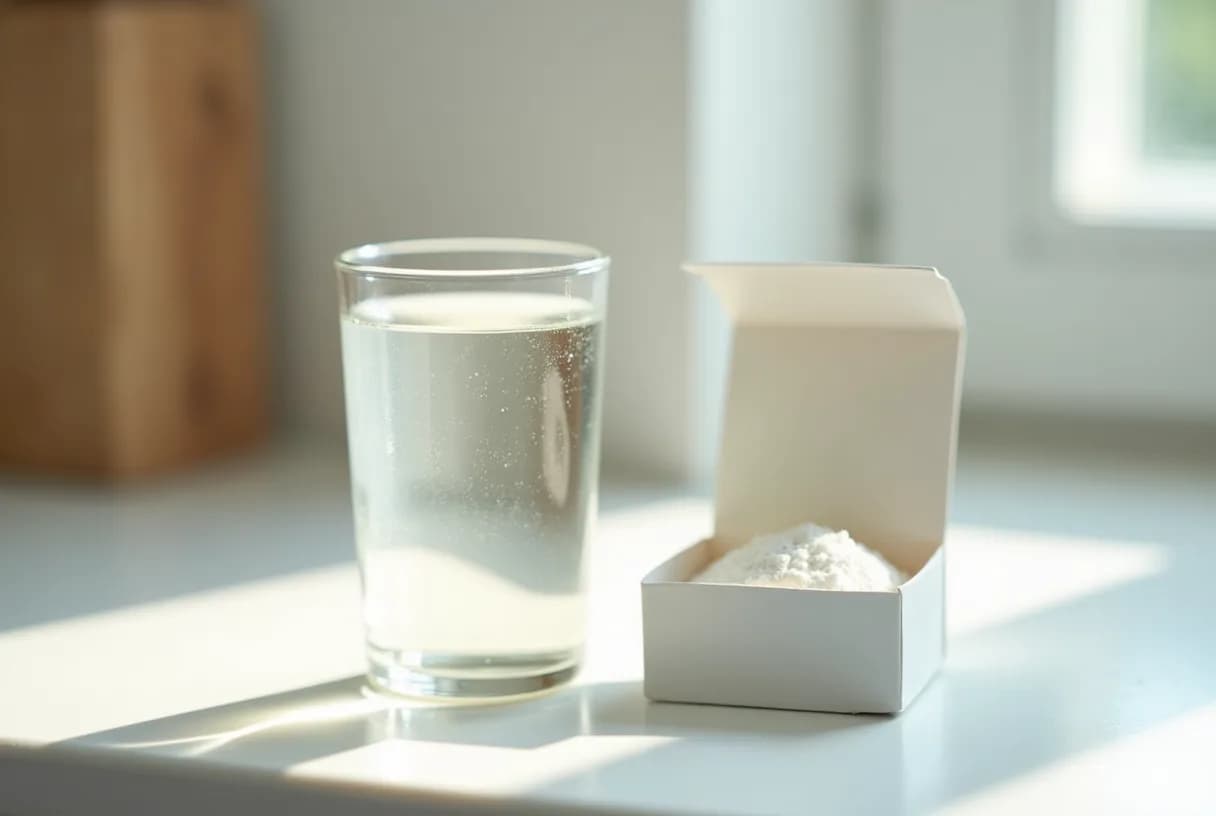
The honest answer: No. Drinking baking soda (sodium bicarbonate) — whether mixed with water, lemon, or apple cider vinegar — does not burn fat or meaningfully boost your metabolism. No clinical trial supports it. And unlike most useless "diet hacks," this one is genuinely risky: baking soda is very high in sodium, it interacts with common medications, and in documented medical cases, drinking too much has caused dangerous metabolic alkalosis and even a ruptured stomach. Please don't drink it to lose weight.
If you've landed here after seeing the "baking soda trick" racking up views on TikTok, your instinct to check first was exactly right. The trend is spiking again — usually framed as a cheap, natural way to "melt fat," "flush the body," or "reset your metabolism." The appetite behind it is real and understandable: weight that won't shift, especially in your 40s and 50s, is frustrating and expensive to address. But this particular shortcut doesn't deliver, and it can land people in the emergency room. Here's the full, honest picture — and where to put your energy instead.
What the viral "baking soda trick" actually claims
The recipes vary, but the promises cluster into three ideas:
- "Baking soda burns fat." Usually a half-teaspoon in water on an empty stomach, sometimes with lemon or apple cider vinegar added.
- "It alkalizes your body, and an alkaline body can't hold fat." This is the pseudo-scientific engine behind the whole trend.
- "It boosts your metabolism" or "curbs appetite" so you eat less.
Each of these sounds plausible in a 20-second clip. None survives contact with actual physiology.
Claim vs. evidence: going through them one by one
| The viral claim | What the evidence actually shows |
|---|---|
| "Baking soda burns fat" | No randomized trial has ever shown sodium bicarbonate reduces body fat or changes body composition. It neutralizes stomach acid — a completely separate process from fat metabolism. There is no biological pathway linking it to fat loss. |
| "Alkalize your body and the fat melts" | Physiologically false. Your blood pH is held in a razor-thin range (7.35–7.45) by your lungs and kidneys, minute to minute. What you drink does not move it. If anything you drank did shift blood pH, that would be a medical emergency — not a diet. |
| "It boosts your metabolism" | No credible human evidence. Bicarbonate is studied as a sports-performance buffer for very short, intense exercise — not as a metabolism or fat-loss aid. Any effect on calories burned is negligible. |
| "People lose weight fast on it" | Baking soda is a sodium salt. It shifts water balance, so the scale can dip for a day or two. That is water weight, not fat — and it returns. |
| "It's natural, so it's safe" | Natural does not mean harmless. Excess intake is linked in the medical literature to metabolic alkalosis, dangerous electrolyte shifts, and gastric rupture. |
Why the "alkalize your body" idea is simply wrong
This is the myth worth killing outright, because it powers a whole genre of wellness marketing. Your body does not let your blood pH drift based on your breakfast. The lungs adjust blood pH within minutes by changing how fast you breathe off carbon dioxide, and the kidneys fine-tune it over hours to days by excreting or holding onto bicarbonate. Together they keep blood pH inside roughly 7.35–7.45 whether you drink lemon water, cola, or plain water. As one clinical review put it plainly, the alkaline-diet construct "reflects persuasive marketing more than biochemical facts."
The one place your body is meant to be acidic is your stomach — that acid is how you digest food and kill pathogens. Deliberately neutralizing it every morning isn't "detoxing"; it's blunting normal digestion.
Is drinking baking soda dangerous? This is the part that matters
Most diet fads are a waste of money and nothing worse. This one is different, and that's the whole reason we're writing it. The active ingredient is sodium bicarbonate, and both words carry risk.
The sodium load
A single half-teaspoon of baking soda contains roughly 600 mg of sodium — about a quarter of the entire daily limit (2,300 mg) recommended for most adults, in one small scoop. Repeating that daily is a serious concern for anyone with high blood pressure, heart failure, or kidney disease, where a sodium surge can drive fluid retention and raise blood pressure. Product labels themselves say to ask a doctor or pharmacist before use if you're on a low-salt diet or have high blood pressure.
Metabolic alkalosis and worse
When people take large or repeated doses, the documented outcomes are alarming. Case reports describe severe metabolic alkalosis (blood tipped too alkaline), hypernatremia (dangerously high sodium), and low potassium — a combination that can trigger muscle weakness, confusion, seizures, and heart-rhythm disturbances. In one published case, a previously healthy adult developed severe alkalosis and hypernatremia after escalating baking-soda use. Acute massive ingestion has also caused spontaneous rupture of the stomach: baking soda reacts with stomach acid to produce a rush of carbon dioxide gas, and in reported cases the stomach over-distended and tore. These are rare, but they are real, published events — not internet scare stories.
It interferes with your medications
By raising stomach pH, baking soda changes how your body absorbs many drugs, and can reduce or alter the effect of NSAIDs, certain antibiotics and antifungals, corticosteroids, and more. If you take any prescription medicine, this alone is reason to leave it out of your routine. If you're unsure how something interacts, our interaction checker is a good first stop before a pharmacist conversation.
So what is baking soda good for?
Baking soda isn't evil — it's just being sold for the wrong job. Its legitimate uses are narrow and worth knowing:
- An occasional antacid. Sodium bicarbonate is an FDA-recognized ingredient in some over-the-counter antacids for short-term heartburn or indigestion — used per the label, occasionally, not daily. If you need heartburn relief regularly, that's a reason to see a clinician, not to self-dose.
- Cooking and baking. As a leavening agent it's completely fine — the amount in food is tiny.
- Household cleaning. Its best-known role, and a safe one.
None of these involve drinking a spoonful of it on an empty stomach every morning.
The real reason the scale won't budge — and what actually helps
The frustration driving this trend is legitimate, and it deserves a real answer instead of a gimmick. Weight becomes genuinely harder to manage in midlife: muscle mass declines, sleep and stress hit metabolism, and hormonal shifts around perimenopause change where the body stores fat. That's biology, not a lack of willpower — and it responds to approaches that are proven, not viral. A few that carry real evidence:
- Protein and strength. Prioritizing protein and resistance training protects the muscle that keeps your metabolism up. See our guide to a high-protein diet for women.
- Movement you'll repeat. Even walking for weight loss is more effective than any powder, because you'll actually keep doing it.
- Understanding metabolism honestly. If you want to know what genuinely nudges calorie burn (and what doesn't), start with foods that boost metabolism and our broader weight and metabolism hub.
- Skepticism toward the next "natural Ozempic." The same feed pushing baking soda pushes other quick fixes — we've weighed the evidence on the so-called natural Ozempic claims and on berberine so you don't have to guess. The pink salt trick is another one worth reading before you try it.
When to talk to a doctor or pharmacist
This is the safety bottom line, so please don't skip it:
- Before using baking soda as an antacid at all — if you have high blood pressure, heart failure, or kidney disease, or take any prescription medication, ask a pharmacist or doctor first.
- If you've already been drinking baking soda and feel nauseated, weak, unusually swollen, confused, or notice an irregular heartbeat or muscle cramps, stop and seek medical care — these can be signs of alkalosis or electrolyte imbalance.
- If severe stomach pain or swelling follows a large dose, treat it as urgent.
- If weight or metabolic changes are worrying you, ask your clinician to check the real drivers — thyroid, blood sugar, medications, and perimenopause can all play a role, and they're treatable when identified.
You were right to look this up before trying it. The honest verdict is simple: baking soda won't help you lose fat, and it can genuinely hurt you. Put your effort where the evidence actually points.
This article is for education and is not medical advice. Don't start, stop, or change any medication or supplement based on what you read here — talk to your clinician or pharmacist about your specific situation.