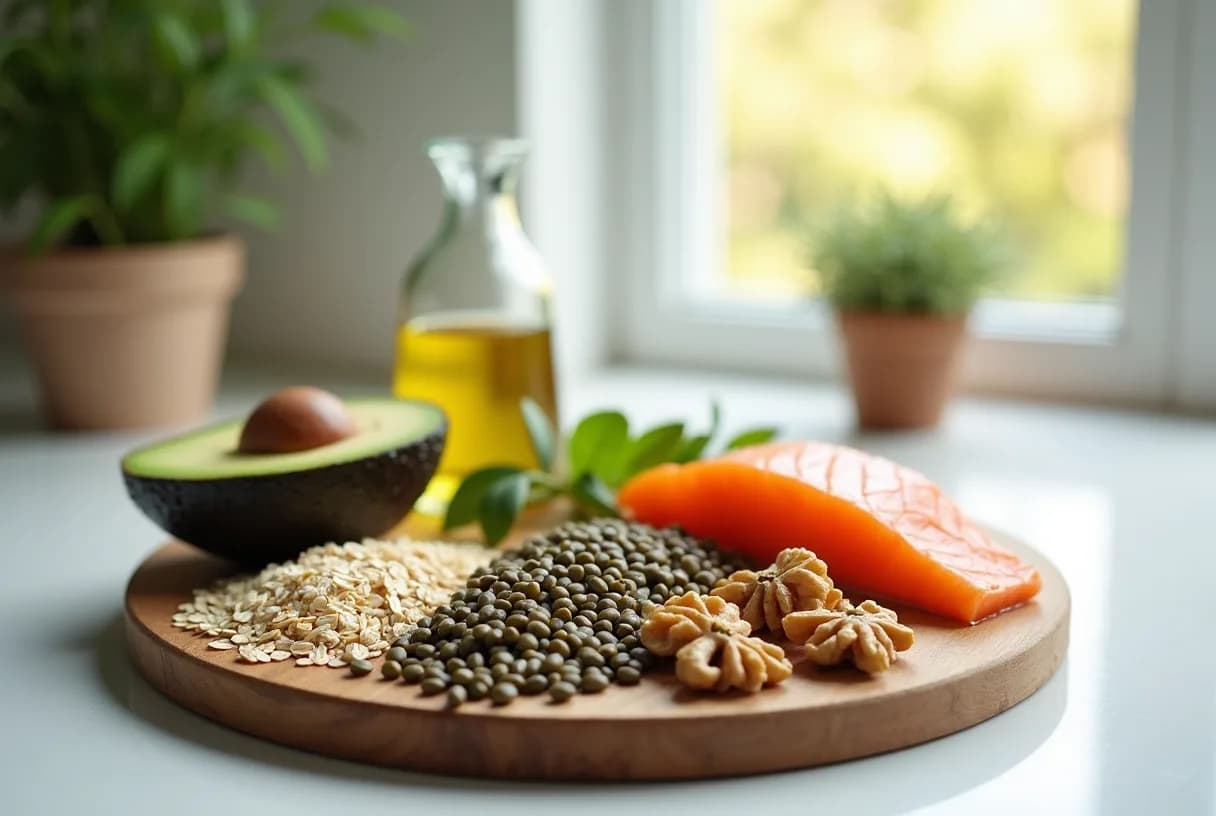
Short answer: the foods with genuine, measured cholesterol-lowering power are oats and barley (beta-glucan), beans and lentils, nuts, plant sterol- or stanol-fortified foods, psyllium, and unsaturated fats like olive oil used in place of butter. Each one moves LDL cholesterol by roughly 3–10%. Stack several into the same week and you can realistically expect 10–20% — a real, useful shift that still lands well short of what a statin does, and does not replace one when a clinician says you need it.
What follows is the honest version: the mechanism, the amount actually used in trials, and the average effect size — not the best-case headline.
Which foods lower LDL, and by how much?
The numbers below are averages from randomized controlled trials and their meta-analyses. Individual response varies enormously: some people drop 20% on the same diet that barely moves someone else. Effects are also largely substitution effects — oats help partly because you ate oats instead of a croissant.
| Food (amount tested) | How it works | Honest average effect on LDL | Strength of evidence |
|---|---|---|---|
| Oats and barley — 3 g beta-glucan/day (about 1 cup cooked oatmeal plus a barley side, or ~80 g dry oats) | Beta-glucan forms a viscous gel in the small intestine that traps bile acids. The liver must pull LDL out of the blood to make replacements. | About 5–7% lower (roughly 8–10 mg/dL). Below 3 g/day the effect fades. | Strong — the basis of an FDA-authorized health claim. |
| Beans, lentils, chickpeas — 130 g cooked/day (about ¾ cup) | Soluble fiber plus resistant starch; fermentation products in the colon appear to blunt cholesterol production in the liver. Also displaces meat. | About 5% lower (roughly 6–7 mg/dL) at one serving a day. | Strong — pooled randomized trials. |
| Nuts — 30–67 g/day (one to two handfuls of almonds, walnuts, pistachios) | Unsaturated fat replaces saturated fat; plant sterols and fiber reduce cholesterol absorption. Dose-dependent. | Up to about 7% lower (~10 mg/dL) at the higher 67 g dose; roughly half that at one handful. | Strong — pooled analysis of 25+ trials. |
| Plant sterols and stanols — 2 g/day (fortified spreads, yogurt drinks) | Structurally mimic cholesterol and compete with it for absorption in the gut. | About 8–10% lower — the largest single-food effect on this list. | Strong for the LDL number, but no trial has shown fewer heart attacks. Surrogate endpoint only. |
| Psyllium husk — about 10 g/day | Same bile-acid trapping as oats, but far more viscous per gram. | Roughly 7–9% lower (~10–13 mg/dL). | Strong. Bloating and gas are common at first; introduce slowly, with plenty of water. |
| Olive oil (extra-virgin) — 3–4 tbsp/day in the PREDIMED trial | Works by displacement. Every 1% of daily calories moved from saturated to polyunsaturated fat lowers LDL by roughly 2 mg/dL. Butter swapped for olive oil is the swap. | Modest on its own; meaningful as part of a Mediterranean pattern, which cut major cardiovascular events by roughly 30% in PREDIMED. | Strong for the eating pattern; the oil is not magic in isolation. |
| Soy protein — 25 g/day (tofu, tempeh, edamame, soy milk) | Soy protein and its isoflavones increase LDL-receptor activity in the liver; also replaces meat. | Only about 3–5% lower (~5 mg/dL). Honest caveat: the FDA proposed revoking its authorized soy heart-health claim in 2017 because trial results were inconsistent. | Moderate, and weaker than the marketing suggests. |
| Oily fish — salmon, sardines, mackerel, herring; 2 servings/week | EPA and DHA reduce triglyceride production in the liver. They do not pull down LDL — DHA can nudge it slightly up. | Little to no LDL change. Triglycerides fall 15–30%, but only at the 2–4 g/day EPA/DHA doses used in trials — far above what food or a standard capsule delivers. | Moderate for eating fish. Fish-oil supplements for prevention were largely null in VITAL, ASCEND and STRENGTH. Do not start a high-dose regimen on your own. |
| Soluble-fiber fruit — apples, pears, citrus, berries, prunes | Pectin gels and binds bile acids, like beta-glucan but weaker per serving (about 1–2 g soluble fiber per fruit). | Small alone. Counts toward the 5–10 g/day of soluble fiber that yields roughly a 5% LDL drop. | Moderate — worth eating, but not a lever by itself. |
| Avocado — one per day | Monounsaturated fat plus fiber; earlier small trials suggested benefit when it displaced saturated fat. | Small at best. In the largest trial (1,008 adults, 26 weeks, one avocado daily — and funded by the Hass Avocado Board) LDL fell by just 2.5 mg/dL, about 2%: statistically detectable, clinically trivial. The trial’s main outcome, visceral fat, did not move at all. | Weak. A good food; not a cholesterol treatment. We flag it because most articles still list it as one. |
Why do these effects look so small?
Because a single food is a single lever. The interesting finding is what happens when you pull several at once. In controlled feeding trials, a "portfolio" combining plant sterols, viscous fiber, soy protein and nuts lowered LDL by nearly 30% — close to a starting statin dose — under tightly supervised conditions. When people ate the same way in ordinary life, the drop was closer to 13%.
That gap between 30% and 13% is the whole story of diet and cholesterol: the ceiling is high, and adherence decides where you actually land. Two practical consequences:
- Additive beats optimal. Oats at breakfast, lentils at lunch, a handful of walnuts, and olive oil instead of butter will beat any amount of searching for one perfect superfood.
- Removal matters as much as addition. Adding oats to a diet built on butter, processed meat and pastry mostly cancels out. Saturated fat is the biggest dietary driver of LDL, and swapping it out is the highest-yield change most people can make. Our heart-healthy diet guide walks through the swaps.
What actually raises HDL — and should you even try?
This is where most cholesterol advice goes wrong. HDL ("good") cholesterol tracks with lower cardiovascular risk in observational data, so for decades raising it looked like an obvious target. Then it was tested.
| What | Mechanism | Typical HDL change |
|---|---|---|
| Regular aerobic exercise | Increases lipoprotein lipase activity and reverse cholesterol transport. | +2–3 mg/dL, and mainly above roughly 120 minutes a week. |
| Quitting smoking | Smoking suppresses HDL and damages how it functions; the effect reverses within weeks to months. | +2–5 mg/dL — and by far the biggest total risk reduction on this list. |
| Olive oil and other unsaturated fats replacing refined carbohydrate | Monounsaturated fat raises HDL where refined starch and sugar lower it. | +2–4 mg/dL; polyphenol-rich extra-virgin oil also appears to improve HDL function, not just the number. |
| Oily fish | Chiefly by lowering triglycerides, which mechanically frees up HDL. | Small: +1–3 mg/dL. |
| Losing excess weight | Less insulin resistance, less exchange with triglyceride-rich lipoproteins. | Roughly +1 mg/dL for every 3 kg (7 lb) lost. |
| Alcohol | Genuinely raises HDL — and raises blood pressure and breast-cancer risk. | Not a reason to drink. No health authority recommends starting. |
Now the honest part. Every drug built to raise HDL has failed to prevent heart attacks. Niacin raised HDL and did nothing for outcomes in two large trials (AIM-HIGH and HPS2-THRIVE), while adding harms. The CETP-inhibitor drugs raised HDL dramatically: torcetrapib caused harm, dalcetrapib and evacetrapib were stopped for futility, and the one that did slightly cut events (anacetrapib) appears to have done it by lowering LDL and apoB — not by raising HDL. And genetic studies show that people born with HDL-raising variants do not have fewer heart attacks. No supplement — niacin, fish oil, any "HDL booster" — has ever been shown to reduce cardiovascular events by raising HDL.
The workable interpretation: HDL is a barometer, not a lever. A low HDL is a real signal that something metabolic deserves attention — inactivity, smoking, insulin resistance, high triglycerides. The fix is to address those things, not to chase the number. A very high HDL is not a prize either — at the extremes, mortality curves back upward. But the threshold is much higher in women: in the Copenhagen cohorts the lowest mortality sat around 93 mg/dL in women (73 mg/dL in men), and excess risk appeared only above roughly 116 mg/dL. An HDL in the 70s or 80s is not something to worry about.
Why did my cholesterol jump after menopause?
This blindsides a lot of women who changed nothing about how they eat. In the SWAN cohort, which tracked women through the transition, total cholesterol, LDL and apoB rose sharply in the roughly one-year window around the final menstrual period — LDL climbing about 5 mg/dL in that single year, roughly three times its pace in the years before or after. It is not simply aging: it is timed to the loss of estrogen, which supports LDL-receptor activity in the liver.
LDL particles also tend to become smaller and denser after menopause, and triglycerides drift up. In other words, the same LDL number can carry a little more risk than it did at 40. This is the moment to get a full lipid panel rather than assume your old baseline still holds — see cholesterol levels by age, our menopause and heart health guide, and the heart risk check.
Which "cholesterol foods" are overhyped?
- Coconut oil. Marketed as heart-friendly; in pooled trials it raises LDL by around 10 mg/dL compared with liquid vegetable oils. It is a saturated fat.
- Eggs. For most people, dietary cholesterol affects blood cholesterol far less than saturated fat does. The bigger problem is usually what sits on the plate beside the egg.
- Fiber gummies. Often contain fibers with no viscosity — no gel, no bile-acid binding, no LDL effect.
- Red yeast rice. Not a gentle natural alternative: it contains monacolin K, which is chemically identical to lovastatin. The dose is unregulated and varies wildly between bottles, and it carries the same muscle and liver cautions and drug interactions as a prescription statin. Tell your clinician if you take it. Our interaction checker and supplements hub cover this ground.
What does a day that actually hits the targets look like?
- Breakfast: oatmeal made from about ½ cup dry rolled oats (roughly 2 g beta-glucan), with berries and a spoon of ground flax or a handful of walnuts.
- Lunch: a lentil, chickpea or bean dish — about ¾ cup cooked hits the tested serving. Dress it with olive oil, not a creamy dressing.
- Snack: a small handful of almonds or pistachios (about 30 g).
- Dinner: oily fish twice a week; otherwise tofu, tempeh or more beans, plus a large vegetable portion and a whole grain such as barley.
- The swaps that do the quiet work: olive oil instead of butter, whole fruit instead of juice, less processed meat.
Our recipe collection and nutrition hub have versions of these that people actually cook twice.
Does food replace a statin?
No — and anyone telling you otherwise is selling something. Diet at its realistic best lowers LDL by 10–20%. Statins lower it by 30–50% and, unlike plant sterols, have decades of outcome trials showing fewer heart attacks and strokes. If your clinician has recommended one, diet is what you do alongside it, not instead of it. Never stop or change a prescribed medicine to "try food first" without talking to the person who prescribed it.
Where food shines: when your LDL is borderline, your overall risk is low or intermediate, and your clinician has told you there is room to try lifestyle first — and as the foundation under a statin, since the two work through different mechanisms and their effects add up.
When to see a doctor
A cholesterol result is a clue, not a diagnosis. Reference ranges differ between laboratories, and the same LDL means different things in a 45-year-old non-smoker with normal blood pressure than in a woman with diabetes, hypertension or a strong family history. Only your clinician can interpret your number in the context of you. Our lab results explainer can help you read the report, but it does not replace that conversation.
Book an appointment if:
- Your LDL is 190 mg/dL (4.9 mmol/L) or higher, or a close relative had a heart attack or stroke before age 55 (men) or 65 (women). That raises the possibility of familial hypercholesterolaemia — an inherited condition that needs treatment and family screening, not a bowl of oats.
- Your cholesterol has risen and you are in or past the menopause transition, so your risk can be reassessed against your new baseline.
- You have diabetes, high blood pressure, chronic kidney disease, an inflammatory condition such as rheumatoid arthritis, or you smoke — each changes what your target should be. See also high blood pressure in women.
- You have never had a lipid panel, or your last one was more than 4–5 years ago.
- You take red yeast rice, high-dose niacin or high-dose fish oil — these belong on your medication list.
Call emergency services (911 / 999 / 112) immediately if you have chest pressure, tightness or pain; pain spreading to the jaw, neck, back or arm; unusual shortness of breath; nausea with a cold sweat; light-headedness; or sudden crushing fatigue. Women's heart-attack symptoms are more often these quieter ones than the dramatic chest clutch — which is exactly why they get dismissed. Do not drive yourself, and do not wait to see whether it passes.
Related reading
- Cholesterol levels by age — what the numbers on your panel mean
- The heart-healthy diet — the substitutions that do the heavy lifting
- Menopause and heart health — why risk shifts at the transition
- Foods high in omega-3 — where fish oil helps and where it does not
- Heart risk check and the heart health hub
This article is for information, not medical advice. It cannot tell you whether your result is fine, and nothing here should be used to start, stop or change a medication. Bring your numbers to a clinician who knows your history.