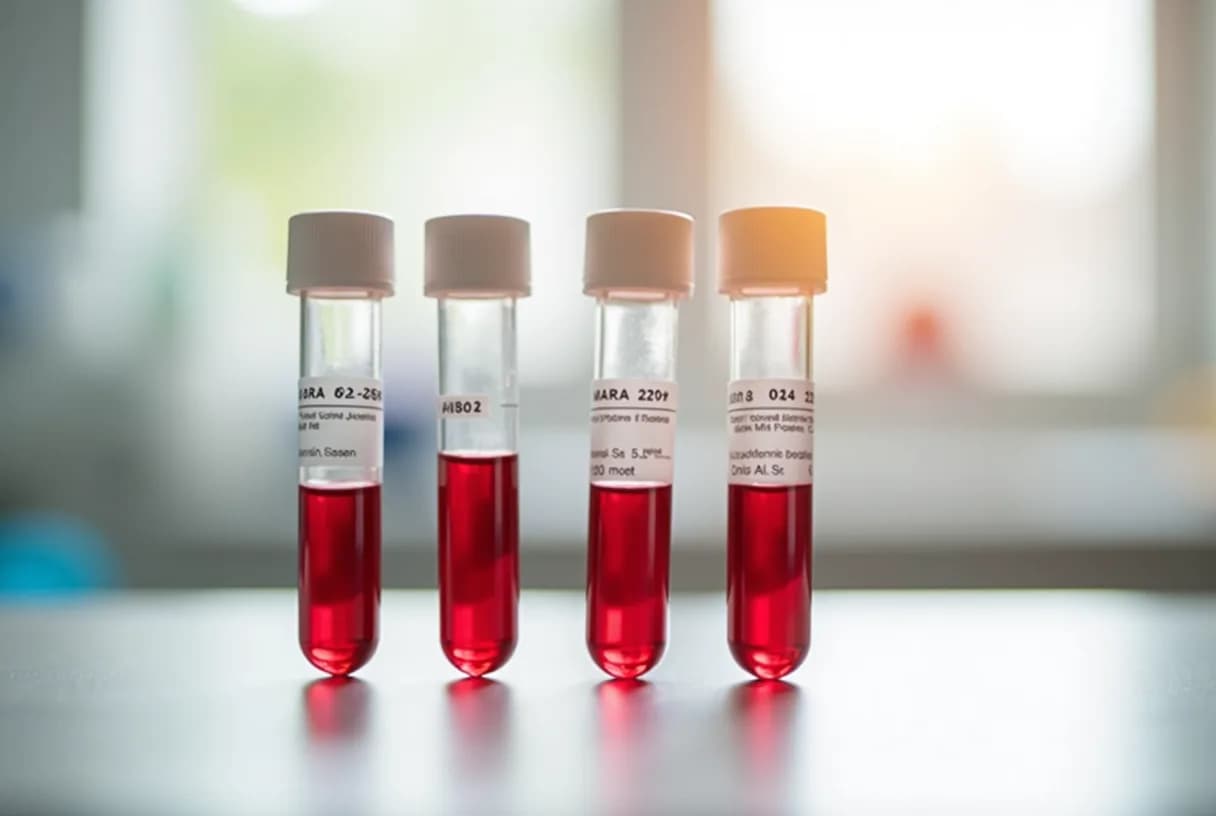
The common signs of anemia are pallor, fatigue, breathlessness on exertion, palpitations, cold hands and feet, brittle nails, hair shedding, restless legs, headaches, brain fog — and, most tellingly, a craving to crunch ice. Pallor is real, but the face is the least reliable place to look for it: check the inner lower eyelid, the nail beds, and the creases of your palm, where the skin is thin and blood-rich. None of this proves anything on its own. Anemia is confirmed by a blood test — and iron stores (ferritin) usually fall long before hemoglobin does, which is why you can feel awful with a "normal" blood count.
What does anemia actually feel like?
Anemia means your blood carries less oxygen than your body wants. Every symptom below is downstream of that one fact — organs and muscles asking for oxygen they aren't getting, and a heart and lungs working harder to compensate. Symptoms usually creep in over months, which is exactly why they get normalised.
| Sign | What it actually looks or feels like | How to check it | How specific to iron deficiency? |
|---|---|---|---|
| Pallor | Not "ghostly white." A loss of the pink undertone — skin and mucous membranes look washed out, sallow, or grey-toned | Pull down the lower eyelid in daylight: the rim should be pink, not pale pink or near-white. Also check nail beds, palm creases, tongue, inner lip | Moderate. Marked pallor of the inner eyelid is one of the more useful physical clues; subtle pallor is unreliable |
| Fatigue | Not sleepiness — a heaviness. Everything costs more effort. You nap and don't feel restored | Compare to yourself 12 months ago, not to other people | Low. The single most-dismissed symptom, and the most overlapping with perimenopause |
| Breathlessness on stairs | Puffed after one flight when you used to manage three; talking while walking uphill becomes hard | Use a fixed benchmark — the same staircase, the same hill | Moderate, if it is new and getting worse |
| Palpitations | A pounding, thudding, or racing heart — often at rest or on lying down. Sometimes a whooshing in the ears | Note when it happens and how long it lasts | Moderate. Always worth reporting, and worth a same-day call if it comes with chest pain or faintness |
| Cold hands and feet | Cold when nobody else is; fingers and toes slow to warm up | Persistent, not just in winter | Low. Also seen in thyroid disease and Raynaud's |
| Brittle nails / spoon nails | Nails split, peel, or flatten. In advanced deficiency they can curve upward into a shallow dip (koilonychia) | A drop of water on a spoon nail will sit in the dip rather than run off | Spoon nails: high, but uncommon and late. Brittle nails alone: low |
| Hair shedding | More hair in the brush and drain; the ponytail feels thinner. Diffuse, not patchy | Track over 2–3 months, not day to day | Low, and the evidence linking low ferritin to hair loss is mixed — an association, not a proven cause |
| Restless legs | An evening urge to move the legs, relieved by moving them; worst when sitting still or in bed | Ask: does it get better the moment you stand and walk? | Moderate–high. Iron deficiency is one of the few well-recognised and correctable contributors, and iron status is routinely checked in people with restless legs |
| Pica (craving ice, dirt, chalk, paper) | A compulsion to chew ice (pagophagia), or to eat non-food substances such as soil, clay, or raw starch | Ice-crunching is the one people confess with a laugh. Take it seriously | High. Pica — ice-craving especially — is strikingly associated with iron deficiency and often settles quickly once iron stores are being replenished, before hemoglobin has fully normalised |
| Headaches | Dull, pressing, often worse when standing up | Note whether they arrived alongside the fatigue | Low on its own |
| Brain fog | Losing words mid-sentence; re-reading the same paragraph; forgetting why you walked into a room | Notice whether it tracks with the fatigue | Low. Overlaps heavily with perimenopause, poor sleep, and thyroid disease |
| Sore tongue / cracked mouth corners | Tongue looks smooth and glossy and feels raw; painful splits at the corners of the mouth | Look in daylight, mouth open wide | Moderate. Also seen with B12 and folate deficiency |
How do you actually check for pallor?
The face is a bad instrument. Facial colour changes with room lighting, temperature, makeup, blood pressure, and how recently you exercised — and in medium and deeper skin tones, pallor may not show on the face at all. That is a genuine failure of how this sign is usually taught, and it means anemia is missed more often in women with darker skin.
Look instead where a thin membrane sits directly on top of a capillary bed:
- The inner lower eyelid (conjunctiva). In natural daylight, gently pull the lower lid down. A healthy rim is a clear, wet pink-red. Pale pink, salmon, or near-white is the finding that matters — and it works across all skin tones.
- The nail beds. Press a fingernail until it blanches, then release. Colour should flood back promptly and look pink, not chalky or bluish-pale.
- The creases of the palm. With your hand open and fingers extended, the lines in the palm should be darker and redder than the surrounding skin. When they lose that contrast and look the same colour as the palm, that is a recognised sign of significant anemia.
- The tongue and the inside of the lower lip. Both should be a rich pink.
Be honest with yourself about the limits of this. A pale eyelid is a reason to get a blood test, not a diagnosis. And a normal-looking eyelid does not rule anemia out — mild and moderate anemia frequently look like nothing at all. If you have the symptoms, the absence of visible pallor is not a reason to skip the test.
Why does anemia get missed at midlife?
Because almost every symptom on that list has a ready-made alternative explanation the moment you turn 45. Fatigue, brain fog, palpitations, poor sleep, hair shedding, low mood: these are also the recognised territory of perimenopause. So the symptom gets attributed, the conversation ends, and no one draws blood.
The cruel irony is that perimenopause is also when iron deficiency becomes more likely, not less. As ovulation becomes erratic, cycles can turn heavier, longer, and closer together — the exact pattern that drains iron. Two plausible explanations for the same fatigue are competing, and only one of them can be settled with a blood test in ten minutes. Settle that one first.
Deconditioning is the other trap. Breathlessness on the stairs gets filed under "I'm out of shape," and the treatment — do more exercise — makes an iron-deficient woman feel worse, which she then reads as proof that she is even more out of shape than she thought.
What causes it in women who still have periods?
Heavy menstrual bleeding is the most common cause of iron-deficiency anemia in menstruating women — and it is drastically under-reported, because women compare their periods to nothing but their own. ACOG describes heavy menstrual bleeding as bleeding that soaks through a pad or tampon every hour for several hours in a row, needs doubling up on protection, requires changing protection overnight, lasts more than seven days, or passes clots the size of a quarter or larger. If any of that describes you, that is not "just a heavy period." That is a cause — and one worth treating in its own right.
Other common contributors: pregnancy and postpartum recovery, a diet low in absorbable iron, celiac disease or other absorption problems, gastric surgery, regular use of medicines that irritate the stomach lining (including frequent anti-inflammatory painkillers), and blood donation.
One caution that gets skipped, and it matters: finding a heavy period does not automatically close the case. A heavy period explains where iron is going, but it does not by itself prove nothing else is bleeding. This is why the American Gastroenterological Association's guideline suggests that even premenopausal women with confirmed iron-deficiency anemia — not just iron deficiency alone, and not just postmenopausal women — be considered for evaluation of the gut rather than iron replacement on its own, and why testing for celiac disease is part of the standard workup. Your clinician weighs your age, your symptoms, your family history, and how severe the anemia is. The point is not to alarm you; it is that "you have heavy periods" is a reasonable first answer, not automatically the last one.
And if you've already been through menopause?
This is the point most articles skip, and it matters more than everything above. New iron-deficiency anemia in a postmenopausal woman — or in any adult who is not losing blood monthly — needs a cause found, not just iron replaced. The gut is the usual source of hidden blood loss, and guidelines recommend looking at both ends of it (upper endoscopy and colonoscopy) precisely to rule out things you very much want to catch early. Taking iron without asking why can raise the hemoglobin, quiet the symptoms, and hide the reason for months. Ask your clinician the question directly: what is the source?
Which blood tests actually answer the question?
Symptoms generate the suspicion. Blood settles it. Two numbers do most of the work, and they fall in a specific order.
| Test | What it measures | Commonly cited thresholds (adult women) | Why it matters |
|---|---|---|---|
| Hemoglobin (Hgb), part of a full blood count | Oxygen-carrying capacity in the blood right now | WHO defines anemia in non-pregnant adult women as haemoglobin below about 12 g/dL (120 g/L); individual labs publish their own ranges | Confirms whether anemia is present — but it is the last thing to drop |
| Ferritin | Iron stored in the body — the reserve tank | Thresholds genuinely differ. WHO uses under 15 µg/L for depleted stores in adults; much UK guidance uses under 30 µg/L; the American Gastroenterological Association uses 45 ng/mL when diagnosing iron deficiency in someone who is already anemic | Falls first. Ferritin can be scraping empty while hemoglobin is still technically normal — that stage is iron deficiency without anemia, and it can absolutely make you feel unwell |
| MCV (red cell size) | Average size of your red blood cells | Below roughly 80 fL is "microcytic" | Supports the picture — but is often still normal early on, and can be masked if B12 or folate is also low |
| Transferrin saturation | How much iron is actually in circulation and available | Below about 20% suggests iron-restricted red cell production | Useful when ferritin is ambiguous |
| CRP (inflammation marker) | Whether inflammation is present | Interpreted alongside ferritin | The crucial caveat. Ferritin rises with infection, inflammation, liver disease, and obesity — so a "normal" ferritin can be falsely reassuring. Without CRP alongside it, a normal ferritin in an inflamed body proves very little |
Numbers vary between laboratories, between assays, and between guidelines — the ferritin disagreement above is real and unresolved, which is why the same result can be called "normal" in one clinic and "deficient" in another. A result is a clue, not a diagnosis. Your clinician interprets it in the context of your symptoms, your periods, your medicines, and your history. Our lab-results explainers walk through what a ferritin result means and how hemoglobin is reported, so you can arrive at the appointment with better questions.
Two practical points worth knowing before you get stuck:
- Ask for ferritin explicitly. A standard full blood count does not include it. If only hemoglobin is checked and it lands just inside the range, you can be told you're "fine" while your iron stores are empty.
- Test before you start supplementing. Iron supplements push ferritin up and can blur the picture for weeks. If you have already started, say so — it changes how the result should be read.
When to see a doctor
Seek urgent or emergency care — call emergency services or go to the ER — if you have:
- Chest pain or chest tightness
- Breathlessness at rest, or breathlessness that comes on suddenly
- Fainting, or feeling like you are about to pass out
- A racing or pounding heart that will not settle
- Black, tarry stools; visible blood in stool; or vomiting blood (or material that looks like coffee grounds) — signs of active bleeding
- Menstrual bleeding soaking through a pad or tampon every hour for several hours in a row
Book a regular appointment — and ask specifically for hemoglobin and ferritin — if you have persistent fatigue, breathlessness on stairs, palpitations, restless legs, unexplained hair shedding, or any craving to chew ice; if your periods have become heavier, longer, or more frequent; if you are postmenopausal and anemia has been found on any blood test; or if you have already been told your iron is low and nobody has explained why.
Do not start iron on your own to "see if it helps." Iron in the wrong person is not harmless. An overdose of iron in a young child can be fatal, so tablets have to be kept well out of reach. Some people carry a genetic condition that makes them load too much iron. And — most importantly — self-treating can quiet the one symptom that would otherwise have prompted someone to go looking for a bleed. Get the test. Let a clinician decide whether you need iron, in what dose and form, and how you will be followed up.
What to do next
- Check your inner eyelid in daylight today. It takes five seconds and costs nothing — and remember that a normal-looking eyelid does not rule anemia out.
- Write down your symptoms and your period pattern before the appointment — how many days, how many pads or tampons, whether you pass clots, whether you flood overnight. Concrete numbers get taken seriously in a way that "heavy-ish" does not.
- Ask for the right panel: full blood count plus ferritin, and CRP alongside it if you have any condition that causes inflammation.
- Read up while you wait: our overview of iron and anemia, the fuller symptom picture in iron deficiency symptoms, what a low result actually means in low ferritin explained, why this hits women hardest in iron deficiency in women, what the diagnosis involves in iron deficiency anemia, and — for after a diagnosis, alongside whatever your clinician advises — foods high in iron.
The point of all of this is not to convince you that you have anemia. It is to stop you spending another two years being tired on the assumption that this is simply what midlife feels like. One blood test tells you whether it is.
This article is for information only and is not a substitute for individual medical advice. Reference ranges differ between laboratories; only a clinician who knows your history can interpret your results.